Showing posts with label Hans Morgenthaler. Show all posts

Friday, May 19, 2023

On a whim?

Project HaMo (translation): a very short essay from the Swiss Alps

A glorious late summer day. A hundred thousand peerless peaks rise into the sky: grassy hills, rocky pinnacles, snow peaks, narrow ice ridges, tall and short,  a multitude of old friends and countless strangers.

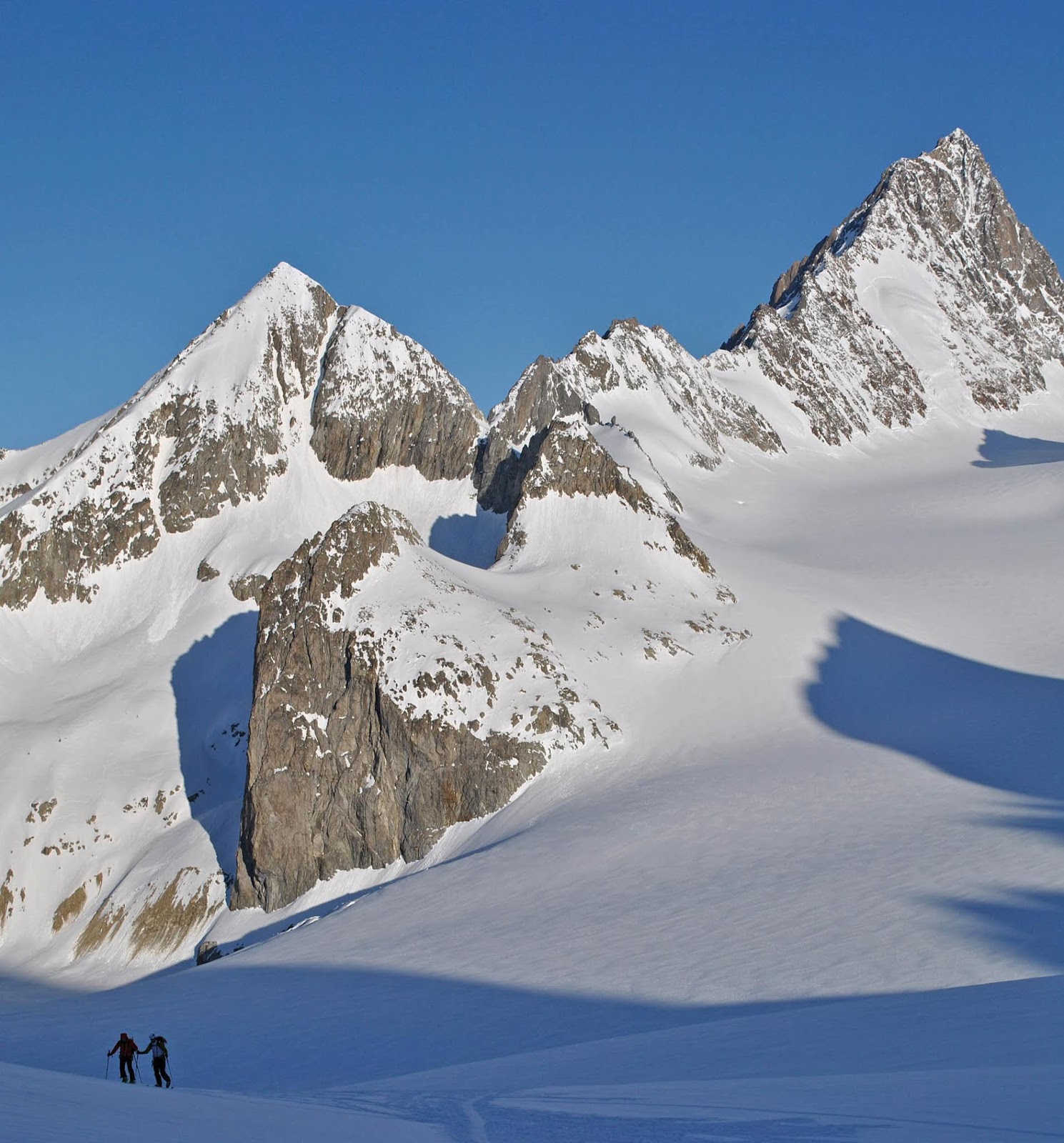
"As innocent and quiet as only a harmless pinnacle can be..."
Photo by courtesy of Alpine Light & Structure

There they parade themselves, beckoning and inviting, each in its own way: that one offering its green pillows for an easy repose, the dark one hinting at scrambling pleasures, the snow dome with its a morning’s worth of devotions, to say nothing of that promising ice ridge … Look how they beckon!

A young mountaineer sets out cheerfully, as if answering a summons. How could he resist? Which one of the mountain throng was it? Won’t it be hard for him to make his choice? Unerringly, he cleaves to his path, carelessly leaving behind whole chains of mountains, each of which could enchant him, as he weaves through the massifs. On foot, he marches up a long valley surrounded by marquee peaks, further and further, inexorable.

Somewhere in the serried rows of mountains a gap yawns and a valley opens up, one like a thousand others, and beyond it, hardly to be remarked by mere mortals, beckons a little white peak, as innocent and quiet as only a harmless pinnacle can be.

The mountaineer quickens his step as he enters the valley. Suddenly a fever seizes him, and breaking into a run, he finally achieves the summit, overjoyed to be on his little white peak.

As for those hundred thousand other peaks, could it be that they are envious?

References

This is an excerpt from a centennial translation of Ihr Berge (1916), a mountain memoir by Hans "Hamo" Morgenthaler (1890-1928). Translation (c) Project Hyakumeizan.

Wednesday, February 5, 2020

Sunset

Project HaMo (translation): time to turn in, but first ...

Just as night falls, ahead of you there’s the fiery spectacle of the sun sinking, a blood-red ball into the haze of distant mountains. And, behind you, the earth’s ghostly shadow creeps upwards – while you sit in that sheltered spot outside the hut, peaceful, appreciative – and two minutes later you’re safe inside again, next to the toasty oven.

Sunset in the Bernese Oberland
(Photo by courtesy of Alpine Light & Structure)

You’ve drained this day to the dregs; now, overexcited, almost in a fever, you need your sleep to recover. Drained by the sunglare, you’re glad to turn in; onto that wondrously soft pallet of straw. Now listen, outside, how the mountain wind icily heralds the dark night’s chill.

Which moves you most – that spectacle of the sinking sun, ever renewed, or that stealthy shadow, unbelievably fast-growing, with all its eerie accoutrements – when you see them at sunset from a high peak’s godlike seat?

The mightier your mountain, the higher and steeper it is, the more magically the light fades, and so much the greater too the grim looming of night’s onset. But you need strong nerves if you hanker after some yet higher vantage point, so as not to miss the twin spectacles of the radiant fire and the spectre of shadow. For most of us worry ourselves sick, tremble with fear even, just to think about the descent – be that as it may, you need to get a move on.

Before the night goes pitch-black on you, while some light lingers, you need to get down as far as you can, get down the ridge, tackle the steepest bits, the water-slimed rocks, get across the snow cone or the glacier’s crevasses cutting this way and that.

Already you seem to be clueless how, before dawn today, you worked your way through the night and, with your lantern’s help, found your way through a chaos of rubble by a feeble light’s gleam. But, all of a sudden, you don’t trust yourself any more – so much sun have you had through the blazing day that you’re fainting for sleep and a rest. So, down as fast as you can, and you’ll get away without a bivvy.

References

This is an excerpt from a centennial translation of Ihr Berge (1916), a mountain memoir by Hans "Hamo" Morgenthaler (1890-1928). Translation (c) Project Hyakumeizan.

Sunrise

Project HaMo (translation): the darkest hours are before dawn ...

By lantern-light in the Mischabel
(Photo by courtesy of Alpine Light & Structure)

Fully awake at last, all five senses alert!

By lantern-light, fleeting and unsteady, after barely a nibble at the sleep you needed, you were striding and stumbling about, for hours before dawn. Nailed boots screeched as they sought out traces of a path amid the piles of loose rubble, and too often they missed. Again and again, you slipped. A patch of ice, a slatey slab, and you missed your step in this feeble, flickering gleam.

All at odds in these graveyard hours, you ground and sweated your way upwards. The weather was nagging at you too; what if all this toil was for nothing? You longed for daylight to sort it all out. And at last, at last, the light starts to grow – and the sun rises. Now anything is possible.

Those moraines of despond, these tedious spoil-tips, all are set magnificently aglow in the new-born morning. Unquenchable now, your mountain motivation. You’ve rifted yourself out of the valley, you want nothing more to do with down-below. Lissom are your limbs, your senses clear – up and away is today’s order. And now, with more than twelve hours till night falls, it’s broad daylight again.

References

This is an excerpt from a centennial translation of Ihr Berge (1916), a mountain memoir by Hans "Hamo" Morgenthaler (1890-1928). Translation (c) Project Hyakumeizan.

Wednesday, January 29, 2020

Weihnachtskneipe!

Project HaMo (translation): the club's Christmas party proves intimidating for a tyro climber

Weihnachtskneipe! This is when all our club’s mountaineers get together for a cheerful Christmas drink. There is singing and drinking in the lofty guildhall, while mountain memories waft along in the blue smoke of many a summit pipe.

Original illustration from Ihr Berge (1916)

I join them as the club’s youngest member.

What a band of warriors is gathered here! There is the black-bearded giant, here the blond colossus, the quiet and serious ones in between, a head of grey hair on the one who is already getting along a bit.

Many of them I’ve never set eyes on before, and yet I know their names and mountaineering records better than I know my next-door neighbour. And what I know is this – these men have seen the mountains in a way I might never be privileged to.

When the worthiest of this high company shows us some of his most exquisite pictures, a chorus of seniors voice their approval: “Great stuff, well done.”

When they tell of battle and victory, when I hear from their own mouths all the epic ventures that resound among us striplings like sagas of the heroes – then how small this makes me feel by comparison. How likely is it that I’ll ever carry off anything like these feats of theirs? And how these sacred incantations of the club cut into my heart. What use to me is high ambition, spades of daring and an iron will?

For it is Titans I see in front of me, wrestling with giant mountains. I shiver as in a dream. The evening that looked so enticing does yield all it promised – and yet not so much. I must leave the room and, down at heart, I stride away through the dark night.

References

This is an excerpt from a centennial translation of Ihr Berge (1916), a mountain memoir by Hans "Hamo" Morgenthaler (1890-1928). Translation (c) Project Hyakumeizan.

Tuesday, January 28, 2020

Alpine vignettes

Project HaMo (translation): three mountain sketches by Hans Morgenthaler

Winning through to the Finsteraarhorn's summit
(Photo by courtesy of Alpine Light & Structure)
Summit joys

Did you ever win through to the summit of a cold snowy peak that glows in the early light of a high-altitude morning, before the sun even starts to purge the night fogs from the deep valleys? After those hard hours of climbing, your iron-shod steps suddenly found their way so easily. Effortlessly, you promenaded atop the bare crest of your hard-won summit.

Now you could hold your head high, as proud as a commander’s after some victorious battle? Didn’t that set your heart racing, near fit to burst with this surge of summit joy? And then you had to retrace your steps, down the hard-frozen snow slope. Reluctantly and a touch bitter at heart, you let yourself take one last look upwards into that deep blue sky, infinitely far overhead, before you took leave of your liberating summit, and its brief joys.

(For the mountaineers who served in the Great War.)

Yearnings

Original illustration
from Ihr Berge (1916)
In the valley, burdened with an irrepressible longing, my hapless soul quivers for the high mountains, cheers on the day that brings me back to them, and builds up the resistless force that will snap the fetters which keep me from them, yearning just to wander abroad for ever.

Yet, after a hard struggle with the mountains, after weeks of body-bruising encounters, tussling with the rocks and ice in good earnest, my fervent wish is once again for the valley, a bed, sweet milk and freshly-fragrant bread.

Struck to the heart

Have you ever seen how the mountains can capture a tyro climber?

It’s half past five on a May morning. We stand in bright sunlight, four thousand metres up on a peak in the Bernese Oberland, the first "big mountain" that my friend from southern Italy has ever climbed. And I myself have never seen a day dawn quite so clearly in the mountains. Crisply and cleanly the vanquished giants rise up around us. Today, from Mont Blanc’s summit, you could probably pick out each individual top in the far-off Bernina range.

All of a sudden, my swarthy Sardinian friend looks and talks quite differently. Shaken to his core, as if astonished, and gazing all around him, he seems to have woken from some deep slumber: "Is such beauty even possible!" his black eyes twinkle, "and all the time I’ve been frittering away my priceless time at cards and dances." He shakes my hand.

References

This is an excerpt from a centennial translation of Ihr Berge (1916), a mountain memoir by Hans "Hamo" Morgenthaler (1890-1928). Translation (c) Project Hyakumeizan.

Tuesday, October 22, 2019

A relationship

Project HaMo (translation): falling in with a favourite mountain

What a wondrous bond a mountaineer can sometimes weave with his favourite mountain. Whether he made the first ascent, or climbed a new route or did some other great feat, their names are linked forever. The Matterhorn and Whymper – what a noble pairing is that.

Approach to Piz Urlaun c. 2001
Photo by courtesy of Alpine Light & Structure

One day, I’d like my name to be linked to the Cima Aeterna. But, really, this is too absurd. To think of linking one’s name to a famous mountain is sheer ambition – a mountaineer’s arrogance.

Especially when you’re well aware that you can quietly carry on the most pleasant relationship with much smaller mountains, like … and without a soul knowing about it.

Now I must confess: I was besotted with Piz Urlaun for years. I guess you’ve heard the name. And you’ll ask how on earth one can fall for such a minor neighbour of the mighty Tödi. Well, I have no idea. Could it be, perhaps, because he almost presided over an icy grave for me? That would certainly be a curious reason.

Well, I have climbed him by five different routes, again and again. Twice, we put up new lines, and once I climbed him alone – that was best of all.

A pleasant fellow is Piz Urlaun. Quite lowly, at just under 3,400 metres, yet he belongs to a noble lineage and leads a quiet, secluded life. To be up on his snowcap is enchanting, and in autumn you should see how every evening the sun glitters and glances off his steep ice spine, way over towards the Bifertenstock.

We struck up a fine friendship from the first time we met. “You, Urlaun, look over there at the lame old Tödi, who’ll put up with anything,” I said. “No, I wouldn’t stand for it myself,” came the answer from Piz Urlaun as he threw down a minatory rain of ice-blocks.

This convoy of eighty people, this human snake, that feeble Tödi lets roam over his head. Can any of them actually understand him?

Our friendship is quite different, though – isn’t that right, Urlaun? Just the two of us visit you, and quietly enjoy your favours. Not that we haven’t ever fallen out. Even the best of friends can’t get by without the occasional squabble. Just when I thought we’d be together for ever, he twice roughed me up to the point of tears. Once, to give me the brush-off, he resisted my advances with flashes of lightning that came blazing over his back. The other time, right at mid-summer, he pulled on an overcoat of snow so thick that it scared me just to look at.

Yet, quickly and stealthily, I finally made my approach. How amazed he was! Quite alone, I ran up his south flank, before it was even daylight, before he had time to open up his schrunds and crevasses in self-defence. The Biferten Glacier was still in shadow when I stepped onto his head and let out a cheer.

When he saw I was alone, he recovered from his shock and invited me to a sunny rest. From that moment, when we first conversed, stems our deep respect for each other.

Urlaun, you have granted me many rich hours. Though I’ll probably not visit you again so soon, we will often greet each other from afar. Never will I fail to send you silent thanks. And then, Urlaun, will you not cheerfully recall how much you once meant to one small human being?

References

This is an excerpt from a centennial translation of Ihr Berge (1916), a mountain memoir by Hans "Hamo" Morgenthaler (1890-1928). Translation (c) Project Hyakumeizan.

Wednesday, October 16, 2019

Mountains of mystery

Project HaMo (translation): puzzling out a new route in the Bernese Oberland

I’m lying on my back in front of the Finsteraarhorn hut, my face ruddy with sunburn, windlessly ensconced on the warm flagstones.

View from the SAC Finsteraarhorn Hut
Photos by courtesy of Alpine Light & Structure
A late afternoon sun stands over the Grüneckhorn. Sailing along sluggishly before a light fine-weather breeze, shimmering clouds send down their dazzle into overstrained eyes. The Gross Grünhorn casts lengthy fingers of shadow halfway over the snowfields of the Fiescher Glacier. The lesser Grünhorn does much the same as his big brother. The obsidian pyramids of the Gabelhorn and the Kamm stare across glaringly white snowfields at the wood-shingled hut.

The hollow under the Grünhornlücke is warm enough to sunbathe in, its snowfields flawed only by the occasional early-summer crevasses and cracks, and all this framed by the sun-glazed flanks of the Weiss Nollen and the blue-violet shadows of the Grünhörnli. Behind me break the icefalls and bergschrunds of the glacier surrounding the hut.

Meltwater is gurgling stealthily somewhere. The glacier is embalmed in this Saturday afternoon silence; the only human sound is the shuffle of hut-slippers. Now and then I glance up as another chute of snow rattles down from the sunny walls of the Finsteraarhorn. Now the north wind weaves delicate strands of mist around the Bernese Oberland’s highest peak. Lying beside me are my Zeiss field-glasses – will they magnify the wonders of these mountains? As if they could.

Far back in the shadowy glacial basin silently beckons the secret of a steep, still-virgin wall. This is what brings me here. Up it soars, out of the bergschrund, through avalanche-swept gullies and black rock ribs up to the bright cornices – a full 600 metres. The southeast wall of the Hinter Fiescherhorn is still unknown to men. Is that due to its dangers and difficulties? Or has it simply not been worth the effort? Why have alpinists so far steered clear of it, although they’re usually thirsting for new routes? Well, this is my life’s highest aim, my one and only thought – until I have won through to that knowledge.

Again and again, I sweep the wall with my binoculars, searching for weaknesses. Ever and again, the light changes, constantly tricking my eager and searching gaze.

Although the day is still not over, we are trying to get some sleep, so that we can wake up refreshed in the middle of the night and get going. Going to bed so early is not easy. Light still pierces through the window shutters, annoying us. The heavy blankets are too warm. We’re still thinking about the mountain as we fall asleep – still not sure about those cornices, on the summit rocks. If the sun hits them too soon, it’ll trigger avalanches. Or stones. We need to be closer in. We’ll see tomorrow. The mountain wind tugs at the roof, as if it wants to help us.

The Gross Grünhorn, seen from the Finsteraarhorn Hut
One o’clock in the morning. The moon is a slim crescent, dull red, hanging just above the Grünhornlücke. A lake of molten silver has pooled on the firn, edged on all sides with pitch-black margins. The peaks too are touched with droplets and splashes of the noble metal.

Roped together, the two of us stumble down the snowslope, not yet frozen hard, to the silver lake. Then we plunge into the utter darkness of its shoreline. Driven by an unslakeable desire, we move over the firn, brittle as glass.

Now the lake has drained out. A last glowing bight falls along the Finsteraarhorn. When it fades out, all is dark. An ice-cold wind blows down on us. Little stones sparkle tremulously. On our left looms the dark wall of the Grünhorn peaks. Ant-like, tiny, we crawl steadily along under their feet. Flakes of snow are flung in our faces; the wind rushes in the cliffs. I think of falling stones.

Day breaks just under the bergschrund. Quick, point those Zeiss glasses at the cornice. Looks better than I thought.

So, let’s go!

The bergschrund is the gateway to a new world. We finagle our way over it onto steep, icy slopes. We need to move it out, hacking steps as fast as we can. Three hacks with the ice-axe for every step. Hard labour for hundreds of metres, racing the rising sun. Lungs heaving, we make the rock-rib leading to the summit. Now we’re out of harm’s way. And the cornice is small.

A rose-red glow wafts over the snow, rose-red glow the rocks, lighting our new route right up to the summit.

Amid the silence, a great happiness.

So you’ve solved a problem with amazing ease, simply and quickly, a problem that once looked all but impossible. Which was better then, getting to grips with the problem in all its gnarliness, scrabbling for a solution? Or feeling pleased that you’d finally cracked it? Aren’t you sorry now, just a bit, that the hapless, harmless problem has just ceased to be a problem?

References

This is an excerpt from a centennial translation of Ihr Berge (1916), a mountain memoir by Hans "Hamo" Morgenthaler (1890-1928). Translation (c) Project Hyakumeizan.

Friday, October 4, 2019

Famous mountains, forgotten mountains

Project HaMo (translation): a first ascent in the Bernese Oberland

Every year, hundreds of mountaineers pass the Finsteraarrothorn by, on their way to climb the Finsteraarhorn. How many of them would take the chance to climb the forgotten peak instead of the famous one?

Finsteraarrothorn and Finsteraarhorn from the Vordergalmlücke
Photo by courtesy from Alpine Light & Structure
When she saw just the two of us coming, the Rothorn must have been amazed. Baffled, she watched us approach. Her hopes had been dashed too often. So she could hardly have expected that, from the Gemslücke col, we’d veer off the usual track towards her– merely in passing, as it were.

Did she not swoon when she suddenly realised we thought her worth spending a whole day on, just to try her untrodden ridges for size?

And did she not shrug off her clouds and fogs, just to show us that she was worthy of a visit? And what we might experience with her? Could her illustrious neighbour ever have offered such a welcome?

Summit mists 
Three hours we’ve been at this. Thick, grey fog. My ice-axe hacks small notches into the ice, just enough to take half a boot-sole. Steeply upwards, from step to step, on ten metres of tight rope. Not too far left, not too far right. Yesterday, though my scope, I saw a massively overhanging cornice there. Under our boots, three hundred metres of glittering ice sweeps away. Everything is horribly deceptive in this treacherous fog. I can’t see more than a few steps ahead, but it’s brighter than ever in the valley. Flickering vaguely, off to the left, the cliff-edge dances under my eyes; surely it had to be further away. But suddenly I’m right there with my axe; my fear is that I’ve been lured onto that brittle-creaking cornice. Then I go too far over on the other side, so that my left boot can hardly clear the steep ice to land on the next hold.

The mountain’s knife-edge fades steeply into the formless grey, raking summitwards through the dense-knit vapour. But where is the top, and will we ever find it?

We could be at this for hours, fighting our way up. Or, in just a minute, the clouds could part and a ridge of fine-spun silver might usher us to a summit soaring up out of the clouds.

Then these gloomy shrouds could keep their lethal cornices and icewalls back in the depths, while the sun brightens above us and we feel ourselves shiver with anticipation.

Original illustration from Ihr Berge


Now we know you, Finsteraarrothorn. But may we sing your praises? Are you really worthy to be compared with your mighty neighbour? For us two, you meant more to us almost than him. We experienced you to the full, as nobody had before and nobody will ever again. When we stole up on you, you were a shy country maiden, sweeter than the great monarch beside you. Maidenhood was your charm – and we have robbed you of it.

References

This is an excerpt from a centennial translation of Ihr Berge (1916), a mountain memoir by Hans "Hamo" Morgenthaler (1890-1928). Translation (c) Project Hyakumeizan.

Thursday, October 3, 2019

Four-thousanders

Project HaMo (translation): the aldermen of the Alps and their ill-kept secrets

At council, in some sun-drenched assembly hall, convene the venerable aldermen, white-bearded and surmounted with snowy periwigs, revered by all. For these are men of dignity, noblemen, the natural aristocracy of the stark mountain scene, the most exalted of their rugged tribe, overtopping all their electors by a head.

Eiger, Mönch and Jungfrau in an old postcard (c. 1912)

Born to their station, these worthy lords look out with a freeman’s gaze. Their mien is serious, their vestments dignified, and their steeply raked backs exude authority. Looked up to on all sides, there they stand, peerless, and yet – is there none among them who harbours no secret weakness among the highest and best of his mountain peers?

Since time immemorial, these eminences have gazed proudly over their foothills, beaming magnificently and watching over the people of the plain. Time-honoured are their titles and names. Robed in silver and rose-red gold, tilting their ridges aloft, they have stood there in earnest convocation for ages eternal.

The great mountains are the first-born of the young mountain gods. By birth and blood they were ennobled. So what need have they to exert themselves? Invincible by sheer stature, they prevail without a struggle. Those of low degree, strive as they might, could never rise against them. Yet, should one or other of these make the effort to challenge the power of those hereditary heights, what mighty giants they will meet with. Then will you see the sacred mountains of your dreams made manifest.

With their glittering locks of snow, their rivers of flowing ice, their flanks sheer to the heavens, these four-thousanders are the noblest treasures of the world. And yet – surely there is not one without some hidden flaw of weakness.

References

This is an excerpt from a centennial translation of Ihr Berge (1916), a mountain memoir by Hans "Hamo" Morgenthaler (1890-1928). Translation (c) Project Hyakumeizan.

Tuesday, October 1, 2019

Cima Aeterna

Project HaMo (translation): a young mountaineer's fantasy

Thousands of nights, I’ve slept long and dreamlessly, slipping into nothingness one evening to be abruptly hurled back, next morning, into everyday life.

Now and then, though, rarely and unexpectedly, I have strayed off the path of dreamless sleep and, instead of sinking into blind oblivion, find myself regaled by a scene set as if for divinities.

Lhotse at sunset
Photo by courtesy of Alpine Light & Structure

Rapt with joy have I then beheld the Queen of Mountains, a dreamlike summit, her golden evening glow veiled by light, feathery clouds. This vision, I sensed, was reserved for my eyes alone. And with that soaring spur on the mountain’s edge, shrouded in icy mist – a god-like line for climbers – she kisses the messengers of distant stars.

Floating there, the Queen of Mountains rests on walls of chthonic rock, on the granite foundations of the world. From the depths of my dream, she soars up to the heavens. For thousands of metres, she soars straight upwards, unblemished by snow, into a summit of shimmering ice. Her feet are washed in the silvery flow of glacier streams, frozen waves that silently rush forward, and still more silently, towards the depths and my Tartarus below.

Then yearns my innermost being for the highest one, to fly up to the Cima Aeterna, all earthly sorrows cast away, light and free as desire itself.

References

This is an excerpt from a centennial translation of Ihr Berge (1916), a mountain memoir by Hans "Hamo" Morgenthaler (1890-1928). Translation (c) Project Hyakumeizan.

Tuesday, September 24, 2019

Ye mountains!

Project HaMo (translation): Hans Morgenthaler's invocation to the Swiss Alps

And so the centuries gushed forth from their limitless source, like the shock waves of eternity. New ones rolled in, old ones passed, one by one they came and passed, raising in their train countless generations of men. Ye mountains! Feared, ignored, you kept your sad vigil, waiting and watching for the dawn to break when finally you would touch the fate of men.

Original illustration from Hans Morgenthaler's Ihr Berge

Yet, bastioned by faith in your future deliverance from death’s rigid spell, you defied endless ages of assaults from the stormwinds, the burning sun, the grinding ice-fangs, and the water’s gnawing, all to fulfil your destiny as benefactors of mankind.

And you stood fast!

At last, when you had already half-crumbled to grey ruins, men came to their senses and finally opened their eyes to you, ye castles of freedom, woke to a burning love for mountains.

Like a sacred torch, you touched off in the human race first a few paltry sparks, then steady flames, before whipping a wildfire of mountain passion that blazed to heaven.

Your fatal splendour, the mysteries lurking within your death-dealing glaciers, shunned by older generations, were suddenly sought out by the young. All of a sudden, you lured them irresistibly in. The wonders of the high mountains lifted them from the tedium of their circumscribed lives, as if with a single jolt, onto the plane of a nobler existence.

Ye mountains! Can you know what you mean to so many today? That your mere existence enriches so many lives? That legions of good men think of nothing higher or nobler than devoting themselves to mountains, in their strength and obduracy? To serve you for the rest of their lives, to the last breath?

To them, you have become as gods.

Nothing in this world is more sacred to these men. Besotted, smitten, none can wrench themselves free of your love. You hold them in your iron grip. And even when your abyss yawns for them, even as the pulverising rockfall roars and thunders and takes their lives, still they keep their troth in you.

References

This is an excerpt from a centennial translation of Ihr Berge (1916), a mountain memoir by Hans "Hamo" Morgenthaler (1890-1928). Translation (c) Project Hyakumeizan.

Friday, September 20, 2019

The mountains of my home

Project HaMo (translation): how a Swiss mountaineer was made

I can’t recall when it lighted on me, the spark that ignited my deep love for the mountains. But the flame it lit flared up very early in my life.

"The Jungfrau was the one I liked best"
Photo by courtesy of Alpine Light & Structure

It was while I was still in the pram, or very soon afterwards, that the mountains first swam into my ken. My home view then comprised a hoary old castle nestling cozily into a small town, and best of all, a hilly green valley flanked with spacious pine forests. But only later did I make this important discovery.

Far, far in the distance, beyond my old home valley, there rose up on a sudden – this was on a clear summer evening – a host of white pinnacles. Today I would call them the mountains of the Bernese Oberland, from the Wetterhorn to the Blümlisalp. And from that moment onwards they have always kept a special place in my heart.

It seems like yesterday to me – I could already name a few of them, and this meant a lot to me. The Jungfrau was the one I liked best. The mountains were hard to tell apart, yet this name was worthy of them all.

One thing was for sure: I already respected these mountains deeply; they held me in awe. If some wretch came along and tried to make fun of my mountains, I took their side, and never would I have let slip their names to anybody I deemed unworthy, like a little girl.

From that time on, all I wanted was to hear more about mountains.

Soon I got to know my first mountaineer. He was remarkable most of all for his long, bandy legs, which took him stalking past our home every day. For a while, he rather scared me. It was only when, one fine evening, I saw him gazing with longing at those rose-tinged peaks that I started to warm to him. From then on, there were two kinds of people: mountaineers, and the common run of folk, with whom I’ve even now not wholly come to terms.

Then I was allowed to get to know the mountains better and better, or at least look at them from closer and closer. What yearnings they awoke in me! And what intimations came to me from those grassy green hilltops that my father sometimes now and then took me to on a Sunday.

I was always taking refuge in them. When I was sad, the mountains stayed cheerful; when I was beaten down, they stood fast, when I was miserable, they still greeted me, bright and amiable, over the green treetops along our quiet valley.

When they glittered through the schoolroom window, the Eiger, Mönch and Jungfrau, what should I care about tedious mensa, mensae, Pythagoras and the July Revolution? We soon became well acquainted, thanks to many a splendid book.

When, on some gloomy autumn day, I’d almost forgotten what might await me above that pall of fog, I used to run up some hill near the town after school, and even if I was too late ten times, then on the eleventh try, I’d be on top in time to see the sunset. Then I drew its red glow right into my heart, and this small happiness would tide me through the dark winter.

Since then, I have come to know a good many mountains, and I hope to sample a good many more. All have their beauty. But you, my mountain comrades from all over the world, from Africa, Australia, South America, who rate all mountains equally, from Mont Blanc through to the Ortler, can you guess now why I rank these ones highest, our Bernese Oberlanders, the mountains of my home?

References

This is an excerpt from a centennial translation of Ihr Berge (1916), a mountain memoir by Hans "Hamo" Morgenthaler (1890-1928). Translation (c) Project Hyakumeizan.

Wednesday, September 18, 2019

From the life of a snowflake

Project HaMo (translation): meditation on a winter sky

It's snowing. Gently and quietly, soft snowflakes flutter from a grey-speckled sky – the grey speckles are young snowflakes, newly born. One after another, they swirl down together, mingling and mixing, brushing each other. A quick one hastens ahead of a hesitant one, a heavy one clings to a light one, as if it would slow its onrush to the pace of the slowly hovering one. How they leap and gyre. But of course they do! They delight in their very being, sailing round like little birds of paradise. Can you hear them sing? What a joy it must be, to be a soft little flake among snowflakes.

Snowshower at the Aua da Zeznina, Swiss Engadine
Photo courtesy of Alpine Light & Structure
Tender as a maiden, snowflakes cast a quiet glow ahead of them as they drift softly and easily down. To be young forever is what they wish for. What infinite happiness: a life of dancing!

But woe is us. In all their softness and delicacy, they fall to the warm earth. How they tremble! One breath, and they are ruined. One sigh of air and, hardly wakened to life, they have already perished, in their hundreds and thousands, all at once. Hundreds of thousands of snowflake souls fly up to heaven. Alas, poor snowflakes!

It's snowing. The wind whips sharp ice-needles from the wild clouds. Hard knives cut your cold face. Today, the snowflake tribe is in a grim mood. Ice-cold in its furious intent, every flake makes war on the earth. In endless hordes, they drive down like polished projectiles, in dense phalanxes, spoiling for the fight. Showering down like spray, they close ranks, multiplying their force a thousand times, as legions of brave pellets drive after them. How they scour and rush, harried by the wind into slanting files. Try following one with your eyes, and a hundred hit you, thousands of henchmen to every leader, bold and quick, sifting down like sand.

What savage joy, to be a snowpellet among snowpellets!

How they defy the earth, these rough warriors. They prevail by sheer weight of numbers. Grim as a conquering army, they cover the earth, piling up thicker and thicker.

Yet they too will yield. One gleam of sun will vanquish the weakest and drive the stronger ones into each other’s embrace. Now the sunlight strengthens, and even the proudest are wilting. The grey-white masses, tough as they are, melt away; bold snow-spirits ascend to heaven. Did you hear their high, defiant song. What a farewell was that!

Did you see how the snowflakes died? Each knows it will rise anew, invisibly, so that it can lay down its life again and again. Is it because they know something we don’t that they die so easily and cheerfully?

References

This is an excerpt from a centennial translation of Ihr Berge (1916), a mountain memoir by Hans "Hamo" Morgenthaler (1890-1928). Translation (c) Project Hyakumeizan.

Friday, September 13, 2019

Hapless mountains

Project HaMo (translation): a very short story from the Swiss Alps 

In front of the hotel, the old man sits in a cane chair, his left leg slung over his right. This gentleman’s hair is snow-white. He has his gold watch and a telescope out on the table in front of him. “It’s still too early,” you can hear him murmuring to himself.

On the traverse from Morgenhorn to Wyssi Frau
Photo courtesy of Alpine Light & Structure

Several hundred metres above, a little white path comes vaulting out of a side valley on a slope – there, by the black rock next to the pluming waterfall. The path and the torrent hurry down to the valley, now alongside each other, now crossing over, until they suddenly part ways, one zigging left, the other right.

“Still too early!” says the old man. His telescope follows the path. “Yes that was a long and tough one, that route, we got back pretty late.”

“But, hello, there they are. They’ve done it, by Jove!” Still lithe, despite his years, he jumps to his feet, beaming his warmth towards them. He loves his boys.

“The icefall! The icefall! Did you get through all right? Bravo! That couldn’t have been easy. It took us more than three hours to get through to the edge of the rocks on the other side.”

“Good evening, Papa! No, that was easy enough. We found somebody’s footprints, hardly a day old, still quite fresh.”

“So how was the rock-step from the ice onto the ridge? My, that was hard. And difficult to find too! I won’t ever forget how rotten and slippery those rocks were. Just that place took us more than an hour.”

“Hmm, it wasn’t anything special, father. Almost a footpath. Steps in the rock and some solid iron stanchions.”

“Was there a lot of ice, on top of the ridge?”

“All ice, from bottom to top.”

“Really, and you’re back already? That’s really something!”

“No, father, everything was already chopped out for us, a staircase right up to the rocks.”

“The summit rocks aren’t half bad, are they? When we made the first guideless climb – this was with my friend W. – we almost had to back off there. We struggled for hours. That was a fight; we didn’t know whether it would go until we finally made it!”

“Well, the rocks were pretty steep. They took us twenty minutes. There’s a fixed rope there now.”

“That’s shameful, damn it. But you soaked in that great summit view, didn’t you? I took a look in my old climbing diary: we sat on top for two full hours.”

“Father, you know, it was unspeakable up there. A whole bunch of people came up the normal route. One of them – the guides kept calling him ‘Mr President’ – went droning on about mountain sport and the opening of the Alps – so we just went on our way. But this evening, if you don’t mind, do tell us how the mountains were in the old days!”

References

This is an excerpt from a centennial translation of Ihr Berge (1916), a mountain memoir by Hans "Hamo" Morgenthaler (1890-1928). Translation (c) Project Hyakumeizan.