Showing posts with label nonaka. Show all posts

Thursday, February 12, 2026

A meizanologist's diary (114)

12 January: thanks to yesterday’s cold front, which swept away the haze, we get a clear view of Japan’s top mountain from the morning Kagayaki. 


It is Mt Fuji that hales us to Tokyo today, for a meeting of the Fuyō Nikki no Kai. This is a research association dedicated to the memory of the meteorologist Nonaka Itaru and his wife Chiyoko, who held out on the summit of Mt Fuji for almost three months in the winter of 1895 while they made weather observations.

As usual, we meet in the offices of the non-profit organisation that leases the buildings of Mt Fuji's former summit weather station. After the weathermen went down the mountain for the last time in 2004, their jobs taken over by automated instruments, the NPO has kept up the buildings so that high-altitude researchers can use them during the summer months.


This year, the NPO Mt Fuji Research Station will celebrate its second decade, and we discuss how to mark the event (please watch this space). After the meeting, our association’s literary scholar presses a bag of Mt Fuji-themed confectionery into our hands. 


And, in case we feel in need of more cerebral fare, a former head of the weather station lends us some DVDs about its illustrious backstory.

Now it looks as if we have some homework to do…

Friday, April 25, 2025

A meizanologist's diary (101)


22 March: the early Kagayaki sweeps us past a snowy Mt Asama and into town by midmorning. 


At 11am, we climb the stone steps to the temple of Gokokuji in Bunkyō-ku, walk past the main hall into the cemetery and find a small group of friends in front of the monument to Nonaka Itaru and Chiyoko – whose bold attempt to overwinter on the summit of Mt Fuji in 1895 paved the way for a permanent weather station there.


Falling from a clear blue sky, the spring sunlight brings out every lineament in the gravestone’s bronze relief. 


Garbed in their parkas lined with Russian fur, the young couple look every bit as resolute as they did in October 1895, when settling in for their two-month ordeal atop Japan’s highest mountain.


Laconic as it is, the plaque under the bronze relief explains why we are here. Itaru passed away at the age of eighty-seven in February 1955. So we are paying our respects just a few weeks after his seventieth anniversary. Our group comprises members of the “Fuyō Nikki no Kai”, a study association dedicated to researching the Nonakas’ story.

The Nonaka Observatory of 1895.
Illustration from Itaru's brochure of 1900.

Over the past few years, many more details of that history have come to light. Most fictional accounts of Itaru’s project – particularly the novel by Nitta Jirō and any films based on it – end with the couple’s  rescue from their blizzard-wracked hut on Mt Fuji in late December 1895.

For Itaru, however, this was merely a beginning. While Chiyoko was publishing her Fuyō Nikki (Journal of the Lotus), a lively account of the couple’s mountaintop experiences, Itaru started work on a series of articles for Chigaku Zasshi, a geographical journal, explaining his scientific aims and setting out his weather observations. These were published in the second half of 1896.

And then he went back to Mt Fuji, climbing to the summit in three consecutive summers, those of 1896, 1897 and 1898. His aim was to scope out the site for a bigger and better weather station – one that would house a large enough team to support year-round weather observations.

Design for a new Mt Fuji weather station.
From Itaru's brochure of 1900.

The best place for a new observatory, Itaru decided, would not be on Ken-ga-mine, the highest summit on which he’d built his first small hut, but on a flat part of Mt Fuji’s crater rim at a place called Higashi Yasugawara. Lingering geothermal heat there might also help to heat the hut.

But who was going to pay for all this? In 1899, Itaru founded a fund-raising association and in February the following year came out with an 18-page prospectus for the new weather station.

Alas, the funds were slow to come in but this didn’t daunt Itaru. In 1909, at his own expense, he had a spacious villa built at Takigahara at Mt Fuji’s southern foot, as a base for further work on the mountain. And in 1912, with financial help from a prince of the realm, he set up a storehouse on the crater rim, exactly where he had suggested siting his new improved weather station.

The cover of Itaru's brochure of 1900.

By this time, a new generation of meteorologists had taken up the cause of a permanent weather station on Mt Fuji. Preparations were delayed by the world war and even more by the 1923 earthquake, which destroyed the Takigahara villa. In February of the same year, Itaru had to endure the loss of Chiyoko, who succumbed to a flu epidemic.

And so it wasn’t until 1932 that the professional weathermen were firmly established at the new government-funded summit observatory. The following summer, Itaru paid them a visit, accompanied by his daughter Kyōko, who of all their children most resembled Chiyoko.


After taking a group picture, we move on under the flowering cherry trees to look in at the great mausoleum dedicated to the great statesman Ōkuma Shigenobu (1838–1922) - Ōkuma too, it seems, was not immune to the lure of exploration, having helped in his latter years to raise funds for the Antarctic explorer Shirase Nobu.


As a meeting is scheduled at the offices of the non-profit organisation that has revived the buildings of the Mt Fuji weather station, we have to move on. But not before climbing the “Otowa Fuji” that sits at one corner of Gokokuji’s precincts. Although everybody present is of pensionable age, we seize the chance to revisit the summit of Mt Fuji, even if it has to be a miniaturised one…


Wednesday, December 18, 2024

A meizanologist's diary (83)

Meteorologist Wada Yuji
Image courtesy of Wikipedia
16 November: we’ve been summoned to Tokyo, on the early morning Kagayaki, by Wada Yūji (1859–1918). Not in person, of course, given those dates, but to take in an exhibition dedicated to him and his boss, the eminent Meiji-era meteorologist, Nakamura Kiyo’o (1855–1930).

We’re interested in these weathermen because both – but especially Wada – played a key part in the story of Nonaka Itaru and Chiyoko. This was the husband-and-wife team who survived more than two months in a small hut atop Mt Fuji in the winter of 1895 making weather measurements to within an inch of their lives. And had it not been for Wada's timely intervention, they would have burned through that last inch too.

From Yotsuya Station, we walk over to the Tokyo University of Science, where the museum is housed in a fine replica of a Meiji-era building. Nakamura Kiyo’o was the institution's second president, taking office in 1896, one year after he was appointed head of the Central Meteorological Observatory, the forerunner of today’s meteorological agency. 

It’s good that we have just taken a restorative cup of coffee at the station because we are about to get a masterclass on the art of scientific networking in mid-Meiji Japan.


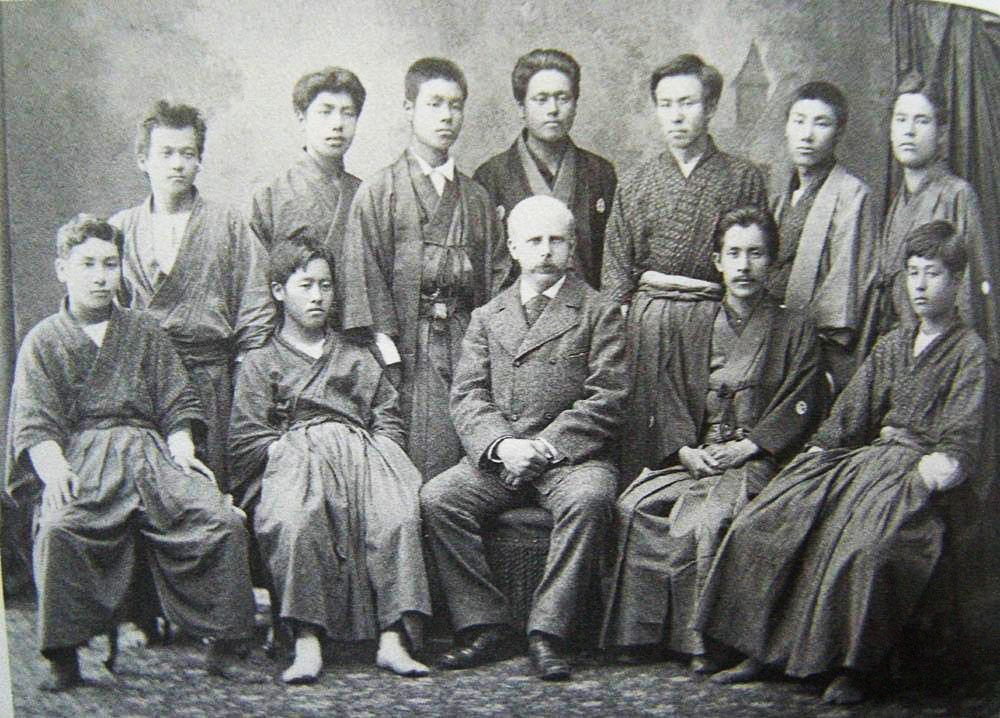
It turns out that both Nakamura and Wada were students of Thomas Mendenhall (1841–1924), who came to Japan in 1878 to teach physics at Tokyo University – there they are in the commemorative class photograph below, taken probably in the same year. And both accompanied Mendenhall to Mt Fuji in the summer of 1880, when he conducted his famous gravity experiment from the summit of Japan’s highest mountain in order to “weigh the earth”.

Thomas Mendenhall and his students in Tokyo, c. 1878 (?)
Nakamura and Wada are sitting to Mendenhall's left
(Image courtesy of Thomas C. Mendenhall II via Wikipedia)

In 1895, a young dropout from pre-medical school, as Nonaka Itaru then was, visited Nakamura and Wada to discuss a preposterous scheme to overwinter on the summit of Mt Fuji. The meteorologists would probably have dismissed this madcap proposal out of hand, had not the meeting been orchestrated by the distinguished scientist Terao Hisashi (1855-1923), another of the “Mendenhall boys” and the science university’s first president. As it happened, both Terao and Nonaka were from samurai families in the old province of Chikuzen. 

So, instead of showing Nonaka Itaru the door, Wada suggested that his stay on Mt Fuji would be more productive if he took a full year’s worth of weather observations. And he further offered to lend him the instruments he would need.

From then onwards, the project was prosecuted with typical mid-Meiji verve. Itaru spent the summer building a hut, Wada helped him instal the instruments, and in October Nonaka reclimbed the mountain to start his observations. Soon afterwards, Chiyoko came up to join him, suspecting that her husband wouldn’t be able to manage on his own (where do women get these ideas, I wonder). Then things started to go horribly wrong, as detailed elsewhere on this blog …

Poster for the exhibition at the Tokyo University of Science

In the afternoon, we attend a meeting of the Fuyō Nikki no Kai. This is an association dedicated to researching the background to Nonaka Chiyoko’s eponymous “Journal of the Lotus”, which she started writing just weeks after she and her husband were rescued from their summit hut. They had in fact been carried down the mountain in a blizzard by an impromptu team of porters led by Wada Yūji himself. By now the fate of the Nonakas was so much a matter of public interest that the meteorologist later wrote a report on this episode for his ultimate superior, the Minister of Education, Marquis Saionji Kinmochi (1849-1940). 

After that, the story as often told – including here on this blog – takes a sombre turn. Itaru was never able to realise his dream of building a bigger and better weather station, perhaps because Wada was posted to Korea in 1899, depriving him of a mentor and a network. And Chiyoko died in her early fifties during the flu epidemic of 1922. But today’s meeting reminds us of Mark Twain’s jibe: “In the real world, nothing happens at the right place at the right time. It is the job of journalists and historians to correct that.”

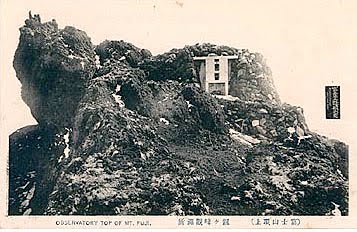
Nonaka Itaru's storehouse built on the crater rim in 1912.
(Image source: historical report by the Mt Fuji Weather Station)

What prompts this thought is an official report which turns out to contain a rare photo of a storehouse that Nonaka Itaru commissioned to be built on Mt Fuji’s crater rim in 1912, more than a decade after he and his wife were dramatically rescued from their cramped and blizzard-wracked summit hut. The new storehouse was set up at Higashi Yasugawara, on the south-eastern side of the crater, exactly where Nonaka had once proposed to build a new and larger hut.

Three years previously, he’d built a spacious villa at Takigahara, a village at Mt. Fuji’s foot, so that future summit parties could use it as a staging post or even as an observatory when simultaneous readings were required at both the top and the foot of the mountain.

So it looks as if Itaru had both the ambition and the means to plot a return to the summit. Nor had he entirely lost contact with Wada – a photo we saw at the morning’s exhibition purports to show the two men together at a “7.5” station hut on Mt Fuji in 1912, the very same year that Nonaka built his summit storehouse.

In the end, though, it was the professionals of Japan’s meteorological service who built a more-or-less permanent weather station on the summit of Mt Fuji. Yet, when they did so, the meteorologists paid Itaru the compliment of adopting the wind-deflecting design of his storehouse for their own building. They also made use of Itaru’s storehouse itself. And they continued to treat him as an honoured guest in their new summit station. 

The full story is sometimes more complicated and nuanced than the storytellers would like to make it….

Thursday, April 11, 2024

A meizanologist's diary (65)

24 March (cont), Tokyo: we come to the office of the NPO Mt Fuji Research Station for a cup of tea but find ourselves imbibing the raw materials of history. Round the table are members of the Fuyō Nikki no Kai, an association dedicated to researching the story of Nonaka Itaru (1867-1955) and his wife Chiyoko (1871-1923), who spent more than two months in the winter of 1895 taking weather measurements on the summit of Mt Fuji.


We are careful not to spill our tea. For on the grey metal office table in front of us is the manuscript of Nonaka Chiyoko’s journal, Fuyō Nikki, just as she set it down in the early months of 1896, with the couple’s high-altitude ordeal still fresh in her memory.

The manuscript of Fuyo Nikki, with editor's remarks

All of us lean in for a closer look. Despite their age, the pages show scarcely a stain or a mark – except, that is, for the scrawls of a red pen, perhaps applied by the editor of the Hōchi-shinbun, which published the journal in 17 instalments during 1896. And the paper still looks astonishingly fresh, as if Chiyoko had just laid down her brush and left the room.

Another document is more formally bound than Chiyoko’s working manuscript – and is written in a different, more cursive, hand. As Nonaka-san, the grandson of Itaru and Chiyoko explains, this is a fair copy of the newspaper articles, as personally compiled by Chiyoko’s father, Umezu Shien.

Umezu Shien's fair copy of Chiyoko's articles

Umezu must have been quietly proud of his daughter’s feat in climbing Mt Fuji unannounced and hence ensuring her husband’s survival. And as a literary man himself – he was a noh master in the entourage of one of Japan’s last daimyōs – he would have been particularly pleased that his daughter too could wield an inkbrush deftly.

We are both moved and motivated. Via the Hōchi-shinbun articles, the manuscript on the table was the starting point for Ohmori Hisao’s modern Heibonsha edition of Chiyoko’s and Itaru’s books - and the first to combine them - which in turn paves the way for the first English version of Fuyō Nikki (Journal of the Lotus) and selections from Itaru’s Fuji-Annai (Guide to Mt Fuji). Please bear with us – you know these things take time. But we feel immensely privileged to have seen where everything started …

Umetsu Shien's autograph and title page


Thursday, February 23, 2023

Chiyoko’s centennial

The Tokyo-based Fuyō Nikki Society yesterday published a blog post to mark the 100th anniversary of Nonaka Chiyoko, The Fuyō Nikki no kai is named after the travel diary in which Chiyoko recorded the epic sojourn that she and her husband Itaru made on the summit of Mt Fuji during the winter of 1895, while they took weather observations. She died a century ago on 22 February 1923, during a flu epidemic, at the age of 53. 

Nonaka Chiyoko in 1914, at the age of 43

The couple held out on the summit for almost three months, surviving both blizzards and beri-beri, a deficiency disease. As they eventually had to be rescued, novels and films have represented their feat as a heroic failure. Yet, in fact, they did succeed in paving the way for a more permanent summit weather station. From 1932 onwards, meteorologists lived year-round on the summit for more than seven decades.

That chapter of the mountain's history ended in 2004, when the weather station on Mt Fuji closed. After automated instruments replaced the human observers, the summit buildings were scheduled for demolition. But at this point, a volunteer group stepped in, with a plan to borrow the facility from the official sector and turn it into a centre for high-altitude research and education. And this they have done by setting up a registered non-profit organisation with an operating budget of some 30 million yen a year.

There is a certain symmetry here. By personally taking the initiative, Nonaka Itaru and Chiyoko showed that year-round high-altitude research was possible on Mt Fuji. And now, after many decades when Japan’s official meteorological agency ran the weather and radar station, high-altitude research on the summit is again back in private hands. Some hundreds of researchers have taken advantage of the repurposed Mt Fuji summit station duirng the summer seasons. But nobody spends the winter up there anymore.

Related posts

Chiyoko's Fuji


And see also "Eighty-Two Days on Mt. Fuji" in Alpinist, no 78, Summer 2022 edition.

Thursday, November 17, 2022

A meizanologist's diary (38)

3 November: somewhere near Nagano, the morning Kagayaki goes to ground in a tunnel. And there the super-express skulks while the authorities work out where Kim Jong-un’s latest projectile is going to land. We arrive in Tokyo with half an hour’s delay.

From Shinjuku station, it is necessary to hurry through the badlands of Kabuki-chō to an office near Shin-Okubo. To be late for this meeting would be unthinkable, as the participants are risking a mostly “in person” meeting for the first time in months, if not years.


At 2pm, Dokiya-sensei calls us to order and the proceedings begin. The “Fuyō Nikki no kai” is dedicated to the memory of the meteorologist Nonaka Itaru and his wife Chiyoko, who sojourned on the summit of Mt Fuji in the winter of 1895 to make weather observations, holding out there for almost three months. Everybody at this meeting has some connection with this story, except perhaps for your blogger, who is merely representing the Sensei (otherwise occupied today).

Nonaka Itaru and Chiyoko in mountain garb
(Photo by courtesy of the Nonaka Itaru & Chiyoko Digital Archives)

As for the “Fuyō Nikki” (Mt Fuji diary) itself, this was the title of Chiyoko’s journal, which she published in a newspaper the year after the mountaintop adventure. A full English translation is forthcoming (watch this space), based on Ohmori Hisao’s definitive joint edition of Chiyoko’s journal and Itaru’s “Guide to Mt Fuji” (Fuji Annai).

Ohmori-san’s “kaisetsu” (introduction) to that edition is the starting point for anyone interested in the Nonakas’ story – he mentions today that it was based on painstaking trawls for contemporary newspaper articles preserved on microfilm in the Diet Library, conversations with legendary figures in the history of Mt Fuji such as Fujimura Ikuo, and more than one foray to the mountain in winter. Indeed, to fully appreciate the magnitude of the Nonakas’ achievement, it helps to have experienced Mt Fuji in full winter conditions.


All this happened a long time ago, yet new details of the Nonaka story are still coming to light – for example, that the Japan Meteorological Association almost certainly admitted Chiyoko to its ranks, showing that Meiji-era scientists might have held remarkably progressive attitudes, at least in this case.

Summit weather readings from November 1895
(Photo by courtesy of the Nonaka Itaru and Chiyoko Digital Archives)

Across the table, Yamamoto-sensei puts up a slide of the cloth-bound ledger in which Itaru and Chiyoko recorded their weather observations in a neat copperplate hand – amazingly, these records have survived in good condition. No less remarkably, the ledger shows that temperature and barometer readings were set down every two hours, night and day, throughout the twelve-week stay on the mountain – only the wind speed data are incomplete, as the anemometer broke down along the way.


Sadly, no trace of the Nonakas’ tiny summit hut remains. Nakayama-sensei, who also runs the association’s website, brings out a paper model of the present summit station, which was constructed in the early 1960s, and shows us that one of its outlying buildings must have obliterated whatever remained of the Nonakas’ refuge. Oh dear, I’d hoped to find some relics one day.

In Japan, Itaru and Chiyoko have been celebrated – mainly for their exemplary “gaman” – in a stage play and a full-length movie, as well as several novels and two TV dramas. The story has seeped out into the English language too, first via contemporaries such as Lafcadio Hearn and latterly through at least one scholarly article and a recent feature in Alpinist magazine.

After being rescued from the frozen mountaintop in December 1895, Nonaka Itaru never did manage to build a bigger and better weather station, as he’d intended. For that reason, some have dismissed him as a dreamer. But his epic eighty-two days atop Mt. Fuji did start people thinking.

One who took note was a prince of the realm, who as a naval officer considered weather forecasting to be a military imperative. Almost four decades after the couple’s winter sojourn, the government decided to fund an observatory on Mt. Fuji. It was staffed year-round from 1932 to 2004, when automated instruments finally replaced the weathermen.


Not all the meteorologists welcomed that decision. It seemed a pity to waste seven decades of high-altitude experience when good use could still be made of those summit buildings. And so, the very next year, some of their number set up a non-profit organisation for the “Valid Utilization of the Mount Fuji Weather Station”.


Since rebranded simply as the “Mt Fuji Research Station”, the summit buildings have been validly utilised every summer since 2007. And visiting researchers have published papers on topics ranging from altitude sickness to greenhouse gas concentrations and even the “sprites” that flash mysteriously upwards from thunderclouds.


With her eyes twinkling over the regulation face mask, our chairperson seems to be a bit of a sprite herself. It seems that the “Fuyō Nikki no kai” is meeting in the offices of the MFRS, and that the memberships of the two committees overlap quite extensively.

I would like to ask Dokiya-sensei about this interesting liminal zone between Art and Science, Adventure and Literature, but, alas, the meeting ends before there is a chance to put the question. And now there is a four-hour Shinkansen journey ahead. Kim Jong-un won’t be accepted as an excuse if I’m unreasonably late for supper …

Thursday, September 4, 2014

The Nonaka scoop

How a Meiji-era mid-winter epic on Mt Fuji was first broken to the English-speaking world

How humiliating. Until recently, Project Hyakumeizan believed that Portland-based Professor Andrew Bernstein and this blog were the first to introduce English readers to the detailed story of Nonaka Itaru and Chiyoko – the couple who endured 82 days on the summit of Mt Fuji in the winter of 1895 in a bid to take high-altitude weather readings.

Chiyoko and Itaru Nonaka and their Mt Fuji summit hut
But no. It turns out that both of us were scooped by Lafcadio Hearn, who had the advantage of climbing Mt Fuji just a year or so after Mr and Mrs Nonaka were rescued. His account is embedded within his essay "Fuji-no-yama", as later republished in Exotics and Retrospectives (1898). The relevant paragraphs are quoted below:

A Japanese meteorologist named Nonaka attempted last year the rash undertaking of passing the winter on the summit of Fuji for purposes of scientific study. It might not be difficult to winter upon the peak in a solid observatory furnished with a good stove, and all necessary comforts; but Nonaka could afford only a small wooden hut, in which he would be obliged to spend the cold season without fire! His young wife insisted on sharing his labors and dangers. The couple began their sojourn on the summit toward the close of September. In mid-winter news was brought to Gotemba that both were dying.

Relatives and friends tried to organize a rescue-party. But the weather was frightful; the peak was covered with snow and ice; the chances of death were innumerable; and the goriki would not risk their lives. Hundreds of dollars could not tempt them. At last a desperate appeal was made to them as representatives of Japanese courage and hardihood: they were assured that to suffer a man of science to perish, without making even one plucky effort to save him, would disgrace the country;– they were told that the national honor was in their hands.

This appeal brought forward two volunteers. One was a man of great strength and daring, nicknamed by his fellow-guides Oni-guma, "the Demon-Bear," the other was the elder of my goriki. Both believed that they were going to certain destruction. They took leave of their friends and kindred, and drank with their families the farewell cup of water– midzu-no-sakazuki--in which those about to be separated by death pledge each other. Then, after having thickly wrapped themselves in cotton-wool, and made all possible preparation for ice-climbing, they started – taking with them a brave army-surgeon who had offered his services, without fee, for the rescue. After surmounting extraordinary difficulties, the party reached the hut; but the inmates refused to open! Nonaka protested that he would rather die than face the shame of failure in his undertaking; and his wife said that she had resolved to die with her husband.

Partly by forcible, and partly by gentle means, the pair were restored to a better state of mind. The surgeon administered medicines and cordials; the patients, carefully wrapped up, were strapped to the backs of the guides; and the descent was begun. My goriki, who carried the lady, believes that the gods helped him on the ice-slopes. More than once, all thought themselves lost; but they reached the foot of the mountain without one serious mishap. After weeks of careful nursing, the rash young couple were pronounced out of danger. The wife suffered less, and recovered more quickly, than the husband.

According to Nonaka Chiyoko, who wrote her own account of this episode, the porter who rescued her was called Tsurukichi. So it was this very goriki (“strong man”) who later guided Lafcadio Hearn on his much less eventful ascent. This means that, unlike Professor Bernstein and myself, Hearn was able to get his story from a first-hand participant in the Nonaka story.

Well, it’s no disgrace to have been scooped by the maven of Matsue. After all, before he came to Japan, Hearn pounded the streets of Cincinnati as a journalist. Nor was Mt Fuji his first try at adventure writing – while working for the Cincinnati Commercial, he agreed to be carried to the top of the city’s tallest building on the back of a steeplejack. But this is another story altogether.

Tuesday, July 29, 2014

People of the Lotus reprised

NHK revives an epic story of mid-winter survival atop Mt Fuji

“Meiji 28 (1895): Nonaka Chiyoko (Matsushita Nao) is praying for the safe return of her husband, Itaru (Satō Ryuta), who is attempting the first-ever mid-winter climb to the summit of Mt Fuji. If he succeeds, he’s determined to build a hut on the mountaintop and shut himself up there all through the next winter taking high-altitude weather observations. But Chiyoko is afraid that, if he goes up there alone, he’ll never come back…”


If this plot-line sounds familiar, that may be because you read it here first, on this very blog. This time, though, the true story of how Chiyoko saved her husband from sacrificing himself to science is being retold by NHK, Japan’s national broadcaster. Entitled Fuyō no Hito, the new six-part “Saturday drama” started on July 26.

This is not the first time that NHK has revived the Nonaka story. In April 1982, a two-part drama was aired with the aptly named Fuji Mariko playing Chiyoko. An English-language guide to Japanese TV notes that the NHK Children’s Division adapted the story “presumably as a means of introducing young viewers to the science of weather”.

Actually, that last remark may need to be taken with a pinch of salt. It’s true that, ever since Itaru and Chiyoko were rescued from their mountaintop ordeal in late December, their story has periodically played to packed houses. In fact, a stage drama about them was put on at the Tokyo Ichimuraza theatre as soon as February 1896. But it probably didn’t dwell much on the science of the weather.


Just before that play opened, Chiyoko finished publishing her own account of the adventure in the Hōchi Shinbun. Again, meteorological details are scant in Fuyō Nikki (Journal of the Lotus), which, as the title suggests, is written in the style of a traditional travel diary. The lotus, by the way, is a nod to the traditional perception of Mt Fuji’s crater as a sacred mandala in the form of a gigantic lotus blossom.

In the autumn of the same year, the poet and author Ochiai Naobumi published a book-length account of the Nonaka story, Takane no yuki (High mountain snows), drawing heavily on Chiyoko’s diary. Then, a few years later, Itaru came out with his own guide to Mt Fuji (Fuji Annai). As you would expect, this account does make ample reference to the science of weather but, by that time, most people had lost interest.

After that, Mr and Mrs Nonaka were largely forgotten until 1948, when Hashimoto Eikichi published a novelistic rendition of their adventure. According to Andrew Bernstein, whose account I rely on here, the timing was not fortuitous: the novel was clearly meant to inspire people during the hard post-war years "by celebrating a Japanese man and woman who had endured the unendurable”.

Be that as it may, the meteorologist and novelist Nitta Jirō thought that Hashimoto had underplayed Chiyoko’s role in the couple’s survival. And so, in 1971, he published his own novel, Fuyō no Hito (People of the Lotus), in which the story is told mainly from Chiyoko’s viewpoint.

It is Nitta’s version that has won out, providing both NHK dramas with their storylines and title. You can watch the second episode of the current NHK Fuyō no Hito this Saturday, August 2. (Sorry for failing to publish this post in time for you to catch the first.)

Judging from the trailer, the series will make the most of a human drama set amid a landscape of almost inhuman severity. But brace yourself for a disappointment if you expect to be introduced to the science of weather.

References

Andrew Bernstein, Weathering Fuji: Marriage, Meteorology, and the Meiji Bodyscape, in Japan at nature's edge : the environmental context of a global power, edited by Ian Jared Miller; Julia Adeney Thomas; Brett L Walker.

The Dorama Encyclopedia: A Guide to Japanese TV Drama Since 1953, Jonathan Clements, ‎Motoko Tamamuro

Wednesday, February 1, 2012

Chiyoko’s Fuji

When Nonaka Itaru made plans to spend the winter of 1895 on the summit of Japan's highest mountain, his wife realised she had to save the aspirant meteorologist from sacrificing himself to science ...

To save her husband, she'd have to deceive him. That much was obvious after Itaru came back from Mt Fuji in February. Flushed with the success of his solo climb – the first ever ascent in winter – Nonaka Itaru could no longer see any flaws in his plan. He'd dreamed for years of making an original contribution to meteorology. Now the way was clear for action.

In the coming summer, he’d build a hut on the summit of Mt Fuji, almost four kilometres above sea level. Then he’d climb up there in October, and take weather readings through the winter of 1895. Nobody had ever before made a round-the-year record of atmospheric pressure at such an altitude. Success would give Japan a lead in the nascent science of weather forecasting…

The scheme was already bold. What tipped it into recklessness was Itaru’s resolve to take weather readings every two hours, night and day – even though Wada-san, Itaru’s sponsor at the Tokyo Meteorological Observatory, had told him that six readings a day would be quite enough.

Chiyoko knew her husband. They'd been married a few years and, besides, they had practically grown up together back in Chikuzen. She knew how the famous stubbornness of Kyushu folk can boil over into folly. If Itaru went up that mountain alone and tried to fight its ferocious winter without proper food or sleep, he wouldn't come back alive.

So – with her own streak of Chikuzen obstinacy – Chiyoko made her own plans. After spending the summer in a village at Mt Fuji’s foot, helping Itaru organise the hut’s construction, she’d travel back to her parents’ home, drop off her three-year-old daughter, Sonoko, and make ready to climb Fuji and join Itaru for his winter vigil. All without telling Itaru, of course, or he’d put a stop to her preparations.

The hut was finished in late September and Itaru took up his vigil there soon afterwards. As soon as the coast was clear, Chiyoko set out for Kyushu, a three-day journey. When she turned up unannounced, little Sonoko asleep on her back, her parents were first delighted, then concerned. Have you displeased Itaru in some way, her mother asked.

Kneeling on the tatami, Chiyoko explained her plan – if she didn't go up the mountain, she would soon have no husband. The parting with Sonoko brought tears, but she knew where her duty lay. In the first week of October, she was back at the village at the foot of Mt Fuji. The mountain loomed overhead like a colossus, snow-covered to its midriff.

Early on the morning of the 12th, she set out from Nakahata escorted by her brother, Kiyoshi, and two porters. As the light began to fade, they reached the hut and hammered on the door. Itaru slid the door aside and looked out at his visitors - first amazed at them, then aghast: "What on earth are you doing here?" he asked ....

Read the full account of Chiyoko's Fuji

Saturday, May 14, 2011

Another mountain (3)

Fuji in the cold season continued: the first mid-winter ascent was made by a young samurai-meteorologist who wanted to build a weather observatory on the summit

“I had already essayed Mt Fuji in summer but, to achieve my stated aims, I now felt it necessary to inspect the condition of the summit by making a mid-winter ascent. Having so determined, I left Tokyo on foot on January 2, Meiji 28 (1895).” Thus begins Nonaka Itaru’s account of his mid-winter climbs, the mountain’s first ever, which he later described in his Guide to Mt Fuji (富士案内).

On January 3, the day after leaving Tokyo, he reaches Tarobo, at 1,400 metres on Fuji’s Gotenba route. He decides to stay in the hut used by summer pilgrims, because he won’t be able to find firewood further up. The night is cold; he leaves the hut at 3.30am and soon finds that this is a different mountain – the terrain looks unfamiliar under snow and he keeps losing the trail.

At 4am, he’s at the second station, where he takes out his thermometer: the mercury’s already five degrees below the zero mark. An hour later, he allows himself his first rest and makes two unwelcome discoveries: the rice-cakes in his pocket are frozen, so he has to eat bread.

Much more serious is the state of the snow – it’s frozen as hard as glass, and ridged up into sharp edges like knives – sharp enough to cut his lip when he breaks off a bit to taste. Now is the time to put on his nailed boots or perhaps attach a nailed leather sole to his winter boots – a primitive substitute for crampons.

Then he rams down the fireman’s hook that he’s pressed into service as an ice-axe – it barely marks the iron-hard glaze – and carefully planting one foot at a time, makes his way up the steepening slope. “One mis-step here,” he notes, “and you wouldn’t stop until the snow runs out.”

At 6am, he’s at the third station and it’s minus 7.5°C. He’s warm, almost too warm, in his six layers of clothing, and he tries to take some off. That proves to be a mistake. Hastily, he puts his outer layers back on. Now the rays of the rising sun are starting to glint dazzlingly off the snow and he dons a pair of blue-tinted spectacles.

The ice is so hard now that it’s difficult to get the iron-tipped fire hook to bite – or to pull it free when it does. Then, disaster strikes: a few steps below the fifth station, the shaft of his makeshift axe breaks. He tries replacing the head of the fire-hook with a knife, but it won’t support his weight.

Worse still, some of the nails in his bootsoles are bending under the strain. In the lee of a hut, he gazes up at the summit – still so far above – and decides he must go down. It’s 10 minutes past 10.

Most accidents happen on descent, they say. Half way between the fourth and third stations, he slips and tumbles several hundred feet down the merciless ice before, by a miracle, fetching up against the snow-covered roof of a hut. By another miracle, he’s more or less unhurt.

Picking himself up, he continues the long march down to Gotemba. He's no longer thinking about the ice in cool, detached scientific terms: now it is quite simply “the enemy”. As he walks, he muses on the weapons he’ll bring to bear on it next time round. The blood of a Chikuzen samurai is up; he’ll be back.

Return match
On the evening of February 15, 1895, he returns to the broken-down hut at Tarobo. Fuji’s upper slopes were hidden in cloud as he walked in from Gotemba and now the wind picks up to a gale, shaking the hut. Rain pours through the leaky roof and quenches the fire. To keep warm, Nonaka improvises a stove from an empty oil-can. Despite these distractions, he manages to record the temperature every hour. The hut is left as soon as the rain stops, at 6:30am the next morning.

The rain and wind – perhaps this is the “haru ichiban” – have melted the snow for quite a distance above Tarobo. It’s much warmer than last time. This is a mixed blessing: when he reaches the snowline, he plunges through an icy crust into deep slush at every step. He’s forced to rest after every twenty paces. The broken crust is so sharp-edged that he’s afraid of cutting his legs on it. At 8am, progress slows to a rest every ten paces.

He’s sorely tempted to give up. But there’s a lot riding on this expedition: to pursue his vocation as a meteorologist, he’s dropped out of preparatory studies for a medical career, against his father’s wishes. He’s already 27; he’s married, he has a two year-old daughter, he has to make a name for himself in his chosen field, and soon.

It’s an exciting time in this new science: a Frenchman has just invented the "isobar" and meteorologists have recently started drawing up so-called synoptic charts of air pressure measured at ground stations. But to fully understand - and predict - the weather, you would also need to plot the pressure of the air at high altitudes. That’s why observatories have recently been built on top of Mt Blanc, Ben Nevis (below) and other mountains abroad. But no observatory as high as Mt Fuji has been manned all the year round.

Nonaka hopes to borrow the instruments for his weather station from Japan’s Central Meteorological Observatory. He’s won the support of Wada Yuji, head of the Observatory’s weather forecasting division. Wada-sensei has recently returned from the Paris Observatory, a centre of meteorological expertise.

The French government started to take weather forecasting seriously after a freak storm tore through its ships during the Crimean war. Wada will be aware how useful accurate forecasts would be for Japan’s own navy - which, at this very moment, is moving in for a final reckoning with the Chinese fleet at Weihaiwei.

Seen this way, Nonaka’s mission is one of national significance. And to fulfil it, he first has to prove that Fuji can be climbed and survived in winter. Right now, however, it’s a less exalted thought that urges him on. That is, if he turns back, he’ll have to wade through that vile ice-crust again. So he keeps going up.

Somewhere above the second station, he passes a torrent of meltwater, a rare sight on Fuji. The temperature is still a few degrees above zero. But the snow is starting to firm up; hope is restored. He grants himself a few minutes rest and gazes down at the clouds covering the Hakone mountains.

Now is the time to tighten the laces on his leather climbing boots – the soles of which he’s studded, this time, with ten nails apiece. Towards 9am, he’s climbing into a blue sky and a freshening wind; little snow-devils are whirling down the slope towards him. Ice crystals sparkle like miniature prisms from the snow, a beautiful sight. By the seventh station, the temperature has fallen to minus 10.5°C and he’s attacking the hard ice with his “tsuruhashi”, a workman’s long-handled pick-axe. This time he will prevail.

One last steep gully through the summit crags, and he’s arrived. It’s just before 1pm and the temperature is 18.2°C below zero. Hastily, he takes shelter in the lee of a rock in order to eat his bread and meat. After lunch, he goes up to the rim and inspects the crater walls with his telescope.


It’s too bad that he has no camera with him because his eyes are the first to see the crater of Mt Fuji in mid-winter. Huge icicles depend from the russet and ochre walls of lava opposite him.

The scenery is as novel as, say, the high arctic ice floes that Dr Fridtjof Nansen is, right at this moment, inspecting from the deck of the Fram under the pale green light of the aurora. You might say that 1895 is a vintage year for extreme scientific exploration. Unlike Nansen, though, Nonaka is on his own. He’s soloing Mt Fuji because the budget doesn’t include money for a “goriki” or guide. He’ll pay for the construction of the summit hut (below) out of his own pocket.

The lack of a camera doesn’t stop Nonaka making careful observations. The snow at the rim is no more than two feet deep, he estimates. That’s important for his plans to build a hut. The wind-blasted rocks of Ken-ga-mine, the highest crag, are bare of snow. So is a patch of ground near the place that the pilgrims used to call Sai-no-kawara, the Buddhist limbo for the souls of children. The ash here is warmed by Fuji’s last flush of volcanic heat; in summer, you could heat up your flask of sake or even a bathful of water here.

He’d like to walk round the crater but the wind is strengthening from the southwest and the weather is turning. At 1.15pm, he starts down, carefully retracing the steps he cut on the way up. Somewhere above the second station, he descends into cloud. Following the line of the meltwater gully, he picks his way down to Tarobo.

Then he picks up the pace, all but running down the long road to Gotemba. If he can catch the 5.20pm train, he can get back to Tokyo sooner; Chiyoko and his baby daughter Sonoko are waiting for him. He makes the station with six minutes to spare.

Ninety-odd years after Nonaka's successful winter climb, I stopped by a half-buried hut to review the weather. Underfoot, the glazed snow had given way to hard blue ice, as translucent as the frozen waterfalls on Ben Nevis. No chance of an ice-axe arrest if you fell on this. One mis-step, and you wouldn’t stop until the snow runs out.

The wind was as fierce as ever, but I couldn’t see any more snow-devils coming. A shadow swept over the snow; a cloud had blotted out the sun. I hadn’t climbed into it; the cloud had just materialised out of the blue sky. Shreds of vapour flitted past, magically touching my jacket and hair with frost.

Now the fleeting cloud was leaving rime-ice on my glasses; when I took them off to scrape them clear, the icy fog started to freeze my eyelids shut. One way or another, I would be going down – in control or out of it. I opted for the former style.


Late in the afternoon, I was retracing my steps over the banked-out mule track when the north wind whipped the fog away. High above, the summit streamed its banner cloud far out into the sky.