Showing posts with label science. Show all posts

Wednesday, April 23, 2025

A meizanologist's diary (100)

15 March: the weather forecast induces Alpinist A to change her plan. Instead of an all-day snowshoe trip, we’ll go for a quick morning traverse of Monju (365 metres), our local miniature Meizan. The sky is already grey when we start out from a temple at the east end of the ridge. And the clouds have dropped yet lower by the time we reach the main summit, an hour or so later.


All three of us have been here many times before. Yet I haven't previously noticed the big boulder to the right of the summit shrine. A helpful placard identifies it as a “lightning fossil”, hinting that the rock has its own magnetic field.

Using my phone’s inbuilt compass, we put this claim to the test. And, gratifyingly, when the phone is brought within a few centimetres of the rock, the needle does swing five degrees or so away from magnetic north. Perhaps there’s a mother lode of magnetite in this rock …


In the woods beyond Monju’s third summit, we pass by a more dramatic reminder of lightning’s power. A bolt from above has split a sapling from its crown almost down to the ground. The wood splinters scattered several metres away are still fresh, suggesting that the tree was struck within the last few months.

On the Japan Sea coast, thunderstorms are more famous for their vigour in winter than in summer. What stirs them up is the temperature difference between cold air flowing in from Siberia and the warm Japan Sea currents, as this NHK programme explains. And right here in our neighbourhood the storms often get an extra fillip from a North Korean volcano…

Blowing cold and hot: how the clouds get their charge.
Diagram courtesy of NHK.

All this adds up to the potential for some serious voltage. In January 1973, a satellite charged with monitoring the test-ban treaty detected a lightning superbolt over the Japan Sea that flashed as brightly as a tactical nuclear weapon. It was hereabouts too, near Kanazawa in 1969, that winter lightning downed one of the Air Self-Defence Force’s accident-prone Starfighters. Another lightning-struck F104 fell into the Japan Sea a few years later.

A big flash over the Sea of Japan.
Image courtesy of NHK.

Rain is spotting down as I put my phone away after capturing the shattered tree. I have to hurry after the two ladies, never ceasing to wonder at how they can walk while conversing at full tilt…

While navigating the muddy path, I’m wondering about that “fossil thunder” boulder that we tested an hour ago. Lightning clearly hits home quite a bit around here - we've seen the remains of blitzed trees on a previous Monju hike too. 

But can lightning really change a rock’s magnetic field? Well, the savants say it can. And, according to this blog, there are other “lightning fossils” on Japanese peaks, such as on Takayama (532m) in Yamaguchi Prefecture, Ryumonzan in Wakayama, and Utsukushigahara in Shinshu – the last named being one of those Hundred Mountains of Japan.

The shrine island of Oshima: strolling over to a magnetic anomaly.

But – hold it – the blogger also names Oshima (above), a rocky island more famous for its shrine and grove of cinnamon trees, as a locus of such strangely magnetised stones. Indeed, we were there with our guest just the other day: it's just an hour's drive away. But on Oshima the suspect rocks are located right by the sea in an old lava flow, not on any summit or eminence. Were they also supposed to have been recrystallized by lightning strikes? Hmm, this may need some further looking into…

By the time we get back to the car, a steady rain has set in, vindicating Alpinist A’s weather sense. It's a good thing we kept our outing short. Fortunately, there is no sign of any electricity in the air.

Sunday, March 16, 2025

New glaciers found in the Japan Alps

A survey by Niigata University and others has confirmed that two more snowfields in the region around Shirouma (2,932m) qualify as "glaciers." The new ice streams bring the total of relic glaciers discovered in the Northern Japan Alps to seven or so – joining the three discovered on Tsurugi and Tateyama in 2012 and two more subsequently found on or around Shirouma.

NHK Shinshu announces the discovery of the new glaciers.

The two newly confirmed glaciers are located under the Kaerazu-zawa and Shakushi-zawa snowfields. The latter can be seen from Hakuba Village at the foot of the Shirouma (“White Horse”) massif. Shirouma is one of Fukada Kyūya’s One Hundred Mountains of Japan.

The view from Hakuba Village.

A snowfield, says NHK (see references below), is defined as a localised area of snow that remains even in the summer. It qualifies as a glacier when it meets certain criteria, such as the ice masses within it moving at a certain speed.

In a survey conducted by Niigata University and others from 2021 to 2022, it was confirmed that an ice mass with a maximum thickness of 43 meters in the Shakushi-zawa snowfield moved up to 26 centimetres in about one month, and an ice mass with a maximum thickness of 29 meters in the Kaerazu-zawa snowfield moved up to 14 centimetres. A paper summarising the survey results will be published in an international scientific journal.

Locations of the Karamatsu-zawa and Kaerazu-sawa snowfields.

There are now four snowfields in Nagano Prefecture that have been confirmed to be glaciers, including the Kakunesato snowfield on Kashimayari (2,889m), another of Fukada’s One Hundred Mountains, and the Karamatsu-zawa snowfield above Hakuba Village.

Researchers on one of the Shirouma snowfields.

As quoted by NHK, Professor Narama Chiyuki of Niigata University, who conducted the survey, said "The impact of global warming on the Japanese Alps has not been fully understood due to a lack of long-term observation data. We believe that the newly discovered glaciers can be used as an indicator of environmental change, and we would like to continue observing them in the future."

References

NHK Shinshū news web, 白馬村の2つの雪渓 新たに「氷河」と確認 新潟大などの調査, 20 January 2025.

Yama to Keikoku magazine, 北ア白馬の2雪渓新たに’氷河’と確認, March 2025 edition.

Wednesday, December 18, 2024

A meizanologist's diary (83)

Meteorologist Wada Yuji
Image courtesy of Wikipedia
16 November: we’ve been summoned to Tokyo, on the early morning Kagayaki, by Wada Yūji (1859–1918). Not in person, of course, given those dates, but to take in an exhibition dedicated to him and his boss, the eminent Meiji-era meteorologist, Nakamura Kiyo’o (1855–1930).

We’re interested in these weathermen because both – but especially Wada – played a key part in the story of Nonaka Itaru and Chiyoko. This was the husband-and-wife team who survived more than two months in a small hut atop Mt Fuji in the winter of 1895 making weather measurements to within an inch of their lives. And had it not been for Wada's timely intervention, they would have burned through that last inch too.

From Yotsuya Station, we walk over to the Tokyo University of Science, where the museum is housed in a fine replica of a Meiji-era building. Nakamura Kiyo’o was the institution's second president, taking office in 1896, one year after he was appointed head of the Central Meteorological Observatory, the forerunner of today’s meteorological agency. 

It’s good that we have just taken a restorative cup of coffee at the station because we are about to get a masterclass on the art of scientific networking in mid-Meiji Japan.


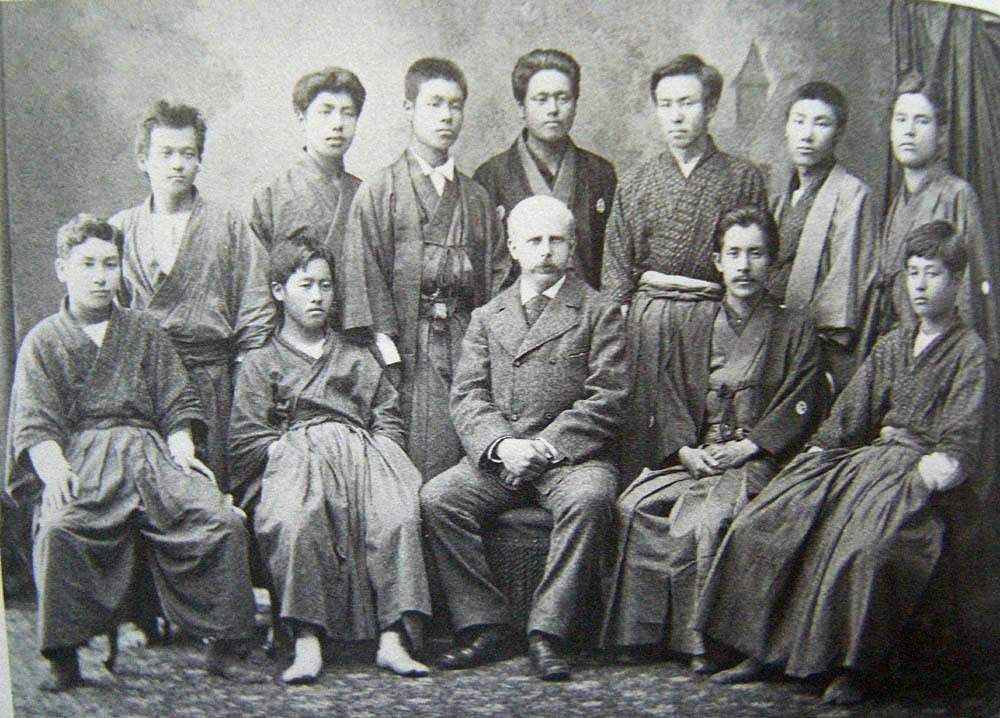
It turns out that both Nakamura and Wada were students of Thomas Mendenhall (1841–1924), who came to Japan in 1878 to teach physics at Tokyo University – there they are in the commemorative class photograph below, taken probably in the same year. And both accompanied Mendenhall to Mt Fuji in the summer of 1880, when he conducted his famous gravity experiment from the summit of Japan’s highest mountain in order to “weigh the earth”.

Thomas Mendenhall and his students in Tokyo, c. 1878 (?)
Nakamura and Wada are sitting to Mendenhall's left
(Image courtesy of Thomas C. Mendenhall II via Wikipedia)

In 1895, a young dropout from pre-medical school, as Nonaka Itaru then was, visited Nakamura and Wada to discuss a preposterous scheme to overwinter on the summit of Mt Fuji. The meteorologists would probably have dismissed this madcap proposal out of hand, had not the meeting been orchestrated by the distinguished scientist Terao Hisashi (1855-1923), another of the “Mendenhall boys” and the science university’s first president. As it happened, both Terao and Nonaka were from samurai families in the old province of Chikuzen. 

So, instead of showing Nonaka Itaru the door, Wada suggested that his stay on Mt Fuji would be more productive if he took a full year’s worth of weather observations. And he further offered to lend him the instruments he would need.

From then onwards, the project was prosecuted with typical mid-Meiji verve. Itaru spent the summer building a hut, Wada helped him instal the instruments, and in October Nonaka reclimbed the mountain to start his observations. Soon afterwards, Chiyoko came up to join him, suspecting that her husband wouldn’t be able to manage on his own (where do women get these ideas, I wonder). Then things started to go horribly wrong, as detailed elsewhere on this blog …

Poster for the exhibition at the Tokyo University of Science

In the afternoon, we attend a meeting of the Fuyō Nikki no Kai. This is an association dedicated to researching the background to Nonaka Chiyoko’s eponymous “Journal of the Lotus”, which she started writing just weeks after she and her husband were rescued from their summit hut. They had in fact been carried down the mountain in a blizzard by an impromptu team of porters led by Wada Yūji himself. By now the fate of the Nonakas was so much a matter of public interest that the meteorologist later wrote a report on this episode for his ultimate superior, the Minister of Education, Marquis Saionji Kinmochi (1849-1940). 

After that, the story as often told – including here on this blog – takes a sombre turn. Itaru was never able to realise his dream of building a bigger and better weather station, perhaps because Wada was posted to Korea in 1899, depriving him of a mentor and a network. And Chiyoko died in her early fifties during the flu epidemic of 1922. But today’s meeting reminds us of Mark Twain’s jibe: “In the real world, nothing happens at the right place at the right time. It is the job of journalists and historians to correct that.”

Nonaka Itaru's storehouse built on the crater rim in 1912.
(Image source: historical report by the Mt Fuji Weather Station)

What prompts this thought is an official report which turns out to contain a rare photo of a storehouse that Nonaka Itaru commissioned to be built on Mt Fuji’s crater rim in 1912, more than a decade after he and his wife were dramatically rescued from their cramped and blizzard-wracked summit hut. The new storehouse was set up at Higashi Yasugawara, on the south-eastern side of the crater, exactly where Nonaka had once proposed to build a new and larger hut.

Three years previously, he’d built a spacious villa at Takigahara, a village at Mt. Fuji’s foot, so that future summit parties could use it as a staging post or even as an observatory when simultaneous readings were required at both the top and the foot of the mountain.

So it looks as if Itaru had both the ambition and the means to plot a return to the summit. Nor had he entirely lost contact with Wada – a photo we saw at the morning’s exhibition purports to show the two men together at a “7.5” station hut on Mt Fuji in 1912, the very same year that Nonaka built his summit storehouse.

In the end, though, it was the professionals of Japan’s meteorological service who built a more-or-less permanent weather station on the summit of Mt Fuji. Yet, when they did so, the meteorologists paid Itaru the compliment of adopting the wind-deflecting design of his storehouse for their own building. They also made use of Itaru’s storehouse itself. And they continued to treat him as an honoured guest in their new summit station. 

The full story is sometimes more complicated and nuanced than the storytellers would like to make it….

Tuesday, October 29, 2024

Poetry of the ice

Book review: a Swiss glaciologist celebrates the transient icebergs on a mountain lake and explains why they matter.

All across the Alps, glaciers are slumping into lakes and pools of their own meltwater. A typical example is the little glacier at the top of the Geren Pass, a windy gap in the ridgeline above Switzerland’s Bedretto Valley. A crescent-shaped lake formed at its foot at the start of this century, and has been expanding ever since, eating steadily into the remaining ice-field. 


In November 2020, however, something different happened here. As winter comes early at 2,670 metres, the lake had already frozen over by the 26th of the month. Unfortunately, nobody was watching on or around that day when, probably within a few minutes, huge blocks of the former glacier erupted upwards, smashing their way through the surface ice or rafting it high into the air.

The lake on the Geren Pass in September 2020.
Image by courtesy of Alpine Light & Structure

What had happened? Within a few weeks, a curious researcher, Giovanni Kappenberger, had skied his way up to the pass to find out. Few could be better qualified to do so. As Kappenberger’s family and given names suggest, his life has spanned the very same Italian and German-speaking regions that the Geren Pass links together. He was born in Italian-speaking Lugano in 1948, but studied natural sciences at Zurich’s Federal Institute of Technology (ETH). While working as a meteorologist for the next few decades, he also kept up his interests in glaciology by helping to monitor the mass balance of the Basodino glacier, Ticino’s largest expanse of ice.

The lake after the "evento catastrofico" of November 2020.
Image from Giovanni Kappenberger: Die Eisberge am Gerenpass

Arriving at the Geren Pass, Kappenberger saw a new chaos of giant ice blocks crowded into the small lake. This couldn’t be a normal “calving” from the end of the glacier, as in other lakes. Instead, he deduced that some kind of “evento catastrofico” was responsible.

Back at the nearby Piansecco hut that evening, he sketched out what must have taken place. The rising lake had progressively submerged the glacier’s tongue over a number of years until the warm summer of 2020 loosened its grip on the rock below, letting the ice break free and float to the surface. And this event was the starting point for Kappenberger’s book, Die Eisberge am Gerenpass: Poesie des Eises (The icebergs on the Geren Pass: Poetry of the ice), published two years later.

Kappenberger's sketch of the "evento catastrofico" that created the new icebergs.
Illustration from Die Eisberge am Gerenpass

Visitors to the pass could now see an extraordinary throng of icebergs jostling each other amid a frozen sea – and thanks to the lake’s low rim, this foreground was set against a backdrop of the Bernese Oberland’s highest peaks, some twenty or thirty kilometres distant. Kappenberger’s next move was to name the largest ice-blocks – Olaf, Irene, Central and so on – so that they could be more conveniently documented. And then he and his colleagues set to work to measure, monitor and record the lake, its water levels, flow rates and its unique icebergs.

The book's back cover
with watercolour by the author.
Or perhaps not quite unique. A submerged glacier tongue has broken free on more than one occasion elsewhere in the Alps, although usually with unspectacular results, as Kappenberger notes. But the icebergs of the Geren Pass were uniquely massive. This they owed to the unusual thickness of the parent glacier, as revealed by a survey with ice-penetrating radar in March 2021.

Between December 2020 and October 2022, Kappenberger made fifteen visits to the Geren Pass. The surveys he and his colleagues undertook, particularly on the lake’s water levels, are summarised in his book, which appeared first in Italian and then in German. 

But the researchers also took the time to enjoy and commemorate the scenery in a generous array of photos and even a watercolour or two. Poems too punctuate the narrative, including verses by Kenneth White (1936-2023), the founder of geopoetics. Kappenberger is delightfully multidisciplinary in his approach, amply justifying the subtitle he gave his book: “Poesie des Eises” (poetry of the ice).

In July 2021, the scientists were even joined by a swimmer who took a dip amidst the icebergs to raise funds for an “IceSwim4Hope” charity. But how much hope is left for the ice on the Geren Pass? The icebergs are already on their way to oblivion – only a few still show their backs above the water at the time of writing – and the glacier’s days too are numbered. Up to 2021, Kappenberger gave it twenty more years of existence; after the ferocious summer heat in 2022, he cut that estimate in half.

The lake in October 2024: few icebergs have survived.
Image by courtesy of Alpine Light & Structure

After a decade or two, visitors to the Geren Pass will see only a little round lake. The shape, though not the size, may remind some of the great basin of the Arctic Ocean. Kappenberger is on familiar terms with the High North, having spent two summers in the Canadian Arctic back in the 1970s, studying the Laika Glacier while curious polar bears looked in at the window of his hut. And in the last pages of his book, he draws the parallels between the Arctic seas and the Swiss glacier lakes.

As Kappenberger notes, the Arctic sea ice is shrinking fast, just like its alpine analogue. Once that insulating cover goes, the sun’s energy will beat down on the ocean to even greater effect, further lessening the temperature difference between the Arctic regions and everywhere else. This will weaken the jetstream, causing it to meander more widely (in so-called Rossby Waves) and reinforcing the blocking high or low pressure zones that bring droughts or flooding in their wake.

That outlook may be depressing – especially if we fail to respond to it – but Kappenberger’s approach is far from depressive. In the prologue, he writes that his efforts to document the icebergs’ brief existence and to understand the underlying dynamics seemed to be the best way of celebrating their beauty. It was like this, he suggests, reaching for a parable:

A man walking through a field happened on a tiger. Pursued by the beast, he ran away. When he came to a cliff, he grabbed the roots of a wild vine and lowered himself into the abyss. The tiger gnashed its teeth at him from above. Terrified, the man looked downwards, where he saw another tiger waiting to devour him. Only the wild vine protected him from that fate, and now he saw a couple of mice starting to gnaw at its tendrils. Just then, the man saw a strawberry growing next to him. With one hand, he kept his hold on the vine root and with the other he plucked the strawberry from its stem. My, how sweet it tasted…

Neither this parable or the book itself will appeal much to readers of a denialist persuasion. On the other hand, for those who like their hard scientific facts leavened with a dash of Latin wit, charm and aesthetic flair, Kappenberger’s slim volume is bound to taste sweet.

References

Giovanni Kappenberger, Die Eisberge am Gerenpass: Poesie des Eises, Unterstalden: rottenedition, 2022 (German edition, 203 pages, fully illustrated, translated from the original Italian text). The review copy was sourced from Zurich's specialist mountain book store, Piz Berg und Buch. 


Saturday, March 30, 2024

A meizanologist's diary (62)

16 March (cont’d): having voyaged through space in the morning, we opt to travel backwards through time in the afternoon. And thanks to the munificence of the local authorities, there is even a choice of vehicle: we can visit either the Fukui Prefectural Varve Museum and/or the Wakasa Mikata Jomon Museum, which stand side by side close to the Five Lakes of Mikata.

This is the ticket for a date with Deep Time

Since we have a long drive home, we opt for the varves only – which may be a false economy. For it turns out that both museums owe their existence to the Jomon people who lived beside the lakes from 12,000 to 5,000 years ago. When archaeologists started excavating their trash dump or "midden" of oyster shells in the 1960s, they found that the nearby lakes preserved a particularly fine and deep series of ancient sediments.

Paying our respects to a reconstructed Jomon dwelling

Thanks to its sheltered location, and with a bit of help from the local geology, Lake Suigetsu has yielded up one of the world's best series of varves, as such annual markings in the lakebed are known. And, for the trumpery sum of 500 yen each, the Sensei and I are ushered into their presence.

Vis-a-vis the world's longest unbroken varve series

During the 1990s, explains our guide, four sediment cores were taken from the bottom of Lake Suigetsu. When these were overlapped to cover gaps, the varves could be traced back for 70,000 years at a stretch, showing more or less one varve for every passing year. This – and surely we detect a note of pride in our guide's voice – represents the longest unbroken series of varves in the world. 

We are looking at a wall-mounted display of brownish strips. At first glance, these seem about as exciting as the understated neckties favoured by Japan’s more senior businessmen. Then the guide starts pointing out grey shimmers that cut across the general background of fine-grained stripes. “This one is the Tenshō earthquake in 1586,” he says, referring to a shock so violent that some islands in Ise Bay reportedly sank beneath the waves.

Signs of a shock that would spoil your day

Floods and volcanic eruptions too have signed the book of varves. Further along the wall – and so deeper in the stack – is another grey smear. This one, explains the guide, is ash from the Krakatoa-like explosion about 7,300 years ago of Kikai, a volcanic island south of what would one day become Kagoshima. The eruption not only obliterated the island, leaving only a flooded caldera, but it may also have terminated Jomon habitation in Kyūshū. Tephrochronologists love these ash deposits, of course, as they help establish more precise dates for volcanic eruptions. 

Pollen gets in your varves: expanded model of a typical grain

But there’s more. The Lake Suigetsu record is so long and detailed that, thanks to the organic material such as pollen grains preserved in the mud, it has become a kind of international yardstick for calibrating the carbon dating of archaeological finds. So, by counting up the varves, it is possible to know more exactly, for example, just when the Jomon folk turned their hands to pottery.

The climate changes before our very eyes

The Suigetsu yardstick is a long one. It covers the period for which carbon-14 dating can be reliably used - to about 50,000 years ago - and the oldest varves in the continuous series go back to the time when humans first left Africa, driven quite possibly by climate change. Meanwhile, the landscape around the lakes has morphed from a cold, dry steppe into a forest containing beech, oak and walnut trees during the Jomon era, and then again into today's cedar and camellia woods. 

Gazing in the general direction of Deep Time

Contemplating Deep Time can make the head spin: there is, as a pioneer of the discipline observed no vestige of a beginning, no prospect of an end in the geological record. So, for a breath of fresh air, we walk out onto an outdoors terrace. 

A fresh sea breeze ruffles the waters of Lake Mikata, into which the Jomon folk used to toss their discarded oyster shells. Over there, but out of sight behind a low ridge, lies Lake Suigetsu. Under its placid surface, the varves are still piling up at a rate of about two metres per millenium, our guide had said. And I find myself wondering how they will record our Anthropocene Era over the coming centuries ...


Thursday, January 25, 2024

A meizanologist's diary (52)

4 January (continued): walking back to the Sensei’s car from the museum, we find ourselves wondering whether the many long cracks in the tarmac are recent or not. But only briefly. When we light upon a drain shaft that appears to have been thrust bodily out of the ground, the matter is settled.


To find out more, I walk back to the museum’s office. Yes, confirms the curator, all this happened during the initial earthquake shock on New Year’s Day – the museum building, being constructed to the latest standards, rode out the shock undamaged, but the grounds around it liquified – water gushed out of the ground – cracking pavements and breaking up the carpark.


The curator invites me on a quick tour. Liquefaction was responsible for the damage to the stone staircase, which is why we had to enter the museum through the ground-level door. It also caused a mudslide that blocked a stream flowing into the nearby lagoon – it was mainly the waterlogged soil within a narrow zone close to the lagoon that was prone to liquefaction. A backhoe digger had to brought in to clear the channel before the stream overflowed its banks.


Thanking the curator, I walk back to the car. Its navigation system would reckon that Kaga City, the museum’s location, is about 160 kilometres or 100 miles south of the earthquake’s epicentre.

The energies let loose under the Noto Peninsula three days ago are unimaginable – they heaved up coastlines metres above their former level, so that small ports turned into sandy beaches. And perhaps, with earthquakes like this one summing over millennia, they may have shifted the whole top of the peninsula sideways. As for the human cost …

(Source: Wikipedia)

Echoing through my mind are the words of Terada Torahiko, founder of Tokyo University’s earthquake research institute: “Shouldn’t you be amazed by this?”

Monday, January 22, 2024

A meizanologist's diary (51)

4 January: we visit the Nakaya Ukichiro Museum of Snow and Ice in Kaga City. Up here, just inside Ishikawa’s prefectural border, the rice fields are lightly dusted in white. Snow was Nakaya’s core business; he is best known for cataloguing its crystal types and establishing a classification system that paved the way for the ones in worldwide use today.

Nakaya Ukichiro researching
snow in the Tokachi region
We are lucky to find the museum open at all – the stone steps leading up to the usual entrance have been roped off. So we find our way in via the museum office instead. The main exhibition hall presents a timeline of Nakaya’s life – born in Kaga in 1900, attended the elite Kanazawa Fourth High School, went up to Tokyo University in 1922 to study physics …

In retrospect, it might seem obvious that a bright young physicist from Japan’s snow country would devote his scholarly life to the white stuff. But real life is less straightforward. In his second year at Tokyo University, the year of the Great Kanto Earthquake, Nakaya came under the mentorship of Terada Torahiko of RIKEN, whose scientific watchword was “Aren’t you amazed by this?” (fushigi da to wa omoimasen ka?)

Terada would strongly influence the way that Nakaya went about his investigations. As the latter recalled:

Terada considered a ‘physics of form’, concerning which he frequently said ‘If the forms of the phenomena are the same, they are governed by the same laws. To pass over the similarity of forms as merely a superficial agreement is to act as a person who doesn’t understand the true meaning of the word ‘form’. Terada’s words have a very deep meaning, for he not only meditated on the idea but he did actual research into the forms that appeared in various phenomena: his research into fractures, electric sparks, sparklers and the flow of charcoal calligraphy ink all shared the underlying theme of research into forms.

After the great earthquake of September 1923, an event that probably altered Japan’s political evolution, Terada would go on to found Tokyo University’s Earthquake Research Institute, with Nakaya's help. But it was a smaller-scale disaster that shifted the younger man's trajectory. When an airship of the Imperial Navy exploded in mid-air in March 1924, Terada asked his student to help him find out why.

Photos of electrical sparking by Nakaya Ukichiro

The scientists concluded that an electrostatic discharge had ignited the airship’s gasbags, which led Nakaya to a study of electrical sparking. Via graduate studies at London University, where he studied x-rays, this work took him to an assistant professorship at Hokkaido University.

Researching snow in Hokkaido

According to Wikipedia, the Sapporo-based university was short on funds and experimental equipment. Snow, on the other hand, was available in unlimited quantities. The 3,000 snowflake photos published by Wilson Bentley (1865-1931) were a further inspiration to Nakaya, who had built up his own expertise in micro-photography while recording electrical sparks.

The mountain lodge where Nakaya photographed snowflakes

Having found his metier, Nakaya went out into the Hokkaido mountains to study and record snow crystals. After documenting their forms in some 3,000 macro photos, he then sought to reproduce the way that snowflakes form, ultimately persuading the world’s first artificial snow crystals to form on a rabbit’s hair.

Supercooled water freezes instantly 

At this point, a museum attendant rounds us up for a live demonstration of supercooled water. We breathe into a freezer cabinet to see how “diamond dust” forms and watch how a bottle of supercooled water freezes almost instantly when shaken – just as supercooled cloud droplets freeze solid when they hit the wings of a plane.

Airframe for icing experiments at Niseko, 1943

The same insights inspired Nakaya’s research during the war years. A superannuated military aircraft – some say a Zero fighter – was dragged up to the top of a mountain near Niseko in 1943 and left to accumulate ice in the freezing winter winds. Nakaya also experimented with artificial fog dissipation. Sooner or later, scientific theory would always yield up practical applications, he believed.

A landscape by Nakaya Ukichiro
painted while convalescing in the Izu Peninsula

There was more to Nakaya than snow science. We had already admired some of his paintings – Terada-sensei encouraged his students to draw and paint as a way of honing their observational skills – and on our way out, we noticed the cover of a children’s book that Nakaya wrote and published for his two daughters. For the literary arts too were part of his philosophy:

I am not knowledgeable about modern methods of specialised education. However, reflecting on my own childhood experiences, I suspect that perhaps an outwardly unscientific education may have an unexpected effect of enhancing feelings of wonder about nature. The dreams of childhood may be unrestrained and nonsensical, but I would advise against suppressing such dreams too quickly. Children who do not know about sea monsters (umibōzu) and river demons (kappa) are unfortunate. Not only are they unfortunate, but they may also be deprived of a true scientific education if the umibōzu and kappa are expelled too soon from their worlds.


The Nakaya family at home in Tokyo, 1930s

 Appropriately, the museum's next live demonstration appeals as much to the imagination as the intellect. We watch as a museum staffer takes a fresh block of ice out of a handy freezer cabinet, shines a bright light on it, and shows us how melt cavities form inside the ice, almost like snowflakes in reverse. Named for John Tyndall, the Victorian scientist and alpinist, the phenomenon was further investigated by Nakaya in the 1950s. 


Demonstrating how Tyndall figures form

Like negative snowflakes, Tyndall figures appear in an ice-block 

By this time, he was attached to the US Snow, Ice and Permafrost Research Establishment (SIPRE) in Illinois. Among other projects there, he studied how snow can be milled to make surfaces hard enough for roads and runways. Under the auspices of SIPRE, he also visited the Mendenhall Glacier in Alaska and Thule in Greenland, where he researched the crystalline structure of glacier ice:

After a two-year study of single crystals of ice, I came to the conclusion that can be summed up in one sentence: ice is a metal.

Nakaya at an ice laboratory in Greenland

From 1957 onwards, Nakaya spent four summers at Site-2, a research station located 400 kilometres inland on the Greenland ice sheet, taking part in early attempts to bring up ice cores for climatic research. Increasingly he was thinking about how ice and snow fitted into a bigger picture:

Because of the global increase in atmospheric temperature since the beginning of the 20th century, glaciers in many places worldwide are shrinking or retreating. The cause is an increase in CO2 due to the automobile-dominated society and the cutting down of forests. Warming of the climate will melt the ice in Antarctica and Greenland leading to a sea-level rise, and lowlands all over the world will be in danger of being submerged.

Such insights are familiar today, but Nakaya published these words in 1957. The aim of his research now was to understand how the global water cycle – how snow turns to ice in glaciers and so returns to water – interacts with the climate. But time was running short.

Ultimately, Nakaya’s fascination with Greenland was the death of him. Before his last trip to Thule, he refused to visit a doctor, knowing that a check-up would reveal health issues that would prevent him travelling. He returned to Tokyo exhausted by the journey, and died in April 1962.

In a sense, it was inevitable that Nakaya's life’s work would remain unfinished. For, as he himself said, “No amount of investigation into a block of ice could reveal all its myriad secrets.”


Tuesday, October 10, 2023

Mt Fuji, Meizan of aerological science

Microplastics detected for the first time in mountaintop clouds

Researchers from Waseda and other Japanese universities have found fine particles of plastic – microplastics – in clouds, reports the Guardian. This study may be the first to have sampled clouds for this form of environmental pollution.


Using “string-type passive cloud collectors”, the scientists sniffed the air from the tops of Mt Fuji (3,778 metres) and Mt Ōyama (1,252 metres) in the nearby Tanzawa range, both mountains that figure prominently in Japan’s most famous mountain book. Samples were also collected at Tarōbō (1,302 metres), on Mt Fuji’s lower slopes.

The researchers then looked at wind trajectories to work out where the plastic particles came from. As you’d expect, the summit of Mt Fuji attracts a superior range of pollutants. This may be because the winds that blow over Ōyama and Tarōbō come mainly from China, while the top of Mt Fuji also receives airborne tribute from Southeast Asia.

The aerologists follow in a lengthy tradition. They collected their high-altitude samples at the Mount Fuji Research Station. This comprises the buildings of the old weather station, which a non-profit organisation repurposed for summer-only scientific observations in 2007. 

But the weather station itself could trace its origins back to the winter of 1895, when Nonaka Itaru and his wife Chiyoko held out for more than two months in a small hut, making weather observations at the very highest point of Mt Fuji.

In those days, of course, the clouds were entirely free of fine particles of plastic.

References

Yize Wang, Hiroshi Okochi, Yuto Tani, Hiroshi Hayami, Yukiya Minami, Naoya Katsumi, Masaki Takeuchi, Atsuyuki Sorimachi, Yusuke Fujii, Mizuo Kajino, Kouji Adachi, Yasuhiro Ishihara, Yoko Iwamoto and Yasuhiro Niida, “Airborne hydrophilic microplastics in cloud water at high altitudes and their role in cloud formation”, Environmental Chemistry Letters, August 2023.


Wednesday, August 23, 2023

Imaging the ice of yesteryear

Old paintings and photos of two vanishing alpine glaciers have recently been added to an international climate database maintained at the University of Bern in Switzerland. Glaciers are crucial climate indicators, reflecting changes in temperature and precipitation.

The Upper Grindelwald Glacier in 1835
Painting by Thomas Fearnley (National Gallery, Oslo)

Two institutions, Euro-Climhist and the World Glacier Monitoring Service (WGMS) collaborated on this effort. Euro-Climhist, housed at the University of Bern, compiles historical climate and weather data, including information on glaciers. The WGMS, based at the University of Zurich, collects and shares standardised glacier data.

In late 2021, Euro-Climhist and WGMS joined forces to preserve and share historical glacier images as part of the Euro-Climhist database. The paintings, photos and maps of the Grindelwald glaciers and Mont Blanc’s Mer de Glace will expand insights into past glacier fluctuations, helping researchers and the public to understand historical climate events and facilitating the assessment of current and future climate trends.

The Mer de Glace and its extent in the c17 (green) and c19 (red)
Reconstruction by S Nussbaumer and R Wolf

Historical glacier images play a crucial role in understanding interactions between glaciers and climate before the days of systematic measurements. Drawings, paintings, prints, and early photographs can document glacier levels dating back to the 16th century, with some help from meticulous analysis and interpretation of image quality.

The 300 or so images of the Grindelwald and the Mer de Glace glaciers, both well studied since the eighteenth century and before, have been enriched with metadata such as the artist’s name, descriptions and dates. Images are categorised into five types: drawings, oil paintings, prints, photographs, or maps, each varying in accuracy. Drawings and photographs are considered most precise, while oil paintings and prints offer valuable insights despite some imprecision.

First known depiction of Lower Grindelwald Glacier
Before 1642, by Joseph Plepp and Matthäus Merian
(Swiss National Library)

The project's pilot team consisted of researchers from the University of Zurich and the University of Bern, blending natural science, art, and environmental history perspectives. The initial series of integrated glacier images showcases the potential of historical images for understanding past climate trends. While the project focused on the Grindelwald glaciers and the Mer de Glace, more images from various regions could provide further insights.

The initiative was supported by MeteoSwiss, the national weather agency, within the framework of Switzerland’s affiliation to the Global Climate Observing System (GCOS), which gathers high-quality climate observations worldwide.

The Lower Grindelwald Glacier in July 1826
By Samuel Birmann (Kunstmuseum Basel)

The sensitivity of glaciers to climate fluctuations makes them vital indicators for climate change. Fluctuations in temperature and precipitation directly influence glacier size and mass. The alpine glaciers are shrinking fast due to warming temperatures and less snowfall, with this trend accelerating in recent years.

References

Translated and summarised from the MeteoSuisse blog, “Historische Gletscherbilder ermöglichen Rekonstruktion von vergangenen Gletscherständen”, 18 August 2023.


"Suddenly transported to a world forgotten by nature"

“Some courageous hunter might attempt this route”

Wednesday, April 19, 2023

Wilting walls

A warming southern ocean bodes ill for the snows of Tateyama

Tateyama’s famous snow corridor opened to visitors on 15 April this year. As CNN reports, the centrepiece is half a kilometre of roadway excavated between snow walls that have sometimes towered up to a height of 20 metres. A tour bus provides scale in the brochure photos used to advertise this spectacle.

Image by courtesy of the Tateyama-Kurobe Alpine Route

A one-day excursion to this mountaintop might set you back as much as ¥30,000, even starting from nearby Nagano. But will the punters get what they pay for? In recent years, some have been disappointed. As one visitor reported on TrustPilot, “The irony was that, at the Murodo snow wall, the wall had melted such that it only came just above the top of the bus. Certainly not as impressive as the photos in the brochure indicated.”

The date and year of this comment – May 2016 – could be significant. Tateyama sits in one of the world’s snowiest regions, where the winter winds sweeping in from Siberia pick up moisture from the Japan Sea and dump it liberally on any mountain that stands in the way.

Even so, climate change is starting to bite. Seasonal snow accumulations in Japan were already shrinking a decade and more ago, except in northern Tohoku and Hokkaido. But the maximum snow depth in 2015/16 was the lowest in 16 years, say eight meteorologists who simulated the weather dynamics behind that exceptionally lean winter.

The dearth of snow in 2015/16 coincided with one of the most severe El Niño events – a warming of the equatorial Pacific Ocean – seen in a century. And, as the eight meteorologists conclude in their paper, “Analysis of the four largest El Niño events shows that warmer Aprils around Japan can be a typical response,” adding that yearly variations probably also played a role in the weak snowfall.

As it happens, the World Meteorological Organization recently warned that we may be heading into another El Niño phase, following three years of “an unusually stubborn and protracted La Niña”. So, if you want to see the Tateyama snow walls in their full glory – they are right now looming around 13 metres over the road – it may be wise to pony up that ¥30,000 soon, while La Niña still reigns.

References

Maggie Hiufu Wong, “On the ‘rooftop of Japan,’ a stunning 20-meter-deep snow corridor reopens to visitors”, CNN Travel, 14 April 2023.

Takahashi Hiroshi, “Long-term trends in snowfall characteristics and extremes in Japan from 1961 to 2012”, International Journal of Climatology, December 2020.

Hiroaki Kawase, Akira Yamazaki, Hajime Iida, Kazuma Aoki, Wataru Shimada, Hidetaka Sasaki, Akihiko Murata, Masaya Nosaka, “Simulation of Extremely Small Amounts of Snow Observed at High Elevations over the Japanese Northern Alps in the 2015/16 Winter”, Scientific Online Letters on the Atmosphere (SOLA), 2018, vol 14.

World Meteorological Organization, WMO Update, El Niño may return, 1 March 2023.


Monday, March 13, 2023

Retreat of the snow monsters

Back in the 1980s, Project Hyakumeizan was astonished at the snow monsters on Hakusan. More soberly known as “juhyō” (tree ice), these are the fantastic figures wrought by the trees encrusted with the snow and hoar-frost swept in by the blizzards from the Japan Sea. You can still see them up there, but perhaps not for much longer.

Ice monsters on Hakusan, Advent Sunday 1981

The problem is the climate. Ice monsters will all but vanish from Japan by the end of the century unless climate change slows, warns Fumitaka Yanagisawa, a professor emeritus at Yamagata University’s Research Institute for Ice Monsters and Volcanoes of Zao, as reported in the Asahi Shimbun.

Using historical records, Professor Yanagisawa has established that juhyō previously flourished in a wide arc stretching from Hokkaidō in the north to Ishikawa’s Hakusan massif in the south. But this range has has been shrinking, both from southern end and, less obviously, from the north – where, in Hokkaidō, the mountains are no longer high enough to support the special conditions in which juhyō thrive, namely temperatures of minus 10–15 degrees, two to three metres of snow, and strong northwesterly or westerly winds with a speed of 36 to 54 kph, among others.

Yōteizan, Hakkōda, Zaō, Hachimantai, Azumaya, Hakusan, even humble Makihata – many of the mountains named by Professor Yanigasawa as current and former juhyō habitats also belong to the One Hundred Mountains of Japan. Indeed, the snow monsters put in an occasional appearance in Japan’s most famous mountain book:

I first visited Zaō when word of its frozen trees was first reaching the outside world. At that time, the only shelter above Takayu hot springs was the Kobold Hut belonging to the former Yamagata High School. After that visit, I went to the massif to ski every winter. After the war, however, I have not returned, fearing the crowds that must now overwhelm it …

It would be a pity if the juhyō were to join the Kobold Hut* and a pristine Zaō as half-forgotten footnotes in the history of Japan’s mountains …

References

Sakata, Tatsuro, Climate change quietly slaying Japan’s ‘juhyo’ ice monsters, Asahi Shimbun, 12 March 2023

Alan Taylor, Juhyo: The Snow Monsters on Japan’s Mount Zao, The Atlantic, 22 January 2020

*It seems that the Kobold Hut has survived to this day, now owned by Yamagata University: see this blog post.