Showing posts with label pioneers. Show all posts

Friday, May 30, 2025

Tales of past and present (2)

Continued: A talk about the foreign explorers of Japan’s mountains, then and now.

So times had changed. We’re now in the Taishō era (1912–26). In these years huts were built, paths were made and guide associations formed. Now everybody could go to the mountains. JAC members started to do pioneer work abroad – notably Maki “Yūkō” Aritsune (1894–1989) on the Eiger’s Mittellegi Ridge in 1921, and on Mt Alberta in 1925.

Maki Yuko returns from the Eiger with his guides, September 1921

What were the foreigners doing at this time? Well, some joined the JAC – the club’s records must be very interesting on this topic. According to Hamish Ion, a mountain historian, within a year of the JAC’s foundation there were eleven foreign members (not all of them English) two were Anglican clergymen, like Weston, two were university teachers, and the rest were businessmen in Yokohama, Tokyo and Kobe.

Foreign women too joined: Mrs Frances Weston and Mrs Emily Elwin became members before 1923. Also, two lady missionaries were introduced by your founder member Takano Takazō and Kondō Shigekichi (1883–1969), who had studied at Glasgow University.

Interestingly, when Mrs Weston went back to England, she wasn’t able to join Britain’s Alpine Club – instead she had to join the Ladies Alpine Club founded in 1907 by the hard-driving Mrs Elizabeth Aubrey LeBlond, the pioneer winter alpine climber and mountain photographer. Officially, of course, the JAC did not admit women until 1949 – but this was still a quarter of a century ahead of Britain’s Alpine Club (1974) and the Swiss Alpine Club (1980). This too was pioneer work.

H E Daunt, the "Bell Goat".
Some foreigners also founded their own association: the Mountain Goats of Kobe, who often trained on Rokkō-san. I’m not sure when the MGK started (some say 1911 as the Ancient Order of Mountain Goats), but its house journal Inaka first came out in 1915 and continued for almost a decade. It was edited by a Kobe resident and oil company employee, H E Daunt. 

Daunt was a golfer before he was a mountaineer. As a member of the Kobe Golf Club, the first Japanese golf club, opened in 1913, he won the Japanese amateur championship in 1915. In May 1919, he helped to design Korea’s first-ever golf course, describing his experience in Inaka (1923). Visiting Seoul at the invitation of the South Manchurian Railway Company in May 1919, he helped Mr Inohara, the general manager of the Chosun Hotel, set out the course.

Is it perhaps an exquisite coincidence that there are just 18 volumes of Inaka, like the 18 holes of a golf round?


As you can see, Inaka was well produced – it was printed by a local newspaper company. Alas, even single volumes of Inaka are very rare and expensive - complete sets are even rarer: I only know of two: one in London and one in Kobe – I hope one day it will be reprinted or at least a selection of articles. There is some good stuff in there, for example, an eyewitness account of the 1915 Yake-dake eruption by J Merle Davis, an American missionary, in Inaka Vol II, 1915.

The eruption of Yake-dake in 1915.

By the way, many, perhaps most, of the leading MGK members were also members of the JAC. And for a number of years after the first world war, H E Daunt edited the English-language supplement of Sangaku, the JAC’s journal.

The MGK were not the only show in town. At one point, more than a third of the members of the Kobe toho-kai (神戸徒歩会) were foreigners, and its journal Pedestrian carried articles in English as well as Japanese. The Kobe toho-kai was founded in 1910 as the Kobe Waraji-kai (神戸草鞋会).

Of course, clubs are never the whole story ...

Sunday, May 25, 2025

Tales of past and present (1)

A talk about the foreign explorers of Japan’s mountains, then and now.

Thank you Ishizuka-san and members of the Ryokusōkai for inviting me to speak here at the offices of the storied Japanese Alpine Club – the original idea was to talk about translating Nihon Hyakumeizan (One Hundred Mountains of Japan), but translations can be a dry subject, and so with your help, we settled on the topic of foreign mountaineers in Japan – what they did in the past, what they are doing now, and what they might think of doing in the future.

When I started looking at this topic, I realised that this is a huge field. Quite simply, even if we restrict ourselves to the early days, more foreigners explored the mountains of Japan than can possibly be mentioned, even cursorily, in a one-hour talk. The literature itself is quite sizeable – for example, I haven’t yet managed to lay my hands on a copy of Shōda Hito'o’s magisterial Ijintachi no Nihon Arupusu (Strangers in the Japan Alps).

So – my apologies in advance – I’m afraid that this talk will by no means consult all the available sources; it will skate selectively over the surface. And it will raise more questions than it gives answers. But let us wade in there anyway.

The past
When it comes to the past, there’s no question where we should start. In today’s company, we have to begin with Walter Weston (1861–1940) – here he is with Shiga Shigetaka: together they were the JAC’s first honorary vice presidents.

Shiga Shigetaka and Walter Weston.

By the way, I was embarrassed to read in the Ryokusōkai’s newsletter that certain senior members of the JAC entrusted Weston with a valuable picture scroll, which they intended as a gift to the British Alpine Club’s president. But, when he went back to England, Weston apparently mislaid this handsome present. This is regrettable in the extreme, and I can only bow deeply in apology on behalf of my countryman.

Kamijo Kamonji (left) and Walter Weston (right).

To this audience, Weston is so well known that there is no need to rehearse his story in detail. He first came to Japan in 1888. His book Mountaineering and Exploration in the Japanese Alps (1896) was based on climbs in 1891–93, during which he climbed Yari-ga-take with the pioneer guide Kamijō Kamonji (1847–1917). Then he went home and, in April 1902, he got married.

Kojima Usui and Yari-ga-take surmounted by a surveyor's marker.

In August of the same year, Kojima Usui, made his famous ascent of Yari – inspired by Shiga Shigetaka’s Nihon Fūkeiron (A theory of the Japanese landscape). Then, in 1903, Kojima discovered that Weston had come back to Japan – actually it was his climbing companion on Yari, Okano Kinjirō, who thought of looking in the Yokohama phone directory. Okano and Kojima met Weston for tea, over which they discussed the idea of an alpine club and an alpine journal in Japan – and the rest is history. In October 1905: the JAC was founded.

For his achievements, Weston is sometimes called the father of Japanese alpinism. But was he really?

Foreigners were climbing in Japan before Weston was even born – a whole generation earlier.

Let us rewind to September 4, 1860: Rutherford Alcock (1809–97), the British emissary, is setting out with seven British colleagues and about a hundred Japanese officials, agents of the bakufu and their attendants with thirty horses. Alcock’s dog, Toby, is going along too.

An illustration from Rutherford Alcock's The Capital of the Tycoon.

Alcock’s main aim was political: to assert his right to travel freely under 1858 treaty. But it wasn’t just about politics. Before he became a diplomat, he had been a surgeon and he liked to have men of science around him. In the party was the botanist and gardener John Veitch (1839–1870). On Mt Fuji, Veitch “discovered” the shirabiso and named it for himself: Abies veitchii.

John Veitch and the tree he named for himself.

On September 11th, they all reached summit of Mt Fuji, where a certain Navy Lieutenant Robinson mistakenly calculated an altitude of more than four thousand metres. Later, alas, at the Atami hot springs the dog Toby strolled over an erupting geyser with fatal consequences. Veitch too died too young, at the age of 31 in England, but you can still visit a garden that he helped to create there…

At "Hakoni": from Rutherford Alcock's The Capital of the Tycoon.

As only diplomats could move freely at that time, they naturally accounted for the earliest wave of mountaineering by foreigners. Six years after Alcock’s climb, a Swiss diplomat led the second gaijin ascent of Fuji. 

The Swiss delegation in Edo: contemporary print.

This was Caspar Brennwald (1838–99), who later helped to found a trading company that still exists today. The Swiss planned to bivouac on the summit but met with a thunderstorm that forced them to seek shelter in a pilgrim’s hut.

         Carl Johann Maximowicz and some of his specimens.

On the heels of the diplomats came the scholars. The Russian botanist Carl Johann Maximowicz (1827–91) arrived in Japan late in 1860 and, during the next two years, walked from Hokkaido to Kyushu, taking in mountains such as Unzen, Aso and Kujū on the way. Along the way, he must have found a lot of interesting plants: he sent home 72 chests full of specimens – some of which can still be seen in museums today. Another naturalist, the German Wilhelm Dönitz (1838–1912), climbed Nantai and Fuji in 1875, although he was more interested in spiders and millipedes than flowers.

Benjamin Smith Lyman with his team of surveyors.

Geologists and geographers were no less active. In 1874, Benjamin Smith Lyman (1835–1920), an American mining engineer and surveyor, explored the Daisetsuzan while seeking the source of the Ishikari River. He also surveyed the oil fields in Niigata, partly at his own expense when the government’s funds ran out. By the way, I have never seen a detailed account of Lyman’s journey up the Ishikari River – even the biography by Kuwada Gonpei doesn’t have one. What a pity: it must have been a fascinating journey, and one that can never be repeated.


The following year, Heinrich Naumann (1854–1927), a German geologist attached to the Kaisei Gakkō, climbed Asama. His temper too was said to be volcanic, which cut short his stay in Japan. Otherwise he would certainly have climbed more mountains. But he did get to name the Fossa Magna.

John Milne and an illustration from his book on Mt. Fuji.

Another geologist, John Milne (1850–1913) visited Iwate, Chokai, Gassan and Aso during his spell in Japan as a foreign advisor, which lasted from 1875 to 1895. He wrote two papers trying to explain the curvature of Mt Fuji’s slopes, a question which still hasn’t been fully answered to this day. Wisely, he gave up on that line of enquiry and concentrated on earthquakes. Today, he is known as “father of the seismograph”.

Ernest Satow and his guidebook. 

Of course, I should have mentioned Ernest Satow (1843–1929) before. As a diplomat, he was among the first foreigners to explore the Japanese mountains – during his first posting from 1862 to 1883, he traversed Okutama, visited Fuji, Asama, Haruna, Akagi, and Nikko-Shirane, crossed Tanzawa, climbed Ontake, Yatsugadake, Hakusan, and Tateyama, and made first British ascents of Nōtori and Ai-no-take in the Southern Alps. And he was a keen amateur botanist, even writing a paper on the cultivation of bamboos.

From a contemporary review of the Satow and Hawes guidebook. 

But he made two more signal contributions to mountaineering in Japan. First, he was the literal father of Takeda Hisayoshi (1883–1972), who became a founder of the JAC and an expert on Japan’s alpine plants. And, secondly, with another Englishman, he compiled a guidebook: A Handbook for Travellers in Central & Northern Japan – first published in 1881.

As we shall see, guidebooks are important: they influence where later travellers go and what they see. This one exerted an even more durable sway – it contains a section by William Gowland (1842–1922), a mining engineer, who was the first to talk about high mountains “that might perhaps be termed the Japanese Alps”. And Shiga Shigetaka probably borrowed material from Satow’s guide for his Nippon Fūkeiron – especially the chapter that inspired Kojima’s ascent of Yari.

Mr and Mrs Weston at Kamikochi in 1923.

That brings us back to Weston. For his travels in Kyushu and Honshu, he used the Satow and Hawes guidebook, now known as “Murray” after its publisher, which he later helped to update. He also used trains where he could – according to Weston himself, there were already more than 3,600 kilometres of railways. So, even in the 1890s, his mountaineering had quite a modern flavour, sped on its way as it was by a detailed guidebook and efficient public transport. All that was lacking was modern maps. 

So what happened after the Japan Alpine Club was formed? For a start, JAC members took over the role of pioneers. Kojima Usui identified a “Golden Age” of mountain exploration that lasted until the Army Surveyors published their maps of all the Japan Alps, removing the last shred of mystery from the mountains.

Thus, when Walter Weston traversed Ōtenshō-dake in August 1914, he was following in the footsteps of Kojima and his JAC colleagues, not the other way round. The titles of his two mountain books say it all: “Mountaineering and Exploration…” (1896), followed by “The Playground of the Far East” (1918). By the way, while travelling towards the Northern Alps by train, he was surprised and appalled by the sight of the new oil rigs along the Niigata coast. 

View of oil rigs on the Niigata coast. 

So times had changed…

Friday, May 10, 2019

"No part of the country in so primeval a state"

Climbing Yari-ga-take in 1884 with Ernest Satow and Albert Hawes

Shimashima (accommodation at the Tsu-un Kwai-sha): Yari-ga-take (' Spear Peak') can be most conveniently ascended from this village. The way, a mere mountain path, strikes up the narrow wooded gorge of a torrent, crossing and recrossing it many times by log bridges. Here and there the bottom of the gorge being too narrow for both torrent and path, the latter is carried along platforms of small fir logs supported on struts above the stream.

View of Yari-ga-take
Woodprint by Yoshida Hiroshi (1876-1950)
Occasionally very picturesque spots occur, where rugged precipices of rock dotted with creepers and sparsely perched trees, rise from the boulder-strewn ravine. After a distance of 3 1/2 or 4 ri the road rises steeply up a pass, leading now and then through dense growths of bamboo grass and beds of a stinging-nettle which greatly impede progress.

The top of the pass is 7,000 ft. above the sea level, but high forest-covered mountains prevent a view from being obtained, excepting to the N., and here it is limited to the fine snow peak of Mio-jin-dake, seen just across the valley, and at whose foot the sleeping hut is situated. On the other side of this pass the landscape becomes more extended, and Jo-nen-dake comes in view, while just below, the Adzusagawa, even here a large torrent, is seen rushing in several streams over its wide bed.

At various points there are traces of an old road, along which in former days considerable traffic crossed this pass to Yamada and thence to Takayama. Descending to the torrent, some time is generally lost in finding suitable places for fording it, especially in July, when the snows are melting freely.

The sleeping-hut stands on the bank of a small stream, and is reached immediately after crossing (elevation 4,950 ft.) It is about 7 or 8 hrs. walking distance from Shimashima, but is rather too far from Yari-ga-take for a convenient ascent and descent on the same day; that at the base of the mountain, 3 ri further on (Miyagawa no Koya) is the best starting point, but it is difficult to reach in one day from Shimashima unless the baggage be sent on in front.

The traveller should start from here at daybreak, and in addition to the guide, should take with him a strong coolie to carry him across the torrent, which has to be forded many times, occasionally in places almost waist-deep.

The route for about 3 hrs. lies alternately up one side or the other of the bed or banks of this torrent: on the left, fine, steep, craggy granitic mountains rise to a height of 7,000-8,000 ft., but on the right are tamer wooded hills. Grand mountains are these precipitous masses of granite, surpassing in wildness any to be seen elsewhere in Japan, their curiously steep forms being not unlike some of the ideal crags depicted by Chinese artists.

Perhaps there is no part of the country in so truly a primeval state (with the exception of some parts of Yamato) than this torrent valley in the heart of the Shinano-Hida range, hunters seeking bears and the sheep-faced antelope or lesser game, being its sole frequenters.

Yari-ga-take is still not yet seen, but now the path strikes up a tributary gorge to the left, and passing the second hut, leads up the mountain through a forest. At an elevation of 6,400 ft. a rude shed called Akasaka no Iwa-goya, a camping-place for hunters, is passed, and just above here the forest ceases, and the first snow-field is crossed.

Hence the road lies mostly over snow, but just below the summit, between the peaks, the route winds up and among huge bare masses of rock piled in indescribable confusion. From the irregular resting of some of these crags, so called 'caves' are formed, and in these hunters take up their quarters whilst watching for bears. Ptarmigan are common here.

Hence, a stiff climb up snow and over debris and a rather dangerous scramble up one side of the peak, land the traveller on a table of a few square yards of rock, the top of the 'spear' of the mountain. From the Miyagawa sleeping-hut to the summit is said to be 6 ri. The ascent can be accomplished in 7 hrs. and the descent in 4 hrs.

The peak of Yari-ga-take consists of a hard weather-resisting brecciated porphyry, which is traversed by numerous foliated siliceous bands inclined at high angles and frequently contorted. To this hard rock it owes its height, and to the siliceous bands its jagged spear-like form.

Beyond Shimashima the road recrosses the stream, which is here lined with willow-trees, and passing through a pleasant grove of red pines, emerges on to the Matsumoto plain. At Niimura (accommodation at the Tsu-un Kwai-sha) kuruma can sometimes be obtained. The road is practicable for them all the way, even from Shimashima, were there any to be had.

References

Excerpted from Ernest Mason Satow, CMG, and Lieutenant A G S Hawes, A Handbook for Travellers in Central & Northern Japan: Being a Guide to Tōkiō, Kiōto, Ōzaka and Other Cities; the Most Interesting Parts of the Main Island Between Kōbe and Awomori, with Ascents of the Principal Mountains, and Descriptions of Temples, Historical Notes and Legends, London, John Murray, 1884 edition.

This route description may have helped to foment the first stirrings of modern alpinism in Japan. Shiga Shigetaka (1863-1927) is thought to have drawn on it in writing the chapter on mountaineering in his Theory of the Japanese Landscape (Nihon Fūkeiron), which appeared in October 1894. It was this book - and specifically this chapter - that inspired the young banker and journalist Kojima Usui to climb Yari-ga-take in 1902. This adventure led to Kojima's meeting, the following year, with the mountaineering missionary Walter Weston, who first suggested to him the idea of a Japanese Alpine Club. The rest, as they say, is history ...

Monday, August 6, 2018

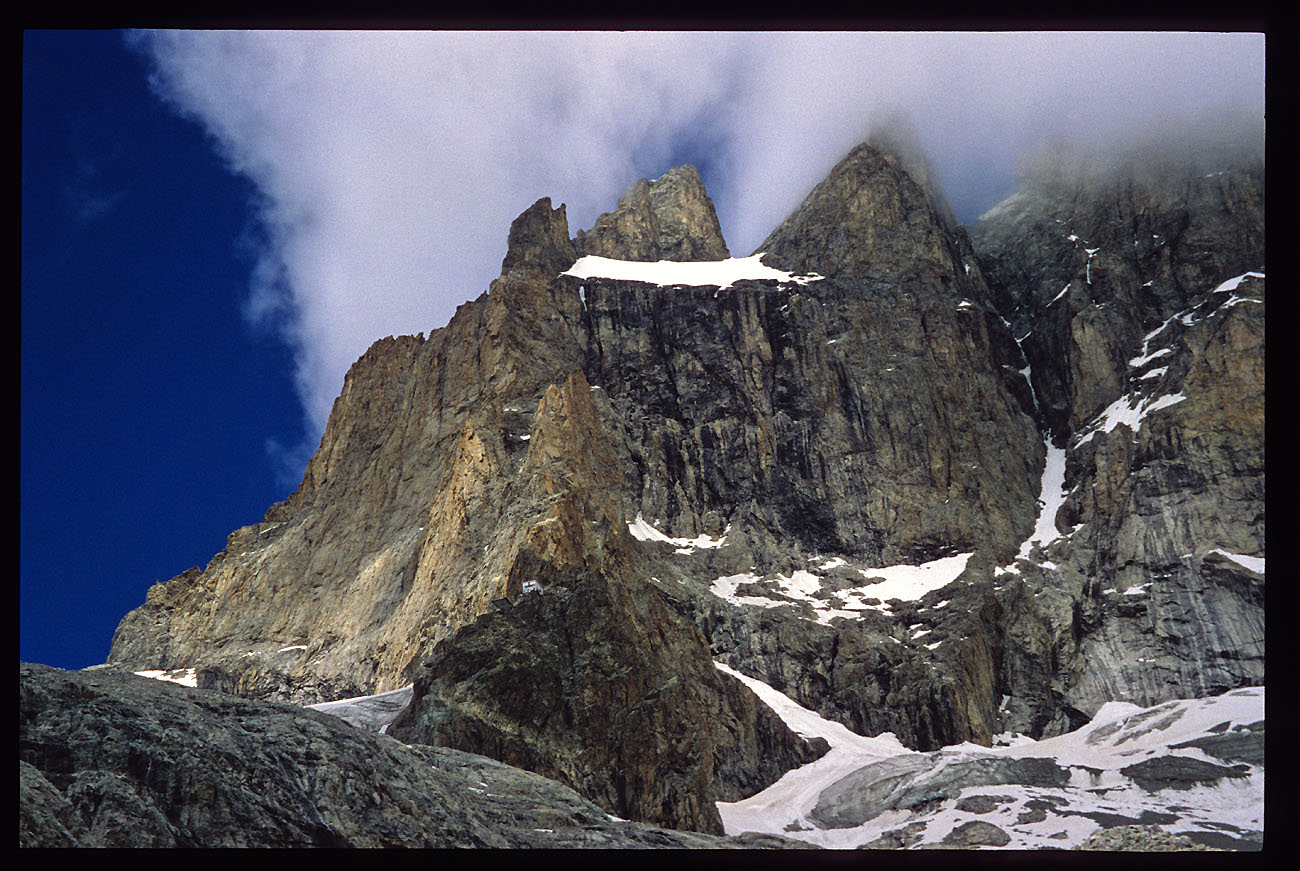
A stormy traverse of La Meije (3)

Concluded: Swiss guide Sam Brawand's account of an epic climb in the mid-1920s with alpinists Matsukata Saburō and Uramatsu Samitarō

What followed, I can hardly describe. As soon as I try to put it into words, it fades into a mere shadow of what we went through. It was as if all the mountain spirits of the Dauphiné and all the devils of hell fought a huge battle over La Meije that afternoon. For four hours, they shot yellow bolts around our heads, dozens of them.


With every flash of lightning, we felt as if somebody had put a giant match to our hair. I don’t mind saying that I ducked my head as deep and quickly into my collar as I could when the sulphurous blasts flashed by. You may object that, every time, I would have been too late to duck, but you try offering your head to lightning strikes for four hours and see if you don’t bat an eyelid. Well, we did flinch, and right often too. And how it thundered! Not pleasantly as on an evening in the Ochsental Hut, where the rolling and rumbling and reverberations go on for ever. Up here, it thundered without echo or reverberation, vicious, shrill, vindictive almost as the devil. It was as if the spirit of the Meije wanted to drive us off the ridge with a giant whip. And the storm howled on, and the snow lashed our faces. Where on this Gallic field would the wild hunt end?

There’s no way off the ridge on La Meije. To the south, the cliffs fall plumb-sheer, and it doesn’t look much better to the north. So all we could do was pull ourselves together and climb. We dealt with tower after tower. Now we’d got this mountain between our teeth, we were determined to hold on. I’ve seen some weather in the mountains since that day, but never again have I met with such a hellish storm, thank God. But even this one came to an end.

The lightning was now less frequent, and the last flash struck down just as Emil and Mr Uramatsu reached the summit of the Pic Central. The air smelt sulphurous. But how was it with our two friends? A moment ago, they’d just been standing there! I was speechless with worry. Anyway, shouting wouldn’t have been much use in that storm. We pressed on. And there they were, safe and sound. Emil was standing on the nearest rock ledge down from the summit. For Mr Uramatsu, the outcome was less comfortable. He’d rescued himself with a well-judged leap into the somewhat less steep north face, where he sat on a stone with his head down, like a goalkeeper waiting for the next shot. But this did not come.

Afternoon clouds from La Meije
We hurried down the last unpleasantly snowed-up rocks to a chimney, which we thought would lead to the way off the ridge towards the glacier. Once again, we fed the reserve rope into a sling and we swung over the bergschrund to the Glacier de Tabuchet, where we were finally sheltered from the cruel wind.

Our watches showed six minutes past four. Fog sat heavily on the glacier, so that we couldn’t see two meters ahead of us. It snowed and snowed. We’d left the Grand Pic on dry rock; now there were 20 centimetres of fresh snow on the glacier. Quickly, I scanned my mental map of the ground. On the right must be an icefall, and not far left of this was the hut, on the Rocher de l' Aigle.

We roped up quickly, leaving our reserve rope in place for the two Austrians. Where could they be? Now we trudged downhill into the thick of the fog. I kept right, intending to go left as soon as any sign of the icefall appeared and look for the hut. Then, lo and behold, the wind blew the fog aside for a moment and we could see, just 50 meters and slightly to our left, the outlines of some crags and a hut.

A warm feeling that we were home and dry suffused us. A few more steps and we would be able to shut the hut’s door on the cold and snow outside. Already I could hear the crackling of the fire, see the steaming teapots and feel the soft flannel of my dry shirt. And my pipe – I could sense it there in my pocket. Everything would be splendid, and surely we’d deserved it.

We stamped the snow off our boots and opened the hut door. And there, if you’ll pardon the expression, we saw our come-uppance. Not a strand of straw was left on the sleeping platform; all of it had obviously gone the way of all mortal things via the stove. There was no wood, and not a single blanket could be found.

So should we stay here? No, never! As we were already soaked to the skin, it wasn’t a difficult decision. We’d held out this far, and things couldn’t get any worse. So out we went again into the fog and snow. Down to La Grave, our final destination! But where to find the way? We went quickly down over the glacier and thought we could see an old track here and there. But then the glacier broke up with crevasses, while the fog lowered and the wet snow kept falling. We didn’t want to get lost on this unknown glacier and chose instead to continue our descent via a rock ridge on its right bank. So we worked our way downwards, lower and lower, over loose rock, ledges and gullies. At last, the fog lifted or rather we came out below it. To our great relief, we could now see the end of the glacier right below us. As quickly as we could, we trundled down the slope and could finally put the wet rope into a rucksack. Then we rushed down into the valley over snowed-up grass and screes. Snow had fallen until well below the level of the glacier tongue.

La Meije from the north
At half past eight, we arrived in La Grave. At the hotel we got rid of our dripping wet clothes and wrapped ourselves in blankets, tying them together with our braces like a monk’s cowl, and enjoyed a delicious victory feast in our clients’ room.

In the morning, La Meije shone white in the sunshine.

References

Translated from the original German text of Samuel Brawand (1898-2001), alpine guide of Grindelwald, Switzerland. As a guide, Brawand is best known for his first ascent of the Eiger’s Mittelegi Ridge in September 1921 together with Maki “Yūkō” Aritsune as his client. Originally entitled Stürmische Fahrt Zur Meije; the memoir was collected in the anthology Schweizer Bergführer erzählen (Stories from Swiss mountain guides), Orell Füssli, Zurich, 1950. Appropriately, the translator happened across this book at the remote SAC Grialetsch Hut during the annual geezers’ ski-tour.

Monday, July 2, 2018

A stormy traverse of La Meije (2)

Continued: Swiss guide Sam Brawand's account of a climb in the mid-1920s with Japanese alpinists Matsukata Saburō and Uramatsu Samitarō 

La Meije starts immediately. By that I mean, there is no long boring approach march; the climbing starts right behind the hut. And as the route was easy to find in broad daylight, we gained height quickly. We slanted into the Couloir Duhamel and after a short climb came up to where the pyramid must have stood. High above us the dreaded Grande Muraille rose into the sky. That must be the entry point.

The Doigt de Dieux, La Meije
(photo by Alpine Light & Structure)

As always, we climbed in two ropes and made rapid progress up the vertical wall. Emil Steuri took the lead with Mr Uramatsu on his rope, and his nose for route-finding did us proud on the Muraille. Hold by hold, move by move, he climbed higher, without looking around and seemingly without pausing for thought, as if he’d been there any number of times. Not a foothold was out of place, I’m quite sure of that.

Judging from the view into the airy depths, we must already have been at the Pas du Chat. Good heavens, that was climbing. Fritz Amatter once told me: "Look, there are holds, just as if God put them there for you to grab." Yes, there surely were holds. And when the holds are firm, on a wall that’s tremendously steep, and the climber is hanging off it or clinging to it over an abyss a hundred fathoms deep, then you get a wonderful sense of confidence in the mountain.

South face of La Meije
(photo by Alpine Light & Structure)

At 9.30 am we were at the Glacier Carré. We could scarcely believe how quickly we’d got up the Grande Muraille. After a quick bite to eat, we crossed the glacier and reached the loose rocks of the Grand Pic.

Only now did we notice that the weather had worsened again. Heavy clouds were rolling in from the west. Things started to get deucedly serious when a nearby roll of thunder punctuated the mountain stillness. What now? We had to get off the ridge. In the flank of the Grand Pic, under an overhang, we waited for something to happen. But we weren’t detained for long. We told ourselves that it was just a joke, and in the next few minutes we gambolled over the Cheval Rouge to the summit. By the time our watches showed 11.10, we were standing on top of this magnificent mountain. And this despite the half-hour we’d lost waiting down there in the rocks because of the dubious weather.

I don't remember how long we rested ourselves on the summit, but I do remember that suddenly over there, beyond the Brèche de la Meije, a searing lightning bolt struck down onto the Rateau, accompanied by a stupendous thunderclap. We hastily packed up. No one spoke a word. We were ready to go down. I had taken the reserve rope off my backpack, glanced over at my comrade Emil and spent the next minute or two pulling the rope through the abseil sling.

We both knew that, right then, it would have been wiser to turn back and give up on the traverse. But we were young and full of ambition, we had two excellent mountaineers with us, and we stood at the start of one of the most beautiful ridge-climbs of the whole Alps. Over there, however, the Pic Central raised his godly and admonishing finger.

Men must indeed atone for their sins. Our fall from grace would become a fact when we pulled down our abseil rope. From then on, there would be no turning back for the four of us.

I was already dangling over the Brèche Zsigmondy on the abseil rope. After my comrades followed me down, we pulled it down and fed it into the second abseil sling. Just as I was again hanging on the rope, snow began to fall, dry snow just as in winter. Then it struck me that we’d really blown it. In the Brèche Zsigmondy, a sharp southwest wind started driving the snow before it. Then the proper storm broke out as addressed ourselves to the Tour Zsigmondy.

How that wind whistled round our ears! The storm howled, flung the snow wildly in our faces and all but robbed us of our breath.

What followed, I can hardly tell ….

 (To be continued)

Sunday, June 10, 2018

A stormy traverse of La Meije (1)

By Samuel Brawand, mountain guide of Grindelwald: an account of a climb in the mid-1920s with the Japanese alpinists Matsukata Saburō and Uramatsu Samitarō 

A deep-blue sky arched over the mountain village of La Bérarde. We had slept wonderfully after the bumpy car ride and were now quickly getting together our food supplies in the hotel. We discovered only too soon that we had to do without our usual Swiss delicacies. All the same, it was possible to find the ingredients for a tolerable menu. Although Maggi soup is unknown here, and we only half-trusted the cheese.

Looking up to the Promontoire Hut on La Meije
(photo by Alpine Light & Structure)
At 10:45 am we left for the Promontoire. Our objective, the proud Meije, rose grandly up in front of us. Like a huge wall, it seals off the northern end of the Val des Étançons. I was to remember this sight when I later admired the Marmolada from the Kontin Valley. But La Meije is the mightier and more regal mountain. I could quite understand why even Edward Whymper thought it unclimbable and why the guide Almer tackled it from the Brèche, for who could have believed that the terrible wall below the Glacier Carré could be climbed?

Yes, yes, it’s easy enough to talk from today’s standpoint. That said, La Meije would certainly be a first ascent for us, in the sense that we were meeting her face to face for the first time. But we were climbing in the knowledge that others had gone before us, which halves the difficulty of even the toughest route. We can reach greater heights because we stand on the shoulders of our fathers, as Fischer once said.

We plucked out the highest-growing juniper shrubs and tied them onto our rucksacks as fuel. At our smart pace, we left the rocky expanse of the Val des Étançons behind us and stepped onto the Glacier des Étançons just below the Promontoire. A little later, at a quarter to four, we were at the door of the Promontoire hut. One last look at the massive mountain above us, and the hut door closed behind us.

Despite the dirt and the sparseness of the hut’s furnishings, we managed to cook a decent dinner. To eat it, we had to use all our aluminum tins as plates. But we didn’t let the poorly appointed hut put us out of sorts. On the contrary, our two clients enjoyed themselves enormously. Mr Matsukata loved such primitive conditions, and Mr Uramatsu made a joke of the notable lack of creature comforts.

In the morning, there was no need to look outside for the weather. The sound was all too familiar. Steady, continuous rain drummed on the tin roof. I don’t know if other mountain climbers feel the same way, but on mornings like this I’m always pulled in two directions. Part of me is only too happy with rain and bad weather: let’s go back to sleep, I say, it’s still so early! The other part of me is upset by thwarted plans, chafes about missing a glorious climb and the princely rewards of a summit. Depending on the planned ascent, one or other part prevails. I remember that the second part of me got the upper hand that morning. To have to give up La Meije because of this tiresome downpour, that was too much. So, gnashing our teeth like thunder, we turned over and thought of snowed-up ridges, cruddy summers and aborted climbs.

It was good for the hut that we had to stay there. A-sweeping and a-cleaning we went. Half an inch of dirt lay on the table, nay, cleaved to it. Behind the stove, the rubbish heap spilled almost out into the entrance passage. While Emil Steuri set to work, I boiled water and started scrubbing the table. I can still I see Emil’s mighty brush strokes driving this playground for bugs and fleas out of the door. Then we beat out the blankets, cleaned up the storeroom, washed the dishes, and after all this hard work, finally won back a cosy little room for ourselves. And, quite by the way, we suddenly found ourselves understanding why our dear wives go into a frenzy of cleaning every Saturday, and we both firmly resolved to keep our tempers when that periodic frenzy should next break out.

La Meije from Val des Étançons
(photo by Matsukata Saburō)
Around noon the sky brightened up and we decided on a little excursion to the Brèche de la Meije. Forty minutes later we were on top and rejoiced at the magnificent view. To the north, the village of La Grave lay deep down in the valley, and to the south and east stood the giants of the Dauphiné, mountain on mountain. Silver-white clouds chased round their heads. Closer to us, the rocks of La Meije towered up into the mightiest mountain of them all. We couldn’t quite get rid of the idea that, earlier in the day, she had intimated to us, frankly if without excessive politeness, that she was in no mood to receive visitors.

Emil and I made our observations for the ascent of the West Ridge, and I reckon that if we hadn’t had along with us two other people for whose lives we were responsible, we would have had the nerve to go on climbing, despite the late hour. We were capable of anything in those days.

In quarter of an hour, we were back down at the hut. It was a welcoming sight, so spick and span that one could almost smell the scent of Persil and soap.

In the meantime, some company had arrived. Two Austrians had arrived in the hut, without guides. Just at that moment, they were going through their gear: all the hut’s chairs were festooned with pitons, hammers, rope slings, carabiners and crampons. A glance at this exhibition was enough to suggest that they had designs on La Meije. But the main thing was that they were two decent young lads.

Next morning, instead of the rain drumming on the roof, the foehn wind was howling round it. At least this made a change from those tiresome showers. Now the better part of my nature was chafing at the bit: were we really going to waste that long drive-in and all that anticipation of this splendid mountain? But we knew to a dead cert that, once the foehn let up, snow would follow.

But, lo and behold, at dawn the sky brightened up. At 7.30 am, we were outside the hut, ready to leave.

(Continued)

Saturday, May 13, 2017

The making of a Meiji mountaineer (5)

Concluded: a translation of Kogure Ritarō's A talk about mountaineering

In this way, the people of a congregation would go on long pilgrimages to their special mountain for a week or more, or even several weeks. Thus, most of the notable mountains had already been climbed, except for those in a small part of what’s now known as the Japan Alps. But if there had been any indomitable monks like those pioneer mountain mystics of old, who tirelessly opened up new mountains and proselytised their faith, I can scarcely imagine that they would have left any mountain untracked. So this is a piece of good luck for us.

Climbing a snow valley at Harinoki, woodprint by Yoshida Hiroshi (1926)
The important thing to note is that most of these mountaineers were commoners. While the city-dwelling aristocracy and the literati were celebrating Mt Fuji simply as something to look at, the commoners were climbing mountains all over the place. Of course, the power of faith is part of the explanation, but one can’t help feeling that the vigour of this mass mountaineering movement and that commoners were organising group ascents from quite early times can be put down mainly to the fact that Japan’s mountains are easy to climb in the summer.

These mass ascents meant that there would be thousands or even tens of thousands of climbers, but except on their chosen route, the mountain wasn’t devastated. For example, when we had to relieve ourselves, we dug a hole, did our business on a sheet of paper, and tidied up afterwards; we were always extremely reluctant to desecrate the mountain. Standing on the top of Shirouma, I couldn’t help feeling sad at the way that beautiful sward was being trampled from end to end. As we keep climbing the mountains that our forebears opened for us, in new ways, and pass them on to the next generation, surely we should want to avoid passing them on in a shop-soiled state.

As my mountain-climbing evolved from such circumstances, it’s only natural that I can’t entirely escape my origins. So I wear Japanese garb over my straw sandals and leggings, don a rush mat against the rain, keep an oiled paper cape ready, hang my baggage from panniers, and wear a hat of cypress bark instead of a straw one. I’ve been told by Mr Fujiki that this makes me look like an itinerant swordsman of old, and indeed there could be some similarities, as this was the traditional garb for travelling. Of course, as a pilgrim, I didn’t carry a short sword or a fighting staff, but fortunately I was able to keep climbing mountains in this way up to the end of the Meiji years, without any accidents, and it was only when I first met the new city-dwelling type of climber, never having heard of such a thing, that I realised to my amazement just how many people like climbing mountains. And among those people are the founders and inaugural members of the Japanese Alpine Club.

Sunrise on Mt Fuji (Goraiko): woodprint by Yoshida Hiroshi

The downside of traditional mountaineering dress is when a storm hits. As you can’t put up an umbrella, all you can do is wrap it tightly in the straw mat and tough things out. I once got caught in this way while climbing Kaikoma from the Todai valley, and I still remember how we struggled to avoid succumbing to the cold. In those days, we’d stay the night at the summit, so as to enjoy the view of sunrise at leisure on the next day, as we felt safe sleeping on an open summit, even if it was colder, rather than camping in a gloomy wood. As for food, I sometimes walked carrying enough large balls of baked rice for three days, but I doubt if such tribulations can be imagined by anybody who hasn’t experienced them.

Well, I’ve rambled on for long enough with my talk, but if you’ve learned something from it about the way mountain-climbing was in those days, then I will consider myself more than amply rewarded.

References

This is a beta translation of a chapter (登山談義) from Mountain Memories (山の憶い出), as republished by Heibonsha in 1999 and edited by Ohmori Hisao. Kogure Ritarō (1873-1944) grew up in a mountain village where people still made regular pilgrimages to Mt Fuji and Ontake. He made his way via the new Meiji educational system to Tokyo, where he joined the Japanese Alpine Club a few years after it was founded, and later became its president. For more about the celebrated mountain meeting at Kirigamine in August 1935, see the introduction to One Hundred Mountains of Japan.

Friday, March 17, 2017

Putting Mt Fuji on the map

Who was the first Westerner to portray Japan's top mountain?

Some visitors to Japan are more productive than others. In a stay of just two years, the naturalist and physician Engelbert Kaempfer (1651-1716) catalogued the country’s flora, discovered that the ginkgo tree was far from extinct, as then believed in Europe, made two visits to Edo, and presented himself to the Shogun.

"Fusino Jamma: een zeer hooge en Zonderlinge Berg"
Detail from a map in Engelbert Kaempfer's History of Japan (High Dutch edition)

On his way to and from the capital, Kaempfer passed close by the foot of Japan’s top mountain. In his History of Japan, published posthumously in English in 1727, he lauds "The famous Mount Fuji in the province of Suruga, which in height can be compared only to Mount Tenerife in the Canaries". Fuji, he continues, "is conical in shape and so even and beautiful that one may easily call it the most beautiful mountain in the world .... The poets and painters of this country never end praising and portraying the beauty of this mountain".

Map of Suruga Bay, showing Mt Fuji (top right)
The German doctor never got the chance to make the first gaijin ascent of the iconic volcano, leaving that honour to Rutherford Alcock a century later. Instead, according to Professor H Byron Earhart (see References), he may have made its first graphic depiction by a Westerner. A sketch appears within an engraving of the Tōkaidō route through Suruga Province that illustrates his book. Interestingly, the summit region is shown as divided into three peaklets.

Mt Fuji: the traditional view
Japanese artists had long depicted the mountain with three peaks – as shown in a famous ink painting of Mt Fuji and the Seiken temple once attributed to Sesshū (1420-1506). Yet this configuration had less to do with ground truth than with an artistic convention, probably rooted in Buddhist numerology, that sacred mountains should have triple crowns. It seems fitting, somehow, that Kaempfer's pioneering image of Mt Fuji should pay homage to this centuries-old tradition.

References

H. Byron Earhart, Mount Fuji: Icon of Japan, University of South Carolina Press, 2011.

Map images: courtesy of the East Asian Library, University of California, Berkeley

Wednesday, March 15, 2017

The making of a Meiji mountaineer (4)

Continued: a translation of Kogure Ritarō's A talk about mountaineering

When they went unescorted by a sendatsu, one might think it would be quite problematic for these unversed pilgrims to make their way safely on unfamiliar mountains without maps, but the fact is that the way was well thought-out, the route was always the same, as were the stops for food and lodging, so that they would eventually reach their preacher as long as they followed this routine. Then too, there were at least three signs on each of the guesthouses that clustered around every post station, marking them as the lodgings for various congregations such as the New (一新講), the Original (故信講), the Reverent (崇敬講), the Divine Wind (神風講) and the Kantō Schools (関東講).


Avenue of cryptomeria trees: woodprint by Yoshida Hiroshi

As most of these names were used to show that the congregation so identified stayed here, the effect was somewhat provincial. For example, I seem to remember that the Divine Wind congregation came from the shrine of Ise, while the Reverents (Sūkei) were probably worshippers of Kompira. As for the New Congregation (whose name was also written as 一新講社), this was a widespread association of inn-keepers that was probably formed around 1881 or 1882, although I haven’t investigated the matter thoroughly. Anyway, there was at least one guesthouse with its sign at every post station.

A guide booklet, as issued by the New Congregation to its pilgrims

When staying at a guesthouse of the New Congregation, the landlord of the first lodgings would give a first-time traveller a booklet of about ten sheets of paper, of 3-5 size (about 9cm x 15cm). The cover was printed with the character for open (開) in white within a red circle, and the characters for the New Congregation (一新講社) below that. The landlord would write his name and stamp his seal in the book and give the traveller a letter of introduction to the next lodgings. Unlike one’s baggage, one would always keep the letter of introduction on one’s person, so that there would be no fear of dropping it or handing it to the wrong person on the way. The letter of introduction would say:-

此御客様御案内申上候に付御入宿相成候はゞ御大切に御取扱之段御願申上候以上

I’d like to introduce this guest to you; please look after them well during their stay.

or

此御客様御さし宿仕候間御着の砌には万事不都合無之様御取扱のほどねがひ候也

This guest stayed with us; when they arrive, please ensure they are well looked after and take good care of them.

Or, sometimes we were given a printed letter from the lodging house we were due to stay in next, and in that case there would be the following additional remarks:

私方より宿引差出不申若外宿引のもの旅人体になり私方を悪しく言ひ外宿をしんせつらしく御すゝめ申か又人力ひきも右様に申候共決て御取上なく御投宿冀望候也

We don’t send out touts. If touts from other lodgings pretend to be travellers and try to do you a favour by speaking ill of us and recommending another lodging house, or if rickshaw men say such things, please don’t listen to them and stay with us.

In this way, one could find the way to one’s destination quite easily, especially when travelling alone, and the letters were extremely valuable as a way of making a booking, as the custom was in the old days. Apart from showing the way between post stations, they had very useful maps to mark the sights and ancient monuments along the way.

Pages of a pilgrim's booklet, showing route and sketch maps

Of course, the paper and print quality of these booklets was poor, and the script would sometimes fade, leading to misunderstandings. In the booklet for the Nakasendo route to Kyoto that I got at the Tsutaya in Kiso-Fukushima, it said you could climb Kisokomagatake either from Agematsu or Nezame, and so I changed my plan to climb from Agematsu and saw the splendid sights of Nezame-no-toko before tackling Kisokomagatake on the following day. According to the map, there was a pond on the summit known as Tama-ike, but when I topped out I found only a hut and no pond. Then, when I found Nō-ga-ike, another pond, I thought this must certainly be Tama-ike and wrote it up as such in my account of the journey for my school magazine. Later, I was sorry to see that this passage was quoted, without much alteration, by Professor Yamasaki Naomasa in the Kisokomagake section of his Geography of Greater Japan.

However, after talking about this at the mountain meeting, when I got back to Tokyo, I found another booklet, which happened to have been issue in October, in which I saw that Tama-dake and Nowaka-ike were written side by side. As the characters other than “tama” and “ike” had been effaced in the notebook I originally looked at, it turned out that I’d carelessly confused this Tama-ike with Nō-ga-ike, so that I’m forced to redouble my apologies. However, in fact, it may be that the pond really was called “Nowaka-ike” because the katakanaワdoes not look as if the small stroke on top of that character (which would make it an ウ) had faded. Thus Nowaka-ike must be the correct name, which was later corrupted into Nō-ga-ike. The notebook also writes what seems to be the Kanekake Rock as Kanesashi Rock. So, if the current name is correct, then the notebook is mistaken. Even with the odd mistake like the one noted above, however, the notebooks were much more useful for people who rarely made journeys than today’s 1:200,000-scale maps.

Style of the well-dressed pilgrim
(Image courtesy of Kotobank)

Congregations like these were organised everywhere, not just in our village and, when on pilgrimage, the groups were led by experienced leaders. Interestingly, these leaders, the so-called sendatsu, often came from the lowest orders of society, and by some rigorous but unwritten agreement, as soon as a group came together, whether its members were rich or poor, and regardless of social status, every body was on an equal footing and the sendatsu’s word was law, so that to oppose it was unthinkable. Speaking of these arrangements, there could be no question of washing these precious garments, as the pilgrims’ white robes had received the inky stamp of each sacred mountain visited, so that one couldn’t help reeling back in disgust if one ever got into a carriage with them. Even in this age of the train, there must be quite a few people who have felt a bit faint if they’ve had the misfortune to be seated with such people.

The members of the congregation, except for the sendatsu, were allowed to wear their ordinary clothes while travelling to the mountain but, as soon as they reached it, they had to change into what we called gyō’i (行衣) or pilgrim’s garb. Even today you can see such scenes. Although this may be less true of congregations from the countryside, groups from the city tend to be fairly riotous and their sendatsu have lost the authority they used to have. So even if they don’t stink out their fellow passengers, they get on their nerves with their drinking and carousing. This is inevitable, as serious pilgrimages fade away, to be replaced with trips that have the atmosphere of a light-hearted mountain excursion. This is not to say that there wasn’t a pleasure-seeking element even in those mountain pilgrimages of old, once the pilgrims were away from the mountain, but the religious element has now greatly faded, leaving the pleasure-seeking to dominate.

Continued

Friday, February 3, 2017

The making of a Meiji mountaineer (3)

Continued: a translation of Kogure Ritarō's A talk about mountaineering

Later, in my high school days, I dragged quite a few friends with me to the mountains, doing my best to sell them on my own enthusiasms. As we were in Sendai, we went out one Saturday to Izumi-dake, a mountain nearly twelve hundred metres high about five leagues northwest of the city that is so ideal for weekend expeditions. We camped out for the night, then climbed to the summit on Sunday and looked out at all the mountains bordering Ōu province, before descending. In April, one could slide down a fairly long snowfield, but even though everyone agreed that this was fun at the time, only two or three of my companions decided they liked mountains and went on climbing them afterwards.

Pilgrims on Mt Fuji (Umagaeshi): woodprint by Yoshida Hiroshi
One of these, for some unknown reason, became a devotee of waterfalls, and so, one summer, he went out in search of waterfalls that I’d never heard of, such as Shōmyō, Hirayu and Hakusui, and as he walked along the Itoigawa highroad towards Matsumoto, he saw the high mountains of the Tateyama and Ushiro-Tateyama range and, discovering that quite a few of these mountains keep their snow into summer, he learned the peculiar names of some of them, such as North and South Goryū. When we met up back at the dormitory, and he asked if I know these mountains, I was embarrassed. So I asked if he’d actually climbed them, and when he admitted he hadn’t, I told him he had nothing to boast about then and felt somewhat relieved. As Shiga Shigetaka's Theory of the Japanese landscape hadn’t yet come out, there was no way of discussing the matter further.

The mountains in question may have been South Goryū or Kashimayari-ga-take. Later, I realised that I should have dug into the matter more thoroughly. But I had no way of knowing, as I had no detailed knowledge of the place. This man later caught a lung infection and died on the island of Hachijōjima just last year. After this episode, my first mountain friend was Tanabe Jūji, who was originally a devotee of the sea but, as everybody knows, has since achieved great things in the mountaineering world.

At the end of the day, the reason that the friends who originally came with me to the mountains didn’t end up as mountain aficionados is that they found the effort of climbing too much of a grind. If you can’t appreciate mountains while accepting the grind of climbing, then it’s only natural that you’ll fall by the wayside. Although we ourselves are apt to say that a climb was more strenuous than amusing, mountaineering gives us so many interesting experiences that we’d never dream of giving it up. But thirty-five or six years ago, people didn’t think like that. Now that mountaineering has parted from religion, and has become a mere hobby, people have lost their motivation to improve their skills, no matter what their potential, in line with the trend of the times. I can’t help being amazed how far “fashion”, if I may be permitted to use the word, holds sway over people.

Speaking of fashion, I can’t deny that the “fashion” (if that is the right word) for mountain pilgrimages in my village helped to attract me towards mountaineering. Every year in August, in the slack season, congregations of twenty or thirty people would set off from Mt Fuji or Ontake or Hakkai-san, while smaller groups of three, four or five people, or just individuals, would seek out more distant places, such as the Three Sacred Mountains of Dewa, Ōmine in Yamato province, or Osore-zan in the Nambu region.

Misty morning at Nikko: woodprint by Yoshida Hiroshi
Closer to home were Mitsumine, Kōshin and Nantai. Of course, this was mountaineering for a religious end, so people’s knowledge of these mountains was rather sketchy, and they were only vaguely aware of whether a mountain was high or low, or how many passages were rigged with chains and so on. For instance, if you asked people who’d climbed Ontake if there were any high mountains nearby, you’d likely hear that there weren’t, except that Mt Fuji looked fairly high. So I was gobsmacked when I later climbed Ontake for myself and saw Kisokoma-ga-take, Norikura and other high peaks staring me in the face.

Even so, when the congregations came back, handed their thank-you gifts and souvenirs round the village, and spent half a leisurely day telling their travellers’ tales, there is no doubt that these mountain mysteries, wrapped round in strange legends, held my attention and made my eyes bulge with amazement, stoking both my fascination with mountains and my desire to climb them, whether I was aware of it or not. I can see myself sitting there, a shaven-headed lad, snotty nosed, mouth agape, listening for all I was worth to the loud voice of the man telling the tale, right by me, in a tea-house, served with pickled plums, or candied red-pickled ginger, or stuff like that.

(Continued)

Thursday, January 26, 2017

The making of a Meiji mountaineer (2)

Continued: a translation of Kogure Ritarō's A talk about mountaineering

In those days, farming villages weren’t distressed as they are today; they were very peaceful places, bustling with people, women too, and in our hill country – although what we spoke of as “mountains” included flat ground with forests and dry fields – we used to go out collecting bracken in spring and mushrooms in autumn. I enjoyed these forays too, although rather more the mountain-climbing than the bracken-harvesting or mushroom-picking. It was probably then that I caught the mountaineering bug.

Village near Mt Fuji: woodprint by Yoshida Hiroshi
The lure of high places is also felt in our childhood tree-climbing; perhaps everyone has felt this. In a small way, it’s how an adventurous, aspiring spirit expresses itself. In his Theory of the Japanese landscape, by way of introducing the charms of mountaineering, Shiga Shigetaka writes how he once climbed up to a high tower and describes how he felt looking down at the people going back and forth below. Although, if it’s a sense of superiority you’re looking for, I’d say that climbing a tree always beats going up to a second-floor window, as I’m sure you’d agree, and this is probably because the second floor is not enough to satisfy an adventurous, aspiring spirit.

We used to vie with each other in climbing trees on the way home from school. Once I clambered about a hundred feet up a sawtooth oak, and, when I looked down, I saw how small my friends had shrunk to tiny heads with their arms poking out from them, as if their heads were walking by themselves. Then I felt dizzy, and I was too afraid to climb down, so that I had to be rescued by a grown-up. In mountaineering terms, you could say I’d got myself into a pickle.

But I am straying from the subject; the first mountain I ever climbed was Akagi. When I was six, my grandmother took me along to Yu-no-sawa, where she was going to take the waters but, as I don’t remember much except being frightened by stories of tengu, being surprised at the lake on the mountain, and ice being carried away from an icehouse, I doubt if this contributed much to my later love of mountains.

Then, at the age of thirteen, I climbed Mt Fuji. Today, when a nine-year old girl has climbed the mountain and a youngster of eleven can brag about having scaled Ko-Yari, this may not sound particularly novel, but in those days it was almost beyond imagining. There were adherents to both the Fuji faith and the Ontake faith in my village and, as our family belonged to an Ontake congregation, I normally wouldn’t have been allowed to climb the other sect’s Mt Fuji before I’d had the chance to climb Ontake for the first time. But it turned out that another boy of my age was going up Mt Fuji, and I was so envious and made such a fuss that the sendatsu, the Mt Fuji guide, made an exception for me as I was just a child and let me tag along.

Pilgrims on Mt Fuji: woodprint by Yoshida Hiroshi
The Fuji congregation in my village had the strange custom of ritually drinking water along the way. Whereas the Ontake congregations made ablutions in water, the Fuji ones drank it. As to how this custom arose, all the old folks have passed away, and now we have no way of knowing. We drank one cup of water on the first day, two on the second day, and so on until we got up to five cups on the day we started on the mountain from Fuji-Yoshida. Since we drank the water after breakfast, just before starting out every day, this was quite an effort. We’d try to eat breakfast as early as possible so that we could take our time getting ready. The guide had a wooden bowl with a lanyard hanging from his belt. The aluminium canteens that we use today may owe something to this practice. Anyway, the bowl held about eight measures of water, so about five bowlfuls meant four gō (almost a litre), and we’d drink that off in one swig, and we used to practise this water-drinking before setting out.

As on Ontake pilgrimages, one wasn’t allowed to circumambulate Mt Fuji’s crater on one’s first visit, but I managed to persuade the guide to let me do so, as I was only a child and so it wouldn’t count as a transgression. What I remember fairly well from this trip is the crowds in the mountain huts pressing in on me, eating mochi as the other food was so dreadful, and drinking delicious sweet sake. My memories of the mountain itself have faded to a blur. But the fine mid-August weather held, so that the views were good and you could take in the surrounding mountains with one sweep of the eye. Among them, I remember recognising Akagi when it was pointed out to me, and being delighted when I saw the sea for the first time ever. Also I remember being shocked when I realised that the simple skyline that I saw from my village was, in reality, a much more complicated affair.

What I took away from my Mt Fuji trip was quite simple; that mountain-climbing was very much for me. That is to say, I thought that climbing to high places was for me; it was only much later that I learned to appreciate the true joys of mountaineering. I might grumble that, if only I’d found a proper mentor and undergone the right training, I would have made something of myself as a mountaineer. Anyway, I did discover, by luck more than judgment, that mountaineering was the best way of satisfying that youthful spirit of curiosity and adventure, and that was a feat in itself.

(Continued)