Showing posts with label art. Show all posts

Wednesday, March 22, 2023

Legends from the Alps

Review: an exhibition at the Swiss National Museum shows that folk tales have propagated themselves far beyond the alpine valleys

Loose scree and steep snow are the least of your problems if you want to cross over to Alp Blengias, an almost deserted valley in the Swiss canton of Graubünden. On a bad day, when the clouds scud low over the ridges, you might also encounter, guarding the pass, a phantom rider on a ghostly palfrey. Just one glimpse, they say, will seal the doom of any wayfarer unlucky enough to meet him. Bearing this tale in mind, I chose a fine day for the traverse but still I wondered - what if ...

"Sennentuntschi" figurine from the Calancatal, Grisons
Photo: Swiss National Museum

If you need to know what kind of supernatural terrors you might face in the mountains, then you might want to take in “Sagen aus den Alpen” (Legends from the Alps), the current exhibition at the Swiss National Museum in Zurich. It is guaranteed to send a chill down your spine.

“This exhibition contains photos which may not be suitable for children,” says a sign posted at the entrance. Nor are the curators kidding. A crude doll in a showcase (see image above) is enough to give anybody nightmares. Carved by nameless cowherds on a high pasture in the Calancatal, an obscure corner of Graubünden – that canton again – it almost thrums with a voodoo vibe.

The folktale underlying this exhibit recalls the legend of Pygamalion – the classical sculptor who carved a statue so exquisite that it came to life. But while Ovid’s rendering of this metamorphosis ends happily, the alpine version takes a much darker turn.

The Sennentuntschi comes to life: from the 1972 stage play
Photo: Swiss National Museum

Having fashioned a "Tuntschi" out of wood, rags and straw on their lonely alp, the cowherds ("Sennen") treat it like a companion. They speak to her, and some even – as the exhibit’s label euphemistically puts it – “abuse her”. When the creature comes to life, she seems at first to put up with her lot. But when the time comes for the cows to be driven back down to the valley, the Tuntschi exacts a terrible revenge …

In the 1970s, the Basel author Hansjörg Schneider turned the ”Sennentuntschi”story  into a successful stage play. But, when aired in 1981, the television version caused an outcry among Switzerland’s more conservative viewers. A so-called Action Committee for Customs and Morals filed a lawsuit against the television company, getting as far as Zurich’s district court before they were forced to desist.

Legends from Graubünden, we surmise, are apt to take a particularly sombre and moralistic turn. The ghostly rider of Blengias is typical of the genre: the protagonist, after cheating his brother out of an inheritance, was condemned to roam eternally in the guise of an equestrian ghost. But the Grey Leagues have no monopoly on alpine gloom.

Witches making weather, woodcut by Michael Greyff, 1489
Photo: Swiss National Museum

Whether or not related to the Sennentuntschi, witches are another of the exhibition’s themes. (Could it be that misogyny is a bit of a thing here?) A broadsheet (below) reports on how three “Hexen” were burned at the stake in 1555 at Derneberg, a locus safely far away from today’s Zurich in both time and space (Lower Saxony). Yet it was just down the road, in Fribourg, and as late as 1731, that a Swiss community most recently turned an alleged witch to ashes.


Books too could be consigned to the flames. For good or ill, legends have enormous staying power. William Tell is a case in point. Although the folk hero is supposed to have inspired the founding of what became the Swiss confederation, in 1291, there is no trace of him in historical records from that time. Yet, when a scholar pointed out in 1760 that the Tell legend bore a suspicious resemblance to a traditional Danish saga, the people of Altdorf publicly incinerated a French edition of his work.
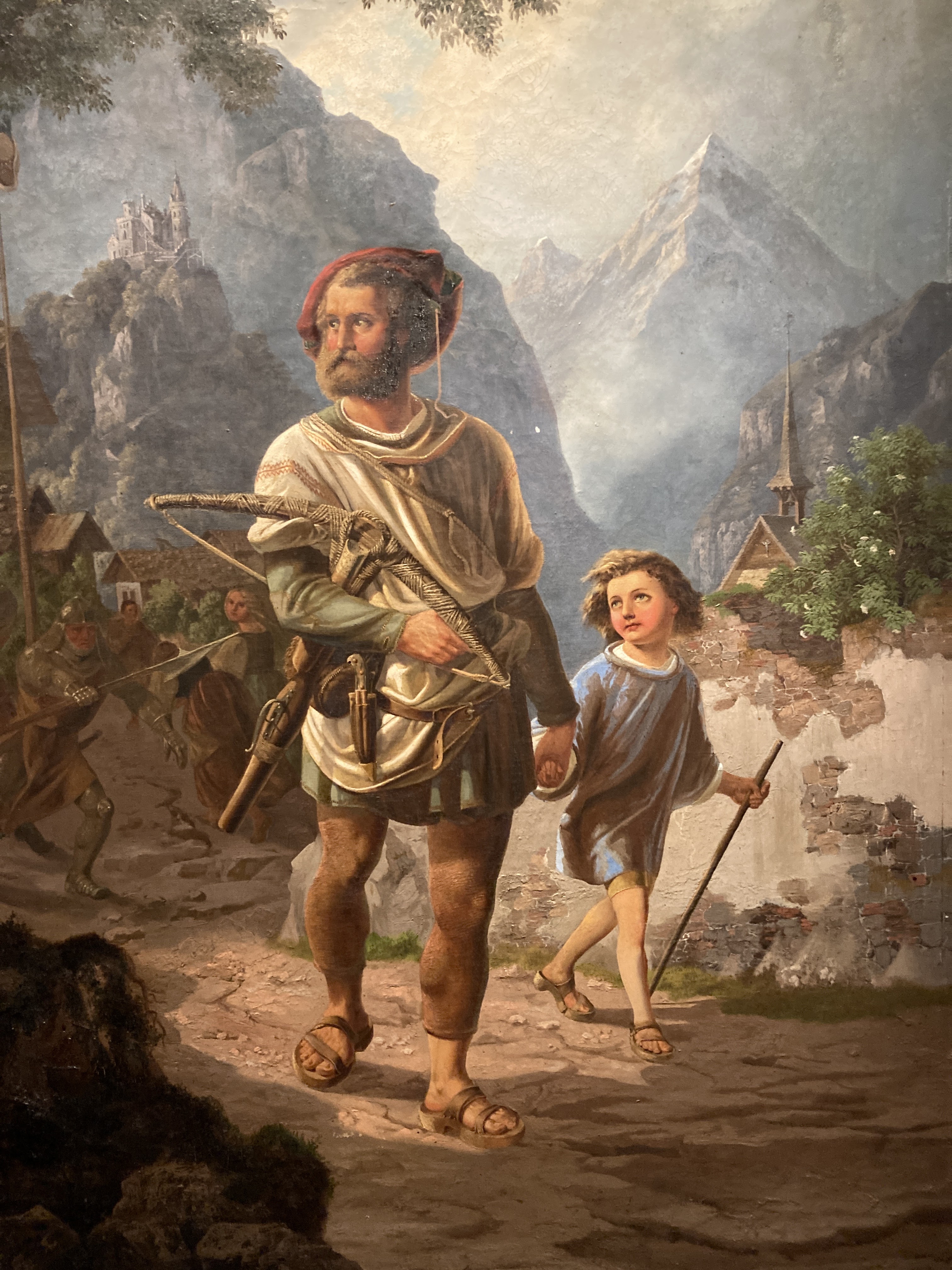
William Tell, as depicted (post-Schiller) by Heinrich Jenny in 1868
Photo: Swiss National Museum

Being outed as a fable did nothing to harm William Tell’s literary afterlife. After Friedrich Schiller dramatised him in 1804, the Tell story went global – there is even a Tagalog version of Schiller’s play.

You could argue that the “Toggeli” has had a similar export success. According to the exhibition’s blurb, this is a spirit that “usually visits through the night, forcing its way through cracks or knotholes to settle on a sleeper’s chest. It weighs sleepers down or throttles them, and causes them to have nightmares.”

Toggeli in action, illustration by Melchior Annen/Peter Balzers, 1908
Photo: Swiss National Museum

It was surely a Toggeli that the Zurich-born artist Henry Fuseli (1741-1825) depicted in his painting “The nightmare” (1781), which shows an incubus crouched on a woman’s chest. Mary Shelley was sufficiently impressed to have fashioned a scene after it in her Frankenstein novel. And Fuseli’s style, if not the picture itself, is said to have inspired the poet and painter William Blake. When it comes to the supernatural, the exhibition suggests, what starts in the Alps might well not stop there.

Fuseli's Nightmare, 1781
(Wikipedia)

Up on the pass to Alp Blengias, I'm happy to say, no phantom rider was lying in wait. Grassy slopes led down into a valley completely deserted, according to the map, except for a single alp hut. Approaching this dwelling, it seemed that somebody had planted beside it a gnarled piece of wood. Or perhaps it was a crudely fashioned statue that, from a distance, looked convincingly like slim human figure standing on one leg, arms raised in the classical yoga pose. Then, as I came closer, the figure started to move….

You know, even on a fine summer day in the Alps, you sometimes get to see the strangest sights.

Sagen aus den Alpen, an exhibition at the Swiss National Museum in Zurich, runs from 16 December 2022 to 23 April 2023.

References

Peter Egloff, Pygmalion forever!, Blog zur Schweizer Geschichte, Swiss National Museum

Leo Tuor, Giacumbert Nau: Bemerkungen zu seinem Leben, Roman, Limmat Verlag, 2014.

Also of reference: 

Sandra Marschner, Sennentuntschi sorgt in Thun für Diskussionen, Blick, 10 September 2025.

Monday, August 31, 2020

Mountain heritage

A Swiss exhibition celebrates the creative legacy of an alpinistic family

Centenaries are there to be commemorated. Some century-old stories by the Swiss alpinist and author Charles Gos have recently appeared in translation on this blog. Meanwhile, an exhibition at his home town in Switzerland is now celebrating the artistic oeuvre of the entire Gos dynasty. “Les Gos: une montagne en héritage” opened at the Médiathèque Valais at Martigny in June and runs until 16 January next year.

Pictures at an exhibition

On a rainy August afternoon, we are welcomed into the exhibition by larger-than-life portraits of a talented quartet. These show Albert Gos (1852-1942), the mountain painter and his three sons, François Gos (1880-1975), the eldest and likewise a painter, Charles Gos (1885-1949), the writer, and Emile Gos (1888-1969), the photographer who made the very portraits we are looking at.

The Gos family

All four men loomed large over the alpine culture of their time. As we turn into the exhibition, an expansive panorama by Albert meets our eyes.

Landscape by Albert Gos

He learned his craft between 1870 and 1872 at the Geneva School of Art under Barthélemy Menn (1815-1893), who introduced the principles of plein-air painting into Swiss art.

Albert Gos en plein air

After absorbing that teaching, Albert Gos ran with it. Preferring to paint in the open air, he left the school before graduating. He concentrated on painting mountains, particularly in the Bernese Oberland and the Valais Alps.

Importantly, he could make a decent living with these works. This mattered even more after 1878, when he married Jeanne Monnerat. François, the first of five children, arrived two years later (there were also two daughters). The couple settled first in Geneva before moving to Clarens, a village near Montreux.

The Matterhorm painter

During his most productive decade, the last of the 19th century, Albert was justifiably known as the “Matterhorn artist”. Indeed, one of these paintings features in Charles Gos’s story “Gladys”.

Landscape by Francois Gos

A painting by François Gos hangs close to his father’s work. Modest in scale, its style is a touch more modern than Albert's, as if the artist had imbibed at the same sources as Félix Vallotton (1865-1925). François studied for five years at the Geneva School of Arts and Crafts and at the city’s art academy before, like Vallotton, moving to Paris. Unlike Vallotton, however, Emil had to work in a factory as a decorative artist.

Poster by Francois Gos

On returning to Switzerland, he gave drawing lessons in Clarens. In 1910, he settled in Munich, and later spent three years in Holland before returning to Geneva, making a living with illustration, sculpture and writing, as well as painting. Travel posters were a forte. In 1913, he helped to start up an art school in Lausanne. Like his father, he showed a predilection for the mountain world, both as a climber and a painter.

Charles Gos, alpinist and author

Charles Gos, after studying in Lausanne and Paris, established himself as an author and journalist, focusing on military affairs and alpinism – mostly the latter in his short stories and novels: Pres des névès et des glaciers (1912), La croix du Cervin (1919), Propos d'un alpiniste (1922), Alpinisme anecdotique (1934), and Solitude montagnarde (1943).

In 1918, he married Edmée de Coulon, who died in 1930. In 1934, he took over the management of the mountain books department at the Victor Attinger publishing house in Neuchâtel. He remarried in 1947, and a son was born two years later.

Mountain photography by Emil Gos

The Gos brothers climbed at a high standard, often without guides. Charles Gos knew everybody in the world of alpinism, from the local guides to the prominent climbers who visited the Alps from abroad. He was elected a member of the Alpine Club in 1935, and once secured a half-hour audience with the “climbing pope”, Pius XI. And this without the benefit of a Catholic upbringing - the Gos family came from a sternly Protestant background.

For his part, the youngest son, Emile Gos, completed an apprenticeship as a photographer in Montreux, in the workshop of Rodolphe Schlemmer (1878-1972). He continued his training in German-speaking Switzerland, in Paris, Munich and London before moving back to Clarens and later starting his own studio in Lausanne. In 1939, he married Claire André, who gave him two children.


Making a living with studio portraits and newspaper photography, he left a more durable legacy in landscape and mountain photography – sampled in the exhibition by a compelling slide show of his medium-format images.


In 1922, he filmed his brother Charles’s short story about the Matterhorn cross (“La Croix du Cervin”). This was one of the first films to be shot in the high mountains. Alas, only fragments of the original footage have survived.


Filming La Croix du Cervin

On the way out, we pick up a copy of the well-produced brochure that accompanies the exhibition (CHF 20, including both French and German versions of the text, with photos).


An article by the art historian Maéva Besse points out that, in its day, the Gos family was by no means unique in passing the torch of mountain culture from father to son. On their own doorstep, there were the Töpffers and the van Muydens of Geneva, whose artistic productions spanned two generations. And, over in Chamonix, the Tairraz and Gay-Couttet clans presided for even longer in the world of mountain photography.

Even so, the truly golden age of the mountain artist may have ended with the first world war. From the biographical sketches given in the exhibition brochure, one surmises that François and Emil Gos had to scrabble harder than their father to eke out a living from mountain art.

Writer with a saturnine streak?

As for Charles, his fiction dwells frequently on human fallibility and the dark side of mountaineering, even while recreating the glittering social and alpinistic scenes of the belle époque. And one non-fiction work concerns itself entirely with mountain accidents. This might signify no more than a saturnine streak in the author's personality. Or was he oppressed by a sense that the civilisation he grew up in, and its genial ways of living, were sliding into the abyss, never to be retrieved?

References

Exposition: Les Gos: une montagne en héritage, Médiathèque Valais - Martigny, Av. de la Gare 15, 1920 Martigny, Suisse.

Website of the Gos family: Une famille d'artistes

Friday, March 17, 2017

Putting Mt Fuji on the map

Who was the first Westerner to portray Japan's top mountain?

Some visitors to Japan are more productive than others. In a stay of just two years, the naturalist and physician Engelbert Kaempfer (1651-1716) catalogued the country’s flora, discovered that the ginkgo tree was far from extinct, as then believed in Europe, made two visits to Edo, and presented himself to the Shogun.

"Fusino Jamma: een zeer hooge en Zonderlinge Berg"
Detail from a map in Engelbert Kaempfer's History of Japan (High Dutch edition)

On his way to and from the capital, Kaempfer passed close by the foot of Japan’s top mountain. In his History of Japan, published posthumously in English in 1727, he lauds "The famous Mount Fuji in the province of Suruga, which in height can be compared only to Mount Tenerife in the Canaries". Fuji, he continues, "is conical in shape and so even and beautiful that one may easily call it the most beautiful mountain in the world .... The poets and painters of this country never end praising and portraying the beauty of this mountain".

Map of Suruga Bay, showing Mt Fuji (top right)
The German doctor never got the chance to make the first gaijin ascent of the iconic volcano, leaving that honour to Rutherford Alcock a century later. Instead, according to Professor H Byron Earhart (see References), he may have made its first graphic depiction by a Westerner. A sketch appears within an engraving of the Tōkaidō route through Suruga Province that illustrates his book. Interestingly, the summit region is shown as divided into three peaklets.

Mt Fuji: the traditional view
Japanese artists had long depicted the mountain with three peaks – as shown in a famous ink painting of Mt Fuji and the Seiken temple once attributed to Sesshū (1420-1506). Yet this configuration had less to do with ground truth than with an artistic convention, probably rooted in Buddhist numerology, that sacred mountains should have triple crowns. It seems fitting, somehow, that Kaempfer's pioneering image of Mt Fuji should pay homage to this centuries-old tradition.

References

H. Byron Earhart, Mount Fuji: Icon of Japan, University of South Carolina Press, 2011.

Map images: courtesy of the East Asian Library, University of California, Berkeley

Friday, February 27, 2015

Meizan inspirations

How Japan's most famous mountain erupted into an Impressionist painting

As it was the Sensei’s birthday, we dropped in at Japanese Inspirations, a new exhibition at the Zurich Kunsthaus. If you happen to be an aspirant meizanologist, you meet Meizan everywhere. So it was no surprise to find Mt Fuji featuring in several landscapes by Hokusai and Hiroshige. The idea behind the exhibition is to highlight how these artists of the floating world influenced the Impressionists, by placing their prints side by side with paintings by Monet, Gauguin, van Gogh and others.


Some of the prints had once been in the personal collection of Vincent van Gogh. An enthusiastic fan of Hokusai and Hiroshige, the artist owned about 400 Japanese prints in all, papering the wall of his studio with them. As if in homage to the master, he even made oil painting renditions of two scenes by Hiroshige (above). The attraction of Japanese woodprints is explained in a letter to his brother:

I envy the Japanese artists for the incredible neat clarity which all their works have. It is never boring and you never get the impression that they work in a hurry. It is as simple as breathing; they draw a figure with a couple of strokes with such unfailing easiness as if it were as easy as buttoning one's waist coat.

Seeing these prints made me wonder what part Japan's top mountain played in van Gogh’s artistic development. He knew Hokusai’s famous views of Mt Fuji, urging his long-suffering brother in a letter of August 1888 to “take (ie buy) the Hokusais as well then, 300 views of the sacred mountain and scenes of manners and customs”. And he greatly admired The Great Wave, one of Hokusai’s Thirty-Six Views of Mt Fuji, commenting on it in another letter to his brother the same year:-

When Paul Mantz saw Delacroix’s violent and exalted sketch, Christ’s boat, at the exhibition that we saw in the Champs-Elysées, he turned away from it and cried out in his article, ‘I did not know that one could be so terrifying with blue and green’. Hokusai makes you cry out the same thing — but in his case with his lines, his drawing, since in your letter you say to yourself: these waves are claws, the boat is caught in them, you can feel it.


As any art historian will tell you, those waves with claws have crashed with resistless force into van Gogh’s Starry Night, painted less than a year after he wrote the letter quoted above. Mt Fuji itself, alas, seems to have been washed away in the process, unless you discern it, subtly transmogrified into that church steeple or those mountains in the picture’s background.


Unfortunately, the Starry Night wasn’t in this exhibition: quite understandably, the New York Museum of Modern Art wouldn't be keen to let the painting out of its sight.

So, navigating through shoals of banquiers and their lamé-clad dames – this is Zurich, remember – we had a quick look round to see if Japan’s most famous mountain had left its mark on any other works by the Dutch master.

Standing in front of the Portrait of Père Tanguy (left), I thought that perhaps we’d struck lucky. The background to this painting shows a selection of Japanese prints, pinned to the wall of van Gogh’s studio, and there, right behind the subject’s hat, was a tell-tale shape  – conical in form, yet maddeningly indistinct.

One couldn’t be certain; the white blur might be the snowy profile of Japan’s most famous mountain. Or, then again, it might just be a cone of sherbert.

It turns out, though, that van Gogh painted three versions of this portrait - Père Tanguy was a figure of some importance to impecunious artists, kindly providing them with paint in return for a drawing or two. The picture shown in Zurich was the second version. But the final one (right), which today hangs in the Musée Rodin, Paris, shows Mt Fuji with dramatic clarity.

It’s as if, after years of absorbing the lessons of his Japanese mentors, van Gogh had finally gained total confidence in the power of line and colour. And, with it, the painterly panache to give the top Meizan its full due.

Monday, January 9, 2012

Purple mountains

The painter who joined the pioneers of Japan’s golden age of alpine exploration

“Except for some literary society, I know of no other association that has more poets and writers than ours,” said Kojima Usui about the Sangaku-kai, soon after he founded Japan’s first alpine club. Perhaps he should have mentioned painters too. There was at least one in the Sangaku-kai. Nakamura Seitaro joined the club just two years after its inauguration. That was in 1907, the same year that he started as a student of the Tokyo Institute for Business Training (商法講習所|), the predecessor of today's Hitotsubashi University.

Nakamura was born in 1888, the only son of a couple who ran a shop selling yukata. He got his first training as an artist by practising the patterns used to dye the linen. While still at school, he organised a group of friends to go hill-walking. Joining the Sangaku-kai would allow him to tackle bigger mountains and perhaps even find new ways up them.


For Nakamura was fortunate enough to start his climbing career during Japan's “golden age” of mountain exploration, when mountaineers had to find their own way without the help of modern maps. In 1909, he joined Kojima on a traverse of the Southern Japan Alps. Unable to splurge on expensive foreign kit, Nakamura got a local smithy to bash out an alpenstock. This may have been Japan’s first domestically produced ice tool.

Atop Warusawadake the party discovered that pilgrims had been there before them. Recorded in the club’s journal, Sangaku, the incident was later quoted in Nihon Hyakumeizan (“One Hundred Mountains of Japan”):

On the summit, they found signs that others had been there before them. Three shrines of unvarnished wood stood there and a rusted iron banner leaned into a rocky niche. And nearby, the pilgrims had left scattered on the ground wooden tablets inscribed with the name of the deity Arakawa Daimyōjin.


In the late autumn of 1911, Nakamura climbed Saru-ga-dake (2,629m), shod in newfangled crampons (at that time, they were still called “kana-kanjiki” – iron snowshoes). This was the first time that a peak in the Southern Alps had been tackled in winter conditions.

In 1913, he joined Kogure Ritaro and Tanabe Jūji for part of their epoch-making traverse from Yarigatake in central Honshu all the way northwards to the Japan Sea. In 1917, he climbed volcanoes on Java and the Celebes and in 1919 he again teamed up with Kogure for an exploration of the Kurobe valley – they got as far as Ike-no-daira in Sen'nin-dani before porter troubles and lack of food forced them to cut short the trip.

Although Nakamura had already decided to become an artist, he left his painting materials at home for these youthful expeditions. From now on, though, he went into the mountains specifically to paint and his works started to appear in exhibitions and in the pages of Sangaku. In 1936, he founded the Japan Association for Mountain Art and exhibited seven paintings at its inaugural exhibition, including one of summer snow on Tateyama (below). He died in 1967, at the age of 79.

Inevitably for a Sangaku-kai member, Nakamura was also a writer. Perhaps inspired by that youthful encounter with pilgrims’ relics on Warusawadake, he published three books on Japan’s mountain religions. Dealing as they did with the mystic aspect of the mountain world, these studies were of a piece with his paintings. The unexplored mountains of his golden age were “vast, mysterious, sublime”, Nakamura wrote, “as if wrapped in some purple cloud, enshrined in the inner recesses of my heart”.

References

“Yama to Bijutsu” chapter in Hito wa naze yama ni noboru no ka?, Volume 103 in the Taiyo Bessatsu: Nihon no Kokoro series (Heibonsha, 1998).

Quotation from Nihon Hyakumeizan from the forthcoming translation as One Hundred Mountains of Japan.

Images of Nakamura's paintings are by courtesy of this website. Paintings show (from top to bottom) the snowfield on Yarigatake; glacial corries on Tateyama; a study of a creeping pine (haimatsu); summer snow on Tateyama, and an edelweiss.