Showing posts with label women. Show all posts

Sunday, September 28, 2025

"Enjoy tackling difficult tasks" (2)

Continued: how Nakamura Teru paved the way to winter climbing and economic independence for women.

In the hardscrabble years after the war’s end, Nakamura translated school textbooks for the occupying forces, and also worked as an interpreter for a US Army court. In 1949, she became a legal and political advisor for the Kantо̄ Civil Affairs Division, but soon resigned. As Japan’s economy revived, the business world was again beckoning.

Nakamura Teru (l.) leads a women's expedition to New Zealand in 1961.
Image from the interview by Ogura Nobuko (in the driver's seat).
 
In the early 1950s, she joined LaBelle, Japan’s first lingerie manufacturer. Soon afterwards, her eye was caught by a magazine article about a fashion institute that was part of the City University of New York. Writing directly to the course directors, she was accepted for a six-month management course but “became so engrossed” that she ended up studying sales promotion and design as well, spending two years abroad. “I think my husband's understanding made that possible,” she later said 

After returning to Japan, she became a fashion advisor and designer for three companies, and also started her own company, Duchess, to sell lingerie of her own design. 

On the summit of Mt Sealy in 1961.
Image from the interview by Ogura Nobuko.

And she kept climbing. Sometimes, she was the first woman to climb certain Japanese peaks. In 1961 (aged 57), she led an all-women's expedition to New Zealand, comprising mainly “old girls” of the Waseda University Mountaineering Club. Over about five months, the five women climbed Mounts Sealy and Walter in the South Island, as well as Egmont and Ruapehu in the North Island. They were warmly welcomed, and played a role in promoting goodwill between the Japanese and Kiwi mountaineering communities.

On the summit of Mt Damfool in 1961.
Image from the interview by Ogura Nobuko.

In 1970, Nakamura’s husband Nobuhiko passed away from cancer. Deeply affected by her loss, she was also involved in a traffic accident. “However, after recovering, I began to live life positively again,” she later recalled. In 1979 (at 75 years old), she went trekking in Nepal for three months, and after returning to Japan, published a book explaining how anybody could follow her example. In 1988, now aged 84, she was an advisor to an expedition to the Indian Himalaya but, starting to feel her limitations, decided it was time to give up mountaineering. 

Visiting Ed Hillary in New Zealand, 1961.

The following year, in 1989, she accepted an offer to take care of Japanese exchange students in Adelaide, sold her house in Hayama and moved to Australia alone. After living there for 10 years, she returned to Japan in 1999 and died in 2009 at the age of 104.

One March, a few years before Nakamura passed away, two of her climbing companions from the New Zealand trip came to visit her at her care home in Yokosuka. One of them, Ogura Nobuko, later wrote up Nakamura’s reminiscences in an online interview on which this post has heavily relied. This is how Ogura-san concludes: 

In late March, when we heard that the cherry blossoms were blooming earlier than usual, I met with Tо̄ya Keiko, a member of our group, at Zushi Station … We talked with Nakamura-san in the lounge on the third floor. For a 101-year-old, her eyesight, hearing, and mental acuity were all excellent, and I could sense the dignified spirit of someone who had lived life so positively. Even now, she enjoys flower arranging and calligraphy, and she reads English and Japanese newspapers every day. She is interested in social issues and cares about young people these days. In the early Showa era, amidst societal discrimination against women, she learned English, became a successful professional woman, and climbed mountains despite various hardships, paving the way as a pioneer in many fields. She was a remarkably calm and quiet person, yet possessed an incredible vitality that seemed to be hidden within her. During the visit, [those of us] who had been with her on the New Zealand expedition, shared our memories. We mentioned how she had been a strict but supportive mentor, pushing us to become truly international figures … It was a day that truly reinforced her constant messages: "Enjoy tackling difficult tasks, because anyone can do easy ones," and "If you truly want to do something, you can usually accomplish it." 

References

Kawasaki Yoshimitsu, Yama to Keikoku illustrated history of Japanese mountaineering (目で見る日本登山史), Yama to Keikoku-sha, 2005. 

Miyashita Keizо̄, Nihon Arupusu: Mitate no Bunkashi, Misuzu Shobо̄, 1997.

Ogura Nobuko,* “元気に100歳 本気でやれば、何でもできる 101歳の人生記録”, downloaded April 2016. 

*Ogura Nobuko (b. 1932) was a member of the New Zealand expedition led by Nakamura Teru in 1961. In her student days, she was a member of the Waseda University Mountaineering Club – the first woman ever to join the much-storied association. In 1975, inspired perhaps by Nakamura’s example, she founded a mountaineering club, the Shiran-kai (“purple orchid society”), primarily for women in their 60s and 70s. The club’s premise is that hiking keeps you young. To that end – and to provide mental stimulation – Shirankai members take it in turns to organize and lead hikes. “Once you have this experience, you naturally develop empathy and consideration for others, as well as independence and judgment skills,” Ogura-san says. 

More about the Shiran-kai (Japanese language)


Tuesday, September 23, 2025

"Enjoy tackling difficult tasks” (1)

How Nakamura Teru paved the way to winter climbing and economic independence for women.

But how could we have forgotten Nakamura Teru? In Yamakei’s illustrated history of Japanese mountaineering, there she stands, flanked by two companions, every bit as tall and confident as the president of Japan’s first climbing club for women should be. The photo was probably taken a few years after she made her name as the first woman to scale Mt Fuji in mid-winter.

Nakamura Teru (centre) at the Iwabara ski resort, early Showa era.
Image by courtesy of the Yamakei illustrated history of Japanese mountaineering. 

She topped out on Japan’s highest mountain on New Year’s Day in the second year of Shо̄wa (1927), after starting from Gotemba on the previous day. As was her usual practice in the mountains, she climbed not with men friends – which she thought improper – but escorted by a professional guide and “gо̄riki” (porters). On the party’s return, journalists were waiting for her at the mountain’s foot.

Nakamura Teru and her guides at a shrine before climbing Mt Fuji.
Image by courtesy of the Yamakei illustrated history of Japanese mountaineering. 

The year of her Fuji climb helps to explain why Nakamura’s achievements might be missed, at least in a too casual sweep of Japan’s mountaineering history. Her climbing days came a decade or so after those of the Taishо̄-era “otenba” (tomboys) yet too soon to profit from the social freedoms gained by the post-war generations. So she was born too late to be a mountain pioneer, like Murai Yoneko, but too early to be a Himalayan mama-san, on the lines of Tabei Junko.

But she did pave the way towards economic independence for women. Indeed, she had little choice in the matter. After Teru was born in 1904 in Yūbari, Hokkaido, her father’s mining business failed and her mother moved the family first to Kitakata in Fukushima, where Teru started primary school, and then Tokyo. Since they got no financial support from Nakamura’s father, her mother started a small boarding house while making kimonos, helped by her daughter after school hours.

Nevertheless, Teru managed to start learning English at an early age – unusual in those days – and later attended a typing school to learn English typing. These skills led to a job with a trading company, where her salary soon exceeded that of a university graduate. After work, she went to the Young Women’s Christian Association (YWCA) to learn English shorthand. She also became a Christian around this time. Later she moved to the Ford Motor Company subsidiary in Japan, where she worked for almost a decade and a half.

Nakamura Teru at Matsumoto station after a ski trip.
Image by courtesy of the Yamakei illustrated history of Japanese mountaineering. 

Nakamura started mountaineering in the early 1920s, and climbed Mt Fuji when she was 22. The following year, she went back and made her famous winter ascent. As she said in an interview much later:

Anyone can climb Mt Fuji in the summer, but I really wanted to challenge myself by climbing it in winter. If I want to do something, I can't hold back; I immediately think, "Let's try it, whether I can do it or not!" Winter mountaineering is a battle against the snow. More important than reaching the summit is dedicating yourself wholeheartedly to the mountain itself. Because I was the first woman to do it, I gained a lot of attention, and even received an offer from a film company.

Climbing with guides and porters would take Nakamura only so far. In 1931, she helped to found what was probably Japan’s first mountaineering club for women, the Tokyo YMCA Sangaku-kai. After a decade in which the club typically carried out two or three long traverses in the northern or southern Japan Alps every year, the club formally ceased to exist during the second world war. But its former members continued to meet up for many years afterwards.

Members of the YMCA mountaineering club on Kaikoma in 1932.
Image by courtesy of the Yamakei illustrated history of Japanese mountaineering. 

As for Nakamura herself, she kept on climbing in winter – and writing about it too. The cultural historian Miyashita Keizо̄ quotes from an article she wrote for the mountaineering magazine Tozan to Ski in 1933 about a trip to the Ushiro-Tateyama range:

I sometimes gain a sense of peace even from the bitter north wind that whirls up the powder snow and buffets my body, just as if it were a zephyr from Botticelli. For what better raiment can the mountains have than snow. Like Eloise’s wedding robe, snow evokes a sense of solitude, while in the moonlight it recalls the chilly beauty of Ophelia's winter weeds.

At the age of 33 Nakamura donned a wedding robe herself, changing her name to Satо̄, and leaving her job at Ford Japan. “I married relatively late, but that was because I loved my job and due to family circumstances,” she said in a post-war interview. Her husband’s work took them to Pusan in Korea yet Teru’s English skills were not left to languish – at one point during the war, she was asked to work as a spy....

Friday, April 25, 2025

A meizanologist's diary (101)


22 March: the early Kagayaki sweeps us past a snowy Mt Asama and into town by midmorning. 


At 11am, we climb the stone steps to the temple of Gokokuji in Bunkyō-ku, walk past the main hall into the cemetery and find a small group of friends in front of the monument to Nonaka Itaru and Chiyoko – whose bold attempt to overwinter on the summit of Mt Fuji in 1895 paved the way for a permanent weather station there.


Falling from a clear blue sky, the spring sunlight brings out every lineament in the gravestone’s bronze relief. 


Garbed in their parkas lined with Russian fur, the young couple look every bit as resolute as they did in October 1895, when settling in for their two-month ordeal atop Japan’s highest mountain.


Laconic as it is, the plaque under the bronze relief explains why we are here. Itaru passed away at the age of eighty-seven in February 1955. So we are paying our respects just a few weeks after his seventieth anniversary. Our group comprises members of the “Fuyō Nikki no Kai”, a study association dedicated to researching the Nonakas’ story.

The Nonaka Observatory of 1895.
Illustration from Itaru's brochure of 1900.

Over the past few years, many more details of that history have come to light. Most fictional accounts of Itaru’s project – particularly the novel by Nitta Jirō and any films based on it – end with the couple’s  rescue from their blizzard-wracked hut on Mt Fuji in late December 1895.

For Itaru, however, this was merely a beginning. While Chiyoko was publishing her Fuyō Nikki (Journal of the Lotus), a lively account of the couple’s mountaintop experiences, Itaru started work on a series of articles for Chigaku Zasshi, a geographical journal, explaining his scientific aims and setting out his weather observations. These were published in the second half of 1896.

And then he went back to Mt Fuji, climbing to the summit in three consecutive summers, those of 1896, 1897 and 1898. His aim was to scope out the site for a bigger and better weather station – one that would house a large enough team to support year-round weather observations.

Design for a new Mt Fuji weather station.
From Itaru's brochure of 1900.

The best place for a new observatory, Itaru decided, would not be on Ken-ga-mine, the highest summit on which he’d built his first small hut, but on a flat part of Mt Fuji’s crater rim at a place called Higashi Yasugawara. Lingering geothermal heat there might also help to heat the hut.

But who was going to pay for all this? In 1899, Itaru founded a fund-raising association and in February the following year came out with an 18-page prospectus for the new weather station.

Alas, the funds were slow to come in but this didn’t daunt Itaru. In 1909, at his own expense, he had a spacious villa built at Takigahara at Mt Fuji’s southern foot, as a base for further work on the mountain. And in 1912, with financial help from a prince of the realm, he set up a storehouse on the crater rim, exactly where he had suggested siting his new improved weather station.

The cover of Itaru's brochure of 1900.

By this time, a new generation of meteorologists had taken up the cause of a permanent weather station on Mt Fuji. Preparations were delayed by the world war and even more by the 1923 earthquake, which destroyed the Takigahara villa. In February of the same year, Itaru had to endure the loss of Chiyoko, who succumbed to a flu epidemic.

And so it wasn’t until 1932 that the professional weathermen were firmly established at the new government-funded summit observatory. The following summer, Itaru paid them a visit, accompanied by his daughter Kyōko, who of all their children most resembled Chiyoko.


After taking a group picture, we move on under the flowering cherry trees to look in at the great mausoleum dedicated to the great statesman Ōkuma Shigenobu (1838–1922) - Ōkuma too, it seems, was not immune to the lure of exploration, having helped in his latter years to raise funds for the Antarctic explorer Shirase Nobu.


As a meeting is scheduled at the offices of the non-profit organisation that has revived the buildings of the Mt Fuji weather station, we have to move on. But not before climbing the “Otowa Fuji” that sits at one corner of Gokokuji’s precincts. Although everybody present is of pensionable age, we seize the chance to revisit the summit of Mt Fuji, even if it has to be a miniaturised one…


Friday, October 11, 2024

Pints, potions and glasses (1)

A three-part disquisition, in which we celebrate the Golden Age of drinking and mountaineering.

Nobody who reads Peaks, Passes, and Glaciers, a collection of the earliest effusions "by Members of the Alpine Club", can fail to be impressed by their capacity. Not just for adventure – so much can be taken for granted in the protagonists of this heroic era – but for their consumption of alcoholic beverages. Yes, you read that right: drinking while climbing was more than merely acceptable; in those days, it was de rigueur.


For this was the true golden age of alcoholic alpinism. Strictly speaking, of course, the term “Golden Age” refers not to the potations but only to the pioneering climbs between Alfred Wills’s ascent of the Wetterhorn in 1854 and Edward Whymper’s conquest of the Matterhorn in 1865 – the phrase was coined by the controversial W A B Coolidge, an Oxford don-turned-mountaineer who doubtless enjoyed his port at High Table.

Yet alcohol stood at the very heart of this alpinistic enterprise. Paging through the inaugural volume of Peaks, Passes, and Glaciers (1859), for example, we find a “W. Mathews, Jun.” gearing up at a village in the Val de Bagnes for an attempt on the Graffeineire, or Grand Combin:

Our next step was to settle the commissariat for the three days’ march. We took six loaves of bread, a quantity of excellent cold chamois, a piece of cheese, chocolate, sugar, and ten bottles of sour white wine. Wine is always a heavy and troublesome thing to carry, but it is not easy to dispense with it, and I have always found a mixture of wine, snow, and sugar a very refreshing beverage at great altitudes. Simond was greatly dissatisfied that there was no vin rouge; “ Le vin blanc,” said he, “coupe toujours les jambes” – a result which happily we did not experience.

Now William Mathews (1828–1901) was not just any old toper. He too was at the very heart of the enterprise, having first proposed the formation of an Alpine Club in a letter to a climbing colleague in February 1857, the year after his bibulous investigations in the Val de Bagnes.

The Finsteraarhorn from the southeast
Illustration from Peaks, Passes, and Glaciers

Matters moved along during an ascent of the “Finster Aarhorn” in August 1857 by William Mathews, his cousin St John Mathews, John Ellis, E S Kennedy and J F Hardy – who wrote up the trip for Peaks, Passes, and Glaciers, not omitting details of the commissariat:

We woke on August 12th to find the clouds all swept away, and as brilliant a morning as we could desire. In the highest spirits we ate a hearty breakfast, and then descended to the kitchen to arrange about provisions. Wine in abundance, one bottle of brandy, afterwards rashly increased to two, roast mutton, roast veal, ham, sausage, cheese, bread, figs and raisins, were put together, one after the other, till the pile looked big enough to feed an army, and the corresponding arithmetic amounted to seventy-four francs. Later in the morning the guides expressed a desire for “noch ein wenig Brod und Fleisch,” and the result of our consenting to this request was that the bill was increased to 114 francs, whence I presume that the word “wenig” does not exactly correspond to our English “little”, nor do I think it would have been a difficult matter to prove, from the character of the additions which were actually made to our store, that the phrase “Brod und Fleisch” includes things potable as well as things edible.

The supernumerary bottle of spirits soon took the anticipated toll on the least reliable of the party’s guides:

He had already, in my opinion, had more cognac than was good for him, but being somewhat flustered by our objurgations, he now drew frequent and copious draughts from the dangerous flask.

Leaving two of the guides behind on a col, the party reached the summit at 11.53 – the first to do so for sixteen years – and celebrated their triumph appropriately:

A very small modicum of brandy tempered with snow was then administered to each (wine would have been better, but it would not have been possible to carry a sufficient quantity through the final climb), and we sat down to enjoy the magnificent scene around us.

In fact, they did more than enjoy the scenery, for it was during this same expedition that Mathews and his friends resolved to form what was to become the world’s first Alpine Club. And we may depend upon it that the fateful decision was adequately lubricated.

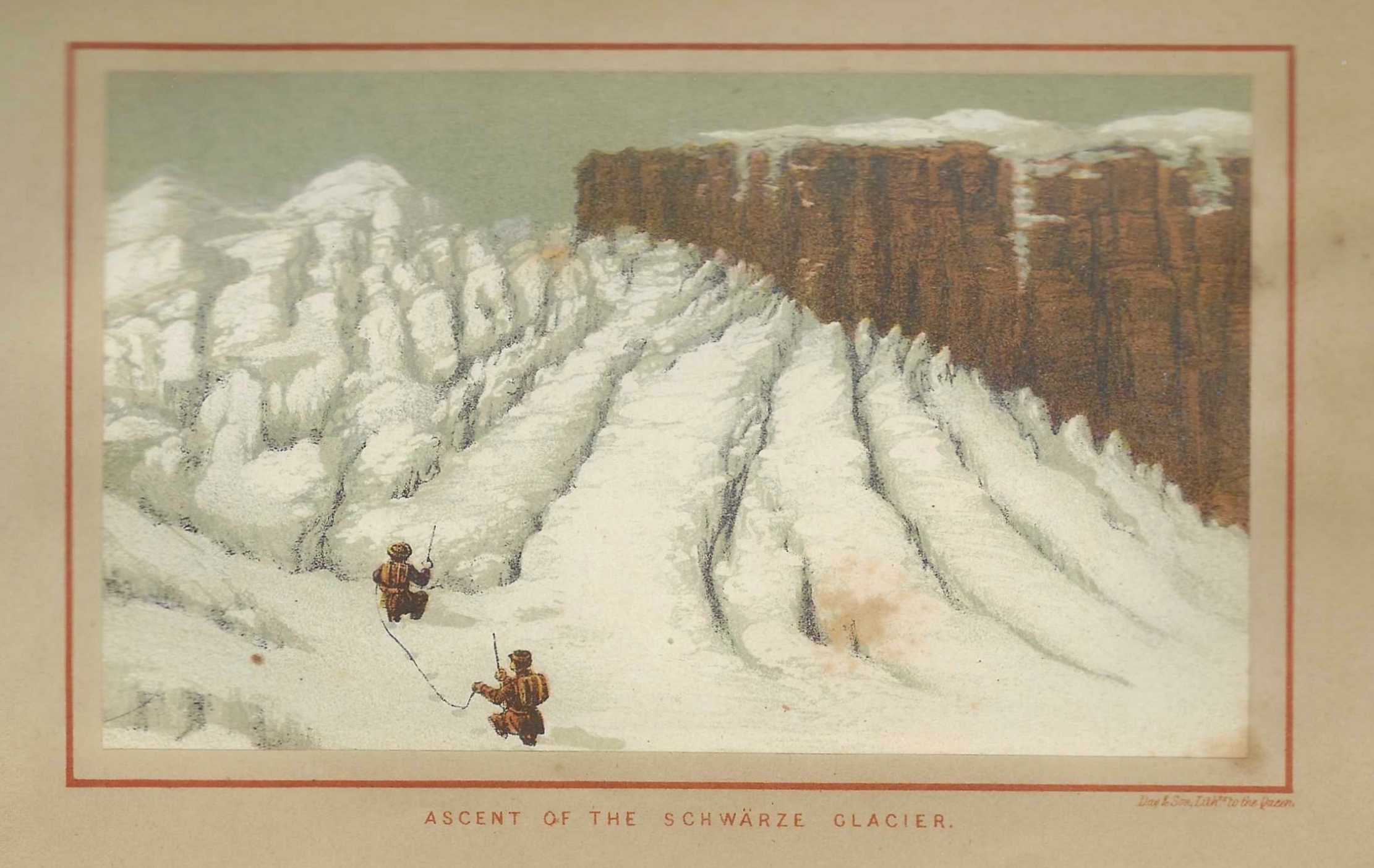
Ascent of the "Schwarze Glacier"
Illustration from Peaks, Passes, and Glaciers

During the following autumn, ad hoc gatherings ensued at Mathews's house near Birmingham, leading to the founding of the Alpine Club itself on 22 December 1857 at a dinner meeting chaired by E S Kennedy. If only we still had the wine list from that illustrious occasion at Ashley’s Hotel in London….

Now steady on, I hear you objurgate, the Alpine Clubbists were by no means the first to bring beverages into the mountains. And this one must concede. And while we’re at it, let us dispel any inference that such drinking was just a guy thing: when Henriette d’Angeville (1794–1871) climbed Mont Blanc in 1838, one of the first women to do so, her commissariat included “18 bouteilles de vin de St. Jean, 1 bouteille d’eau-de-vie de Cognac, 1 bouteille de sirop de capillaire, 1 baril de vin ordinaire.”

A view of Mont Blanc from the Jardin
Illustration from Peaks, Passes, and Glaciers

Then there was Albert Smith (1816–1860), the impresario who put on a show about Mont Blanc in London that ran for 2,000 performances over six years. The script was inspired by his ascent of the mountain in 1851 when, between them, his four guides and twenty porters had to carry sixty bottles of vin ordinaire, six of Bordeaux, ten of St George, fifteen of St Jean, three of cognac and two of champagne, to say nothing of other liquid refreshments supplied by the Hôtel de Londres at Chamonix.

After all, nobody in their right mind would drink the local water in those days. And, while we’d now buy our beers and wines at an alpine hut, those Golden Age pioneers had to carry up all their victuals to some high-mountain cowshed or bivouac à la belle étoile

(Next: the risks attendant on alcoholic alpinism are acknowledged)

Saturday, September 28, 2024

“A light grey felt hat is cool”

What ladies wear in the mountains: some hints from a hundred years ago

We raise our chapeau to Elise Wortley, who recently attempted Mont Blanc (4,805.59m) in period dress. Aiming to highlight women adventurers who achieved astonishing feats, Wortley started the climb in a bonnet, tweed dress and hobnailed boots, as worn by Henriette d’Angeville, who made the ascent in 1838. You can read more about Wortley’s venture on her own website or in her Financial Times article (subscription may be required).

"When climbing, the skirt ... must be looped up"
Illustration from the Badminton Library, Mountaineering


Just in case this retro vibe should catch on, we reproduce below the advice given on a “Climbing outfit for ladies” in the Badminton Library volume on Mountaineering, first published in 1892 and reprinted in 1901. The book was compiled by Clinton Thomas Dent, a medical man whose climbs included a first ascent of the Grande Aiguille du Dru. As a footnote reveals, though, he wisely deferred to “Mrs Jackson, Mrs Main and Miss Richardson” for the views set out here:

Women who climb should, like men, dress in such a manner that they are protected from extremes of either heat or cold. Every garment should be of wool, and the softer and lighter the material the better. The only exception to this latter point should be the skirt, and this will be found most serviceable if made of cloth, rough in texture and as thick as the wearer can get, provided it is not clumsy. A closely woven tweed is suitable. A small check pattern mends neatly if torn. Grey or brown are the most suitable colours for a climbing skirt; blue soon shows the marks of dust or stains. The skirt should be a plain walking skirt of an ordinary length, the broad hem turned outwards and with a deep border of stitching. Three yards round the hem will be found a good width for a skirt. A mackintosh bordering to the skirt is quite useless.

Mrs Main (née Elizabeth Hawkins-Whitshed) models a mountain skirt
Image courtesy of Women's Museum of Ireland

The pockets should be large and in definite places, one on either side and one at the back. They should be outside and flaps to button down. Two or more buttons are desirable on each flap, so that nothing may slip out when sleeping in huts. A small waterproof pocket in the skirt by the band is useful for carrying the bank notes current in Austria and Italy. The other pockets should be lined with sateen, and one can covered with mackintosh. When climbing the skirt must, whatever its length, be looped up, and therefore it is easy to have a skirt which, in the valleys or towns, does not look conspicuous. For looping up the skirt, the following simple plan is effective. An extra belt of strong ribbon is put on over the skirt, which is then pinned to it in fish-wife style. The length is arranged according to the requirements of the occasion. One safety: pin attaching the two sides and another fastening the back, the hem being pinned on to the outer belt, do the work. The safety pins, however, are apt to drag and tear the skirt. An equally good method of shortening the skirt is by an arrangement of loops and buttons. Strong tapes are well stitched up each seam inside the skirt, and also up the middle and back widths: each tape carries a large bone button and two tape loops not too low down. The tape gives more hold for the buttons, and prevents any of the material being torn out.

A rough cloth coat lined throughout with silk may taken in case of cold. A fairly thick Shetland shawl has many uses. It is very light and warm. Tied over the head in cold or windy weather, or in a hut at night, it is a great comfort.

Mrs Main in midwinter, probably on Piz Palu c.1898

The knickerbockers should be made of tweed, the band being lined with flannel or other woollen material. The tweed should match the skirt, and will then be found suitable either when worn, as formerly, under it, or, following the practice occasionally adopted, worn without the skirt, the latter being taken off before beginning the climb.

The bodice is an important part of the outfit, A soft grey flannel blouse, high in the neck, long in the sleeves, and loose, is the best for both heat and cold. The bodice should have breast pockets, one of them being suitable for carrying a watch.

A light grey felt hat is cool. A knitted helmet,which can be pulled over the whole head and face, the eyes only being uncovered, is a necessity in very cold weather. A large silk handkerchief is useful to tie the hat on in a high wind.

Mrs Main sets out on a winter expedition.
Image from True Tales of Mountain Adventure

Woollen stockings (one pair on, another pair in the knapsack), thick, watertight, nailed mountain boots, and cloth gaiter to button or to pull on in the Chamonix style (hooks and laces are apt to catch in a skirt are all essential. Putties, or spats and putties combined, are much to be recommended. Gloves should invariably be of wool, and of the shape worn by babies, the fingers being enclosed in a bag, and the thumb only having a separate casing. Let the gloves come well up the arms, and have at the very least two pairs with you on an expedition. A large safety hook and eye in each pair will enable them to be hung from the waist belt. A very fine woollen mask to protect the face is much pleasanter to wear than one of linen.

Lady alpinist and guide, c. 1906
Image from True Tales of Mountain Adventure

A more extensive outfit is required on a tour when access is not to be had to heavy luggage for several days. The climber may have to spend a few nights in the more civilised of the Alpine centres, or perhaps twelve hours may even be passed in such places as Geneva or Turin. It is necessary to be provided against such contingencies, and if a little thought and trouble are given to the matter, neither the weight nor the bulk of the extra garments necessary need be great.

Silk (only to be worn when not climbing) can be substituted for wool for the under-clothing, of which two complete changes are desirable, not including what is worn. A dark blue or grey silk blouse can be worn with the climbing skirt in the evenings, and a small dark felt hat, which will fold flat, and a pair of gants de suède will help to do away with the stamp of the climber. Leather soles, without any heel whatsoever, put to a pair of neat black laced shoes, will pack flat and take up very little room. The whole weight of the bundle (which can be tied up in a large silk handkerchief) need not exceed 4 1/2 Ibs., including such essentials as soap, a comb, pocket-handkerchiefs, and other small things which the experience of each climber will suggest.

References

C T Dent and other writers, The Badminton Library: Mountaineering, London and Bombay: Longmans, Green and Co, third edition, 1901. 

Mrs Aubrey Le Blond (also known as Mrs Main, Elizabeth Hawkins-Whitshed), True Tales of Mountain Adventure, London: T Fisher Unwin, 1906. 

You may also like: Alpine apparel in early modern Japan and Was Walter Weston a gear freak?

Sunday, March 10, 2024

Indomitable

Sorry this is a bit late for International Women’s Day. Then again, Nicole Niquille really deserves a day to herself. An interview in the latest edition of the Swiss Alpine Club’s bimonthly magazine brings us up to date with her story. 


Back in the 1980s, Niquille was one of Switzerland’s top alpinists – notice that the phrase isn’t “top female alpinists”. She went to K2 in 1985 and Everest in 1986, qualifying as a mountain guide, the first Swiss woman to do so, in the same year. “There was no feminist motive, I just wanted to live in the mountains,” she is quoted as saying in the interview.

Eight years later, on a Sunday evening in May 1994, her life changed forever. While she was picking mushrooms just a few hundred metres from her house, a falling stone hit her on the head. When she woke up in hospital, she was a paraplegic. 

During the next two years, she had to relearn everything, from speaking to moving her fingers and limbs. Despite all her efforts, she could not learn to walk again. Yet the mountains continue to give her strength: "When I freeze at night and can't pull up the blanket, I think of the nights in the airy tent on K2." 

“You never accept your disability, but you have to live with it,” Niquille says. Living with it meant, in this case, opening “Chez Nicole”, a mountain hostelry which she has run since 1997 with her husband Marco on the banks of Lac de Taney at an altitude of 1,408 metres. 

The restaurant led, in turn, to her next project. One of her kitchen helpers, a Nepalese Sherpa, told her about her sister Pasang Lhamu Sherpa. In April 1993, Pasang was the first Nepali woman to reach the summit of Everest, but lost her life while descending. 

Deciding to get involved, Niquille set up a foundation and invested 100,000 francs of her disability capital in building a hospital at Lukla, the starting point for treks to the Everest region. Opening its doors in 2005, the hospital runs on funds raised by Niquille’s foundation, about 450,000 francs annually.

Without the accident, Niquille says, she “would have led a different life and the hospital in Lukla would not exist”. For herself, she has no regrets: “There is no happiness or unhappiness in life, only people with different life stories,” she says. 

And even if she were to be offered the use of her legs again, she would accept this only every other day. “That way I would really appreciate them and I would know exactly what I had to do on the days I was able to walk.”

References

«J’ai dû trouver une utilité à ma chaise pour pouvoir l’accepter» Rencontre avec Nicole Niquille, interview by Martine Brocard in Les Alpes/Die Alpen, the bimonthly journal of the Swiss Alpine Club, edition 1/2024.

Thursday, February 23, 2023

Chiyoko’s centennial

The Tokyo-based Fuyō Nikki Society yesterday published a blog post to mark the 100th anniversary of Nonaka Chiyoko, The Fuyō Nikki no kai is named after the travel diary in which Chiyoko recorded the epic sojourn that she and her husband Itaru made on the summit of Mt Fuji during the winter of 1895, while they took weather observations. She died a century ago on 22 February 1923, during a flu epidemic, at the age of 53. 

Nonaka Chiyoko in 1914, at the age of 43

The couple held out on the summit for almost three months, surviving both blizzards and beri-beri, a deficiency disease. As they eventually had to be rescued, novels and films have represented their feat as a heroic failure. Yet, in fact, they did succeed in paving the way for a more permanent summit weather station. From 1932 onwards, meteorologists lived year-round on the summit for more than seven decades.

That chapter of the mountain's history ended in 2004, when the weather station on Mt Fuji closed. After automated instruments replaced the human observers, the summit buildings were scheduled for demolition. But at this point, a volunteer group stepped in, with a plan to borrow the facility from the official sector and turn it into a centre for high-altitude research and education. And this they have done by setting up a registered non-profit organisation with an operating budget of some 30 million yen a year.

There is a certain symmetry here. By personally taking the initiative, Nonaka Itaru and Chiyoko showed that year-round high-altitude research was possible on Mt Fuji. And now, after many decades when Japan’s official meteorological agency ran the weather and radar station, high-altitude research on the summit is again back in private hands. Some hundreds of researchers have taken advantage of the repurposed Mt Fuji summit station duirng the summer seasons. But nobody spends the winter up there anymore.

Related posts

Chiyoko's Fuji


And see also "Eighty-Two Days on Mt. Fuji" in Alpinist, no 78, Summer 2022 edition.

Friday, December 24, 2021

Motivations of the Maoist mountaineers

On May 27, 1975, nine Chinese mountaineers successfully ascended the world's highest peak, Qomolangma Feng (Mount Jolmo Lungma), from its north slope, thanks to the loving care and attention of Chairman Mao and the Central Committee of the Chinese Communist Party and to the wholehearted support of the people throughout the country....


 … Their remarkable feat in the conquest of nature, the second of its kind accomplished by Chinese mountaineers, was a triumph of Chairman Mao's proletarian revolutionary line, another creditable achievement of the Great Proletarian Cultural Revolution and the movement to criticize Lin Piao and Confucius.


Thus begins Another Ascent of the World’s Highest Peak: Qomolangma, published by Peking’s Foreign Languages Press soon after the event. This was the second Chinese expedition to the mountain that some recidivist elements still call Everest. The first one in 1960 had completed the north ridge route to the summit, as originally prospected by the British expeditions of the 1920s.

The 1975 expedition was notable for the participation of 36 women climbers and support members, of whom one reached the top. This triumph is set out in a carefully worded paragraph:

The fact that during the Chinese expedition, a woman climber reached the summit of Qomolangma from the north side for the first time in world history, serves as a convincing proof of the great truth pointed out by Chairman Mao: "Times have changed, and today men and women are equal. Whatever men comrades can accomplish, women comrades can too."

The summiteer mentioned above was Phantog (right), who was born as “daughter of a serf” in Tibet. When selected for training as a mountaineer – this was in 1959 – she was working for the “July First” State Farm in Lhasa.

Phantog very nearly became the first woman to summit Everest from any side – except that Japan’s Tabei Junko had pipped her to the post just 11 days earlier, reaching the summit via the southern route. But this was a disappointment that the anonymous authors of the Foreign Language Press book could not bring themselves to mention explicitly.

The book’s illustrations reveal much of the motivations that China’s mountaineers were obliged to profess during the last years of Chairman Mao’s tenure. The words in italics are the original English-language photo captions: 


Source of strength, guarantee for victory. Earnestly studying Chairman Mao's works they enhance their consciousness of the necessity of continuing the revolution and strengthen their determination to conquer the world's highest peak.


"Never forget bitter class oppression, firmly remember the blood and tears of the down-trodden!" A visit to an exhibition on class education in Lhasa, exposing the brutal oppression of the Tibetan people by the serf-owners, arouses burning hatred for the old society and strong love of the new in the minds of the mountaineers.


Study hard to combat and prevent revisionism and consolidate the dictatorship of the proletariat. Secretary of the Party Committee of the Expedition Wang Fu-chou (second right), one of the three that reached the summit of Qomolangma for the first time ever from the north slope in 1960, and mountaineers at the 6,000-m. camp, study the theory of the dictatorship of the proletariat to fortify their revolutionary will in scaling the world's highest peak.


Nothing can stop the advance of the mountaineering heroes armed with Mao Tsetung Thought. Here, they are seen struggling up a snowy slope at 7,400 m. in the teeth of ferocious altitude winds.


Women alpinists write big-character posters to criticize the reactionary fallacy preached by Lin Piao and Confucius, that "man is superior to woman," and to pledge their determination to win honour for socialist China by a successful climb of Qomolangma.


A new member is admitted into the Communist Party at the 8,200-m. camp.


Instantly Base Camp becomes alive with joy and excitement, shouts of "Long live Chairman Mao!" and "Long live the Chinese Communist Party!" echo through the valleys.

There is a coda to this expedition. Four years after their respective Everest ascents, Phantog met Tabei Junko at a climbers’ meet in Chamonix, where they were photographed together with Poland’s Wanda Rutkiewicz, the third woman to summit Qomolangma. The full story is told by Alison Osius, herself a climber of renown.

Photo by courtesy of Isabelle Agresti/Climbing

Phantog and Tabei were coevals, both born in 1939. Both combined full-time jobs with climbing, marriage and motherhood – Phantog had three children, and Tabei two. Each was a member of her country’s mountaineering elite. One wonders if they had a language in common and, if so, what they talked about at that long-ago encounter in Chamonix …

References


Another Ascent of the World's Highest Peak: Qomolangma
, Foreign Languages Press, Peking, 1975.

Alison Osius, The First Three Women to Climb Everest, Climbing online, March 2021.


Monday, July 20, 2020

"Gladys" (9)

Concluded: a tale by Charles Gos from the belle époque of alpinism

No one replied, but we saw a flake of ice shining in the small of her back, embedded in the flesh, that seemed to rise and fall all but imperceptibly. Gladys was breathing!

The Matterhorn at sunrise, a painting by Albert Gos
Opening her mouth, which was frighteningly slack, we poured brandy down her throat. Her complexion was completely white. Her nostrils didn’t twitch, her eyes stayed closed and her ears frozen white. The expression of sheer terror on her face spoke eloquently of the torments she’d endured. It was the grimace of a corpse. We tried in vain to lift her leaden weight: the ice had welded Gladys to the glacier, as if they were one and the same thing.

This was ghastly. To release her from that monstrous embrace, and to avoid hurting her, we had to patiently dig her icy body out of the snow that gripped it and to cut away her tresses. Then we set her down on a blanket, putting a coil of rope under her head, and started to rub her down with alcohol. The clots of snow on her started to melt, all too slowly.

What grim and dismal work this was. And what a picture we must have made, we three men, silently kneeling on the glacier around this lifeless figure, half unrobed, under the flickering light of the lanterns hanging from our ice axes! The light reflected in glints from her golden tresses, mingling in the snow, amid a patch of darkness, a remnant of beauty abandoned to the glacier.

A hint of dawn started to flow around the horizon, projecting the outline of the ridges more clearly against the sky. And as if climbing back from death to life, in a kind of trance, Gladys opened her eyes under the fading stars.

For ten months after this hazardous rescue, Gladys made a slow recovery from pneumonia with complications, hovering a long while between life and death. She came close to losing her frost-bitten feet and hands, but in the end only the little finger of her right hand had to be amputated. On medical advice, the Earl set out with his wife for the island of Ceylon. Only there could the sun finally triumph over the fatal malady she’d contracted in the icy grip of the Tiefenmatten Glacier.

Towards the middle of the following spring, a letter from Gladys reassured me that she had made a good recovery and gave me a rather remarkable account of that terrible night on the glacier. As it documents her state of mind at that time, it might be worthwhile for me to reproduce the letter here, to accompany the above outline of the story of her first accident:

Kandy (Ceylon), Spring 19...

My dear friend, you will doubtless be surprised to receive this letter instead of the promised impressions of our trip to the Temple of the Moon Festival; but let that be as it may. Oliver says you would be interested, and that I should have written about this a long time ago. He may be right. But, you know, I still feel uneasy about this shred of the past, and I’m somehow reluctant to revisit it. Sometimes, I can’t stop this sense of dread overtaking me, and dark images come back to torment me, before subsiding into the depths of whatever subconscious lurks beneath our souls. And then, leaving the sense of dread aside, there is my right hand, my poor little finger, as a hideous reminder.

Alas! I can’t get used to this mutilation, and I have stopped playing the piano for good and all. Sometimes I used to forget myself, but suddenly one note or other wouldn’t play. Then I remembered, but those were dreadful moments and I burst into tears at the keyboard. Then the doctors said I shouldn’t practise anymore because of my nerves, and I did as I was told. I feel like I’ve reached the summit of my life’s trajectory, and now I’m rapidly slipping down the descending arc. 

But let me return to the accident. How can I talk to you about it when, around me, bamboos and palm fronds rustle in the musky airs of this Hindu land? Isn’t it some nightmare that I am about to summon up? My husband told you about our fall. So you have already heard how an avalanche took us in the Penhall Couloir, carrying us down onto the Tiefenmatten glacier, at the foot of the Z’mutt face.

Lifted by a wave of snow, I slid on my back, arms crossed, while the cataract burst around me. Then nothing. Oblivion. When I came to, I found myself alone in the rubble of the avalanche. Crushed by the silence, battered and half buried, I couldn’t grasp what had happened, so much did the horror of the situation dull my senses and, feeling my whole body float away as if under the sway of an anaesthetic, I fainted again. From then on until I regained consciousness, thanks to you, at the end of that tragic night, my mind was so shattered by the fall, exhaustion and shock that it was taken over by some sort of hallucination.

This is what I saw: I was lying limply in a meadow at the foot of a cherry tree in full bloom. The sky was a pure blue and the sun projected onto the green grass the oval shadow of the tree with its exquisite white blossoms. A silver-glinting stream meandered away between mossy banks. Suddenly, by some sleight that seemed perfectly natural to me, another blossoming tree appeared, and then three, four, five, and five and six more, until the previously empty meadow was full of trees. 

Now it was a shimmering vault of white and pink flowers, all under the tender blue of the sky. A delicious freshness wafted from the snowy branches; the flowers were filled with an enervating sweetness, while their petals, as if freighted with dreams, slowly floated away down the stream. I was bemused by this feast of light, of smells, of flowers and colours. A voluptuous numbness flowed through me. It was enchanting just to be alive.

Yet, I didn’t feel alone. Someone else was lying not far from me, someone who was like a stranger to this landscape that I alone could see. I could sense this presence without being able to define it. But who was with me in this paradise? Who was there? I wanted to know, but I could not. As if half asleep, and in spite of some hidden urge to regain consciousness, I was all but unable to respond, almost drowning in this intoxicating torpor. My willpower was slipping away, my thinking became drowsier and drowsier, washing away any shreds of energy that I could summon to make the mental efforts to find out...

Suddenly, the illusion vanished. I no longer felt this presence weighing on my delirious imagination; that enigmatic somebody was no longer there and I found myself alone in the enchanting meadow. And suddenly the light of the sun reddened. A ruddy glare now lit the white blossoms. The blue sky gave way to a leaden one, streaked with long pale plumes. The air caught fire, choking me. The meadow turned red, withering the blossoms and parching the waters of the stream under the desiccated trees. 

Astonished even more by this unaccustomed heat than by the landscape’s sudden transformation – nothing surprises one in a dream, does it? – I begin to strip off my clothes. A pink flame stretches out towards me, burning. I have to escape, run somewhere, to breathe, to cool myself ... but find myself rooted to the spot, transfixed by this searing pink flame; and to escape it I’m stripping off my clothes to the waist. I throw out my arms to push it back, but expose my whole front to the flame. A sensation of heat sears through me, unbelievably brutal. No more than half-aware in my unconsciousness, I somehow sense that this flame, although no hotter than before, has wrapped itself, coiled itself around me, crushing me...

I want to struggle, I claw, I bite, but my strength gives out at once, paralysing me. I choke as the noose tightens. I want to scream, but no sound comes out of my throat. The noose tightens, tightens, crushing me. Then I have the distinct sensation that, in the midst of my swoon, I am fainting away.

When I opened my eyes again, you were bending over me by the light of lanterns and in the dark of night. I have often tried to explain this nightmare to myself, which is more of a hallucination than a dream. A friend of ours from here, an officer that I’ve talked about it, told me that in the course of a geographical expedition to the mountains of Kashmir, he experienced something quite similar. Exhausted, at the end of his tether, he fell asleep on his feet while staggering through the scree of a moraine. A phantasmagorical landscape appeared in front of him, obliterating the real world so completely that he forgot who his companions were and even his own name. He called this a “paranormal mirage”. In explaining my own “paranormal mirage”, I feel it’s simpler to call it a “landscape of lies”.

The white blossoms can only recall the snow that passed over my retina during the fall. As for the rest of the scenery, that must have been dreamed up by my hallucinating mind. You can imagine what sort of physical and mental state I was in after being avalanched all the way down from the Z’mutt ridge. The presence that I couldn’t recognise, that must have been Oliver lying next to me; and I started to feel alone when he went off by himself. The crimson sun reddening the white blossoms was surely a kind of transformation of the setting sun’s glare on the snowy flanks of the Dent d’Hérens – which I somehow picked up on. Just then, in a fit of madness brought on by the fever, I no doubt started to strip off my clothing. And, immediately, the snow touching my skin brought about the burning sensation corresponding to the pink flame. You can imagine how this terrifying drama should have ended, the struggle of a crazed, half-naked woman, struggling in the grip of the snow at the bottom of a remote glacier, and slowly freezing to death.

And then this postscript, by way of a preface to her impending doom: “We plan to return to England, via Genoa and the Alps next July. (Alas, this time without a climb!) But Courmayeur might tempt us. Could we meet up there?”

Alas, no, my dear and precious friend, never were we able to meet again, except at your little grave nestling in the shadow of the glaciers. Wounded on the Matterhorn and fallen on Mont Blanc. Poor Gladys. My imagination, darkened at first, brightens again as your luminous memory blossoms in me.

And I try to imagine that you died amid the struggle and exaltation of achieving some high peak, just as you liked them, real or allegorical. I remember you, Gladys, on that radiant morning, on the snowy heights of the Teufelsgrat, silent and ecstatic, when those words came to your lips – and now I repeat them on the other side of your tomb: “And you, ye Mountains, why are ye beautiful?”

References

This is an excerpt from Project Hyakumeizan's centennial translation of the second story in La Croix du Cervin (1919), a collection of alpine fiction by Charles Gos (1885-1949). Translation (c) Project Hyakumeizan.

Saturday, July 4, 2020

"Gladys" (8)

Continued: a tale by Charles Gos from the belle époque of alpinism

That evening, my brothers and I were the only guests at the small hotel on the Staffel Alp. The season was coming to an end. Although the fine weather had lasted longer than usual, the tourists were thinning out. The high pastures were deserted. Near the hotel, three cows without bells were grazing among the dried-up rhododendrons and the blueberry plants with their reddening leaves. The early twilights smelled of autumn. The evenings were cool and the nights cold. Every morning, frost would whiten the tawny grass. But, during the day, what a rich array of colours there was in that splendid October radiance, where the shadows flow like light itself. Now completely bare of snow, the glaciers sparkled, as if scoured and polished.

The Matterhorn by moonlight: a painting by Albert Gos

For a few days, we had been strolling, aimlessly and listlessly, through the pastures and the terraced moraines below the Matterhorn. Seen from the Staffel Alp, from so close and so low down, the Matterhorn looked twisted, heaving itself laboriously upwards like some colossal ruin. The season’s melancholy only added to its monstrous splendour. But we’d decided to leave, and the next day we would go over the Breuiljoch and down our beloved Valtournanche during the peaceful evening hours.

It might have been ten o'clock that night. We were about to retire to our rooms when a violent hammering on the door of the inn halted us in our tracks. Footsteps creaked along the hallway. Words were exchanged through the bolted door. Perhaps some benighted party arriving from Schönbühl? A key grated in the lock and the door opened. We heard an exclamation of horror. At the same time, we heard another voice, gasping, disjointed, a voice we recognised. We looked at each other in wild surmise:

“Fairness!”

“What?”

“Alone!”

Fearing the worst, we hurled ourselves down the stairs, four at a time. In the dining room, a guttering lamp revealed a maid, wringing her hands, and in front of her, there stood Fairness, without a jacket or waistcoat, his shirt in tatters, hatless, his hair a mess, face pallid and grim, trousers ripped and mud-stained. Pack, ice-axe and rope were nowhere to be seen. A bloody gash lacerated his forehead, dried blood and dirt streaked his hands. This is what death in the mountains looks like. Fearfully, we rattled out our questions:

“Gladys?”

“The Countess?”

“An accident?”

As if dazed and staring blankly, Fairness stammered out:

“We’ve had an accident. No, not dead - Gladys isn’t dead!”

Draining off a cognac in one gulp, he ran his red hand over his red forehead, like an automaton. Then the pain must have jarred him awake: looking up, he only then seemed to see and recognise us, apparently astonished as we were at this extraordinary meeting.

After our traverse of the Täschhorn by the Teufelsgrat, we'd gone our separate ways. The Fairnesses had moved to Cogne, and we had left for the Bernese Oberland. Now, after two months, this unheard-of chance had brought us together again at the foot of the Matterhorn, but this time under such unfortunate circumstances. But this was no time for reminiscences or narratives.

“We were coming down the Z'mutt ridge,” Fairness went on in that matter-of-fact way of his, “Just Gladys and I. From the Italian hut, we’d topped out by Carrel’s route. Conditions were fine on the descent as far as the couloir, but we couldn’t get down further, as there was verglas everywhere, so we kept to the face. Then we were avalanched in the Penhall couloir; it threw us onto the Tiefenmatten glacier. The fall was terrible – I was out for a while. When I came to, Gladys was still unconscious... I wrapped her in my jacket and got here as quickly I could. She's a hundred metres below the rimaye.”

We resolved to leave at once on our rescue mission. After throwing our gear together and lighting our lanterns, we went out into the night, ahead of Fairness and a porter. That unfortunate man, with all his sprains and bruises, followed us at a distance, making a desperate effort to overcome his sufferings. The gnarled limbs of the last pine trees loomed in the darkness. Pebbles grated harshly under our feet on the path. Sheep bleated as we disturbed them; a bell tinkled somewhere. The grass gave way to scree. And before us, like a coastal dune, the black mass of a moraine rose up against the stars. Beyond it lay the icy expanse of the Z'mutt glacier. We wove our way between boulders, stumbling over the ice and the scree, leaping over crevasses, the noise of water rumbling up from their black depths. No breath of wind ruffled the night. The stars twinkled in the still and utterly pure air.

Under the Matterhorn’s dark bulk, we could just about make out the white slash of its glacier, from which sounded the dull murmur of torrents. As we climbed, there were fewer blocks, and the rubble gave way to broader stretches of rough ice. The slope steepened, then eased again. The sky opened up, revealing a new set of constellations. The Tiefenmatten gully loomed in front of us.

We’d come up here in one push, driven by our fears for Gladys, who was dying or perhaps dead. Mountain veterans as we were, inured to fear, we trembled at the thought of having to retrieve a shattered body, pitiful and broken. Exhausted by our efforts, we took a moment's rest on some rocks that had fallen from the Z'mutt ridge. The frigid air cooled our sweating faces and we felt the blood hammering in our veins. A long way below us, we could clearly hear the Count's party moving up and we saw the glow of their lanterns.

Now we uncoiled the ropes and put on crampons. Roped up and widely spaced, we set off again over the hard snows of the Tiefenmatten Glacier. Was she dead or was she alive? The Matterhorn kept its counsel, browbeating us with its dark menace. Quickly arriving on the edge of the first terrace, we struggled to get our bearings. We tried to penetrate the darkness with our lanterns held high, but all we could see was a vague expanse of gray, sloping up into the gloom. Hard by, the Matterhorn loomed majestically into the night, its enormous bulk blotting out the stars in a whole quadrant of the sky. Even so, our eyes were getting used to the pallid light reflected from the snow. Now we could make out the mouth of the couloir and its bounding rimaye, bridged by the avalanche track. It was this below this sinister chasm, stretching from the Dent d'Hérens to the Matterhorn, that we had to make our search for Gladys. No sound of water broke the petrified silence. The darkness hovered thicker there, and the cold bit more deeply into us.

To assuage our fear in the face of this nothingness, I shouted out her name at the top of my voice. We waited, breathing hoarsely and with our hearts pounding. Then, attenuated by the night, the echo reached us - “Gladys” - the syllables of that pleasant name reverberating through space from the rocks lodged among the stars.

Now, more full of fears than ever, we launched ourselves into the darkness, scrambling over crevasses and across snow-bridges, scoring the ice with our sharp crampons. A hundred metres under the rimaye, we reached the avalanche zone, a chaos of snow boulders, pulverised ice, stones and earth. The snow had cascaded out of the couloir, which was now hanging right above us, and, fanning out, had ploughed a sort of giant trench with smooth, hard walls. We clambered up this rim, stopping every five paces to lift our lanterns and search the track of the snowslide. This extraordinary sight brought home to us the avalanche’s destructiveness, and we asked ourselves how Fairness could have escaped alive – and if his companion would too. We would soon find out. We hadn’t been searching for more than an hour, when one of us shouted:

“There!”

In the gleam of the lanterns, at the centre of the patch of light surrounded by darkness, a body lay flat on its stomach, stiff as a corpse, and exposed to the hips. It was Gladys, one leg bent under her, her arms flung out towards the Matterhorn in a gesture of supplication or self-defence. Around her the snow was indented with strange tramplings, as if some violent struggle had taken place. Garments, cloths, a pack, a rope, a hat were strewn about. Footprints and bloodstains showed the way the earl had gone. And there was the woman, leaning on her cheek, her lovely, finely drawn profile, the delicate features, the clenched fingers, her sunburned colour, that beautiful golden hair now disarrayed, muddied and matted with earth, looking as if she’d died in agony. We stood there and felt the pity of it, this tragic martyrdom of a mountaineer. Somebody spoke:

“She’s dead.”

(To be continued)

References

This is an excerpt from Project Hyakumeizan's centennial translation of the second story in La Croix du Cervin (1919), a collection of alpine fiction by Charles Gos (1885-1949). Translation (c) Project Hyakumeizan.