Showing posts with label alpinism. Show all posts

Tuesday, February 4, 2025

Exponents of the extreme

Inside the hermetic world of skiing the steepest alpine faces and couloirs.

Extreme skiing is defined, operationally, by the phrase ‘if you fall, you die’. The local scene is explored by an article by Caroline Christinaz in the current edition of the Swiss Alpine Club’s bimonthly journal. In 2016, a documentary entitled La Liste caused a stir: it featured two Valaisian skiers, Jeremie Heitz and Sam Anthamatten, skiing the faces of the Alpine four-thousanders.

Also making an appearance in this film was the pioneer extreme skier Sylvain Saudan, who died last year at the age of 87. In the 1960s, he was the first to publicise feats such as his ski descent of the 55-degree Spencer Couloir on the Aiguille de Blaitière. Even today, says Christinaz, extreme skiers often prefer to keep their activities to themselves or to reveal them only to a small group of insiders.

Fortunately, some steep-face skiers are more talkative than others. Gilles Sierro from Canton Valais is one of them. For him, skiing on steep slopes is a form of artistic expression and a way of practising mountaineering at the highest level. Last year, he skied the north face of the Dent Blanche, which is up to 60 degrees steep, thus completing his long-term project of skiing all the flanks of this mountain.

And in November, together with French colleagues, he skied two new routes on the south face of the Grandes Jorasses. The sport is not an addiction, he says, it’s more of a search. He keeps his binoculars always within reach, because the descent routes reveal themselves only bit by bit throughout the season. It took eleven years until the conditions were ideal to ski the entire north face of the Dent Blanche.

Sebastien de Sainte Marie is from the French-speaking part of Switzerland, but has lived for years in German-speaking Glarus, Chur, Näfels, Zurich, Aarau and Lucerne. Like Gilles Sierro, he has been skiing since he was a child, but he made his first steep descents in the Mont Blanc massif. "When I moved to Switzerland, I realised that you have to earn your descents here, not like in Chamonix, where you reach the steep slopes by cable car. So I learned to climb on foot," he says. And he also saw how discreet everything is in Switzerland: "It happens that a villager makes a descent that he has mooted for years – and perhaps he does it only once and keeps it to mainly to himself."

Skiing the north face of the Lenspitz
Image by courtesy of Alpine Light & Structure

Due to its extreme nature, steep skiing is often viewed askance. Andre Anzevui from the Valais, now 69, experienced such incomprehension at an early age: "My father was a mountain guide and earned his living from it. He couldn't understand why I was risking my life on these slopes." Anzevui is the only person to have skied the north face of the Matterhorn, with some sections of 74 degrees. That was in the 1970s, but the scepticism towards steep skiing has changed little to this day. "Among mountain guides, the subject is almost taboo," Anzevui says: "We don't talk about it at meetings."

There is less talk about steep skiing in the German-speaking part of Switzerland than in the French-speaking part. The Lucerne-based mountain guide Marcel Steurer has an explanation: "The trends all come from the West. I myself would never have tackled a steep slope if I hadn't been in Chamonix." Steurer skied the steepest mountain slopes in France and Switzerland at the end of the 1990s, including seven different lines on the Mönch alone. But his achievements attracted little attention in the region.

"The mentality in the Bernese Oberland is different to that in western Switzerland, where the search for extremes is booming,” says Steurer, “In Germany, people are more cautious when it comes to risking lives." ‘Stei’ is now 52 years old and has two children. "I'm more cautious today than I was before," he says. "When I was into steep skiing, I always said that this sport was safe if you approach it properly." He has since changed his mind: "I've had a lot of luck."

References

Summarised from an an article Die Alpen 01/25 by Caroline Christinaz, Schattendasein einer Extremsportart: Steilwandskifahren in der Schweiz (German version).


Friday, October 25, 2024

Pints, potions and glasses (3)

The disquisition concluded: In which we trace the sorry decline of alcoholic alpinism.

And so we come to Edward Whymper (1840–1911), whose Matterhorn ascent – and descent – bookended the Golden Age. 

Illustration from Whymper's Scrambles in the Alps in the Years 1860-69

Never one to let his guides wilfully “impair their vigour”, let alone fall into a helpless stupor, Whymper found an effective remedy during his ascent of the Pointe des Écrins in June 1864:

The night passed over without anything worth mention, but we had occasion to observe in the morning an instance of the curious evaporation that is frequently noticeable in the High Alps. On the previous night we had hung up on a knob of rock our mackintosh bag containing five bottles of Rodier’s bad wine. In the morning, although the stopper appeared to have been in all night, about four-fifths had evaporated. It was strange: my friends had not taken any, neither had I, and the guides each declared that they had not seen any one touch it. In fact, it was clear that there was no explanation of the phenomenon but in the dryness of the air. Still, it is remarkable that the dryness of the air (or the evaporation of wine) is always greatest when a stranger is in one’s party; the dryness caused by the presence of even a single Chamounix porter is sometimes so great that not four-fifths but the entire quantity disappears. For a time I found difficulty in combating this phenomenon, but at last discovered that if I used the wine-flask as a pillow during the night the evaporation was completely stopped.

The evaporation may have stopped by the time we enter the Silver Age – generally taken to embrace the years between 1865 and W W Graham’s ascent of the Dent du Géant in 1882 – but not quite the drinking. At least, not completely. The growing technical difficulty of climbs might perhaps have militated against the intake of intoxicating refreshments. Yet, even within the very top rank of alpinists, worthy holdouts could be found against the general trend towards abstemiousness.

Illustration from the Badminton Library: Mountaineering

Albert Mummery (1855–1895), for example, prosecuted ascents at standards that were second to none. The crack named for him on the Aiguille du Grépon was probably the hardest rock pitch ever climbed in the Alps. And, as one might expect, he has little enough to say about high-altitude tippling through most of My Climbs in the Alps and Caucasus – until, that is, we reach the crux of his attempt on the Matterhorn’s unclimbed Furggen Ridge in 1880. It was at this critical moment that his guide, the great Alexander Burgener (1845–1910), remembered the bottles in their knapsacks:

Immediately in front, the long, pitiless slabs, ceaselessly swept by whizzing, shrieking fragments of all sorts and sizes, suggested to Burgener — who has a most proper and prudent objection to every form of waste — that it would be well to drink our Bouvier, and consume our other provisions, before any less fitting fate should overtake them. The knapsack was accordingly unpacked, and, in the grave and serious mood befitting the solemnity of the occasion, we proceeded to demolish those good things with which the thoughtful Seiler had stored our bags. Under these various benign influences our spirits rose rapidly, and Burgener's face resumed its wonted look of confidence; he once more shook his beard with defiance at the falling stones, and called “Der Teufel" to witness that we had been in quite as bad places before.

Then, “springing across the slabs like a herd of frightened chamois”, the party made a terrifyingly stone- and ice-swept traverse towards the Hörnli Ridge, their chosen escape route. Yet, as Mummery later reflected, the Bouvier had helped rather than hindered:

Looking back on that distant lunch, I have little doubt that Burgener fully realised that a rollicking, self-confident party can dodge falling stones and dance across steep slabs, in a manner, and at a pace, which is impossible to anxious and disheartened men. His object was fully attained; by the time we had tied on our hats with sundry handkerchiefs, seen to the lacing of our boots, and otherwise pulled ourselves together, we felt quite satisfied that the stones and ice would exhibit their usual skill in missing the faithful climber.

Alas, just as the art of alcoholic alpinism saw this brief revival, others were starting to lampoon it. In the very same year that Mummery and his crew returned unscathed from the Furggen, Mark Twain published his satirical A Tramp Abroad – in which he sets afoot an expedition to Zermatt’s Riffelberg supported by fifteen barkeepers presiding over “22 Barrels Whiskey” and “27 Kegs Paragoric”. Few, it seemed, could take the great tradition seriously any more.

For the next generation, drinking while climbing had all but faded into folklore. While Geoffrey Winthrop Young (1876–1958), one of the representative alpinists of the Belle Époque, was learning the ropes, he found himself bemused by the guidance he received from an older Clubbist. As he recalls in his memoir, On High Hills:

We had taken advice bashfully as to our outfit ; but my friend, who had grown up under the wing of one of the great and early alpine climbers,’ could only recall one fragment of his counsel, which he gurgled to me at intervals : ‘My boy, what you most need in the Alps is a good drink. Now, if you take six bottles of red wine and three of white, a flask of curacao, some cognac and chartreuse, two siphons, four lemons, some sugar, a litle spice—and don’t forget the ice !—and make your guide carry a large-sized “Dampfschiff” to mix it in—well, then, you'll be sure of a sound drink or so on your peak!’

By an exquisite coincidence, the above-mentioned “great and early alpine climber” is identified by Young in a footnote as Charles Edward Mathews, a younger brother of the same William Mathews who took “ten bottles of sour white wine” up the Grand Combin and played a central part in founding the Alpine Club.

W T Kirkpatrick in alcohol-free ascent mode.

At least Young climbed with a guide, notably the great Josef Knubel (1881–1961) of St Niklaus. But the rot really set in with guideless climbing. Without porters and guides, climbers couldn’t be expected to carry much of a decent cellar with them. Worse still, some seemed to positively revel in their Spartan ethic. One such was William Kirkpatrick, who before the First World War climbed “ten years without guides” in the company of Philip Hope. In his memoir Alpine Days and Nights (1932), Kirkpatrick puts his trust in an “aluminium stove” weighing less than half a bottle of wine. With such a device, he explains:

a climber who has once enjoyed hot chocolate and fried sausages on a snow-field at 5 o’clock on a chilly morning, will never regret the loss of a bottle of thin red wine, or even his glass of Bouvier on the summit. We have always dispensed with wine altogether, and though I do not despise a glass of wine at one’s hotel in the evening, so far as my experience goes I think one actually climbing one is much better without it. Really the number of bottles that mark the route up many well-known mountains would almost suggest that some persons climb for the sake of drinking. I believe the guides are responsible for a large proportion of the bottles, and if they only knew how great an assistance these signposts are to the guideless climber, and how often the joyful cry of “broken bottle” has revived one’s spirits when doubtful of the route, I think perhaps they might drink a little less wine.

“Some persons climb for the sake of drinking”: there, Kirkpatrick said it out loud, or at least insinuated it. And so we come to the final repudiation of a great tradition – first questioned, then ridiculed and finally consigned to objurgation. After Hope and Kirkpatrick, few would dare to take a bottle of wine higher than the snowline, perhaps to sip an abstemious glass safely after returning from a climb. But let us pass on from this present-day pusillanimity and raise a pint to the Golden Age of alcoholic alpinism. For surely we shall never see, let alone toast, its like again.

References

Peaks, Passes, and Glaciers: A Series of Excursions by Members of the Alpine Club, edited by John Ball, M.R.I.A F.L.S., President of the Alpine Club, Fourth Edition, London: Longman, Green, Longman, and Roberts, 1859.

Peaks, Passes, and Glaciers: Being Excursions by Members of the Alpine Club, edited by Edward Shirley Kennedy, M.A. F.R.G.S., President of the Club, Volumes I and II, London: Longman, Green, Longman, and Roberts, 1862.

A F Mummery, My climbs in the Alps and Caucasus, London: T. F. Unwin; New York: C. Scribner's sons, first published 1895.

Geoffrey Winthrop Young, On High Hills: Memories of the Alps, London: Methuen & Co, first published 1927.

W. T. Kirkpatrick, Alpine Days and Nights, with a Paper by the late R. Philip Hope and a Foreword by Col. E. L. Strutt, C.B.E., D.S.O., London: George Allen & Unwin Ltd, 1932.

J. Monroe Thorington, “A Feast of Many Courses”, American Alpine Journal, 1962

Fergus Fleming, Killing Dragons: The Conquest of the Alps, Granta Books, 2001.


Saturday, October 19, 2024

Pints, potions and glasses (2)

The disquisition continued: in which the risks attendant on drinking while climbing are acknowledged.

Those bottles weren’t just for bivouacs, though. During the Golden Age of alcoholic alpinism, they were equally apt to emerge from the havresac (sic) during the heat of the action. Here is J G Dodson, Member of both Parliament and the Alpine Club, tackling the Col de Miage in 1859:

We were feeling that raging thirst for inspiring which the High Alps can compete with the deserts of Mesopotamia. All the oranges, all the apples, were gone long ago; snow in the mouth brought no relief ; we must have some wine, we said to Cachat, as we paused with him to take breath at the foot of a vertical wall of rock, leaving Bohren and Couttet to go ahead and look out for a road. Cachat produced the last bottle from his store, which I put to my mouth, fondly expecting a good draught of St. Jean. It was strong luscious Muscat, one bottle of which our host had insisted on our taking, tepid with the heat of the sun and with being churned in a havresac: for all that, we drank it down like so much water, but it afforded little relief to one’s thirst. I looked at the ridge far above me, and bethought me of the bitter wish expressed shortly before concerning Mont Blanc by a gentleman toiling up it and in the agony of sinking into deep snow at every step, “You infernal mountain, I should like to have you rolled out and sown with potatoes!”


Dodson’s account appears in the Second Series of Peaks, Passes and Glaciers (1862) edited by that same E S Kennedy who chaired the Club’s inaugural meeting. Perhaps thanks to the emollient effect of the strong luscious Muscat, Dodson subtitles his piece as “A Day in a Health-Trip to the Glaciers”.

Health trip? I hear you snort: drinking while climbing is just plain dangerous. And nobody can deny that a certain degree of risk does attend this heady combination. Take the contretemps that befell one Charles Packe BA, while descending a gorge below the Portillon d’Oo in the summer of 1861:

Our stock of wine was carried in two skin bottles, with the exception of a solitary bottle of champagne, which Barrau had brought from Luchon, and which had already escaped such imminent risk of breaking, that I resolved not to give it another chance. Barrau, not at all unwilling to be relieved from his responsible charge, deposited the bottle in a natural wine cooler formed by the stream, but had scarcely done so when a sharp report announced an involuntary libation to the water nymphs of the place. The bottle had burst into pieces, and the champagne was lost to me for ever; but Barrau, with admirable presence of mind, immediately applied his mouth to a little runlet just below the scene of the catastrophe, and, I believe, pretty nearly recovered his full share of the champagne, though probably in a more diluted state than he would have chosen.

The Porte d'Oo
Illustration from Peaks, Passes, and Glaciers, Volume II

Quite distinct from the danger of involuntary libations, the wine itself could be a source of embarrassment. The experience of J F Hardy on Etna in April 1858 may be taken as typical of such disappointments:

The Doctor had very kindly presented me with a bottle of wine grown upon the mountain; and although I had originally some idea of drinking it on the summit, I felt now that, as it was highly improbable that the rest of the party would be with me there, it would be more in accordance with good fellowship to attack it at once. I announced, therefore, to the group around me the prize I had got, and the treat I intended for them, and taking from my pocket that instrument which no wise traveller is ever without, drew forth the envious cork that separated us from the promised nectar. The bouquet was peculiar, perhaps volcanic; but I passed the cup round to each in turn, commencing of course, with my fair friend. It was received by each with solemnity befitting the occasion. There was silence. The draught was too exquisite to allow of words. My turn came to drink, and I drank.

Imagine then the dismay felt by the good Reverend – for Hardy was a man of the cloth, as well as an AC founder member – when the promised nectar turned out to taste like something that “may be successfully manufactured by drowning a box of lucifers in a bottle of Cape”. 

"To enjoy the pleasant air of the peak ..."
Detail from above title page of Peaks, Passes, and Glaciers

Even during the Golden Age, some AC men did question the wisdom of imbibing while ice-climbing. Edward Schweitzer went so far as to interrupt his account of climbing the Breithorn in 1861 to “say here a few words on the injudicious habit of supplying guides and travellers with a heavy supply of food and wine”. And here, under the page rubric of “Injurious Effect of Brandy”, is what he says:

I so entirely subscribe to Professor Tyndall’s opinion, expressed in his admirable and classic work “On the Glaciers of the Alps” that I cannot refrain from repeating it here. He says, “Both guides and travellers often impair their vigour and render themselves cowardly and apathetic by the incessant refreshing which they deem necessary to indulge in on such occasions.” I observed how little food or wine Taugwalder took, and that he preferred the country wine to any stronger drink. This is the habit of all the best guides. With a roll and a piece of chocolate I have sustained myself on many a long climb, husbanding my strength by an even measured pace, and avoiding frequent draughts of water. A piece of sugar will often assuage the painful effects of burning thirst; a raisin or plum will do the same. When water is near, the addition of an effervescent powder is most refreshing but of all beverages, that which soothes me most, when much fatigued, is a slightly sweetened infusion of black tea, mixed with red wine in equal proportions. It is food and drink at the same time, and allays the irritation of the mucous membrane. Butter ought not to be omitted on a mountain excursion; with bread it is often preferable to stringy hard-fibred meat, such as is generally obtained. Brandy ought only to be used as a remedy in case of sudden indisposition. Nothing impairs the nervous powers so much as frequent potations of cognac and water; they give at first an increased feeling of activity, but, “false as the dream of the sleeper,” they assuredly leave the climber more enervated and less fit for work. A case of the kind occurred this season, and might have led to serious consequences. A young Englishman of about twenty-four years of age, the very picture of strength and health, made the passage of the Weissthor from Macugnaga. He was not much accustomed to severe mountain-climbing, and when suddenly confronted by dangerous slopes, he apprehended that his physical powers would not carry him through his appointed task, so he applied himself to frequent draughts of cognac and water, against the warnings of his guides. The result became soon apparent. They had to drag him up by ropes in an exhausted state, endangering in no slight degree the safety of his trusty conductors. In fact, as he told me himself, he had not a notion how he overcame the difficulties and gained the summit: he felt all the time in a helpless stupor.

Monte Rosa from the Gornergrat
Illustration from Peaks, Passes, and Glaciers

Schweitzer had a point of course: when the AC founder William Mathews ascended Monte Rosa in 1856 he was surprised “to see the porters throw themselves onto the snow, and one by one they dropped down exhausted and drunk . . . appearing on the mountain side in continually diminishing perspective”. But, since this was the Golden Age, Schweitzer was not one to take his own advice to excess. Just previous to the diatribe quoted above, he records that his party “partook of a small repast of bread and butter, cold meat, and a cup of Beaujolais”.

Such concerns nothwithstanding, mountaineers who embraced the true spirit of the Golden Age were apt to minimise the obvious risks of alcoholic alpinism. Here, for example, is the Reverend J F Hardy again, this time atop the Lyskamm, one of Zermatt’s trickier four-thousanders, in August 1861:

For somewhat more than half an hour we feasted our eyes with this magnificent panorama, till some one complaining that he felt cold, there was a general cry for more of the Sibson mixture. Perren, who knew the difficulties that were yet to come, was for drinking no more till we were fairly off the aréte; but his prudent counsels were laughed to scorn by the others, who declared it would be a sottise to bring wine to the top of a mountain, and then carry it down untasted. After all two bottles among fourteen were not likely to affect our steadiness very materially; and the slight stimulant would probably do more good than harm. At all events the mixture was taken as before; and then at half an hour after noon commenced the really anxious part of the expedition— the descent of the aréte.

The “Sibson mixture”, Hardy explains, was a “delicious beverage”, invented by the eponymous member of the party and consisting of “red country wine and Swiss champagne combined in equal proportions”. Small wonder that Hardy was fondly remembered by his AC colleagues as “a genial, cheery companion”.


Friday, October 11, 2024

Pints, potions and glasses (1)

A three-part disquisition, in which we celebrate the Golden Age of drinking and mountaineering.

Nobody who reads Peaks, Passes, and Glaciers, a collection of the earliest effusions "by Members of the Alpine Club", can fail to be impressed by their capacity. Not just for adventure – so much can be taken for granted in the protagonists of this heroic era – but for their consumption of alcoholic beverages. Yes, you read that right: drinking while climbing was more than merely acceptable; in those days, it was de rigueur.


For this was the true golden age of alcoholic alpinism. Strictly speaking, of course, the term “Golden Age” refers not to the potations but only to the pioneering climbs between Alfred Wills’s ascent of the Wetterhorn in 1854 and Edward Whymper’s conquest of the Matterhorn in 1865 – the phrase was coined by the controversial W A B Coolidge, an Oxford don-turned-mountaineer who doubtless enjoyed his port at High Table.

Yet alcohol stood at the very heart of this alpinistic enterprise. Paging through the inaugural volume of Peaks, Passes, and Glaciers (1859), for example, we find a “W. Mathews, Jun.” gearing up at a village in the Val de Bagnes for an attempt on the Graffeineire, or Grand Combin:

Our next step was to settle the commissariat for the three days’ march. We took six loaves of bread, a quantity of excellent cold chamois, a piece of cheese, chocolate, sugar, and ten bottles of sour white wine. Wine is always a heavy and troublesome thing to carry, but it is not easy to dispense with it, and I have always found a mixture of wine, snow, and sugar a very refreshing beverage at great altitudes. Simond was greatly dissatisfied that there was no vin rouge; “ Le vin blanc,” said he, “coupe toujours les jambes” – a result which happily we did not experience.

Now William Mathews (1828–1901) was not just any old toper. He too was at the very heart of the enterprise, having first proposed the formation of an Alpine Club in a letter to a climbing colleague in February 1857, the year after his bibulous investigations in the Val de Bagnes.

The Finsteraarhorn from the southeast
Illustration from Peaks, Passes, and Glaciers

Matters moved along during an ascent of the “Finster Aarhorn” in August 1857 by William Mathews, his cousin St John Mathews, John Ellis, E S Kennedy and J F Hardy – who wrote up the trip for Peaks, Passes, and Glaciers, not omitting details of the commissariat:

We woke on August 12th to find the clouds all swept away, and as brilliant a morning as we could desire. In the highest spirits we ate a hearty breakfast, and then descended to the kitchen to arrange about provisions. Wine in abundance, one bottle of brandy, afterwards rashly increased to two, roast mutton, roast veal, ham, sausage, cheese, bread, figs and raisins, were put together, one after the other, till the pile looked big enough to feed an army, and the corresponding arithmetic amounted to seventy-four francs. Later in the morning the guides expressed a desire for “noch ein wenig Brod und Fleisch,” and the result of our consenting to this request was that the bill was increased to 114 francs, whence I presume that the word “wenig” does not exactly correspond to our English “little”, nor do I think it would have been a difficult matter to prove, from the character of the additions which were actually made to our store, that the phrase “Brod und Fleisch” includes things potable as well as things edible.

The supernumerary bottle of spirits soon took the anticipated toll on the least reliable of the party’s guides:

He had already, in my opinion, had more cognac than was good for him, but being somewhat flustered by our objurgations, he now drew frequent and copious draughts from the dangerous flask.

Leaving two of the guides behind on a col, the party reached the summit at 11.53 – the first to do so for sixteen years – and celebrated their triumph appropriately:

A very small modicum of brandy tempered with snow was then administered to each (wine would have been better, but it would not have been possible to carry a sufficient quantity through the final climb), and we sat down to enjoy the magnificent scene around us.

In fact, they did more than enjoy the scenery, for it was during this same expedition that Mathews and his friends resolved to form what was to become the world’s first Alpine Club. And we may depend upon it that the fateful decision was adequately lubricated.

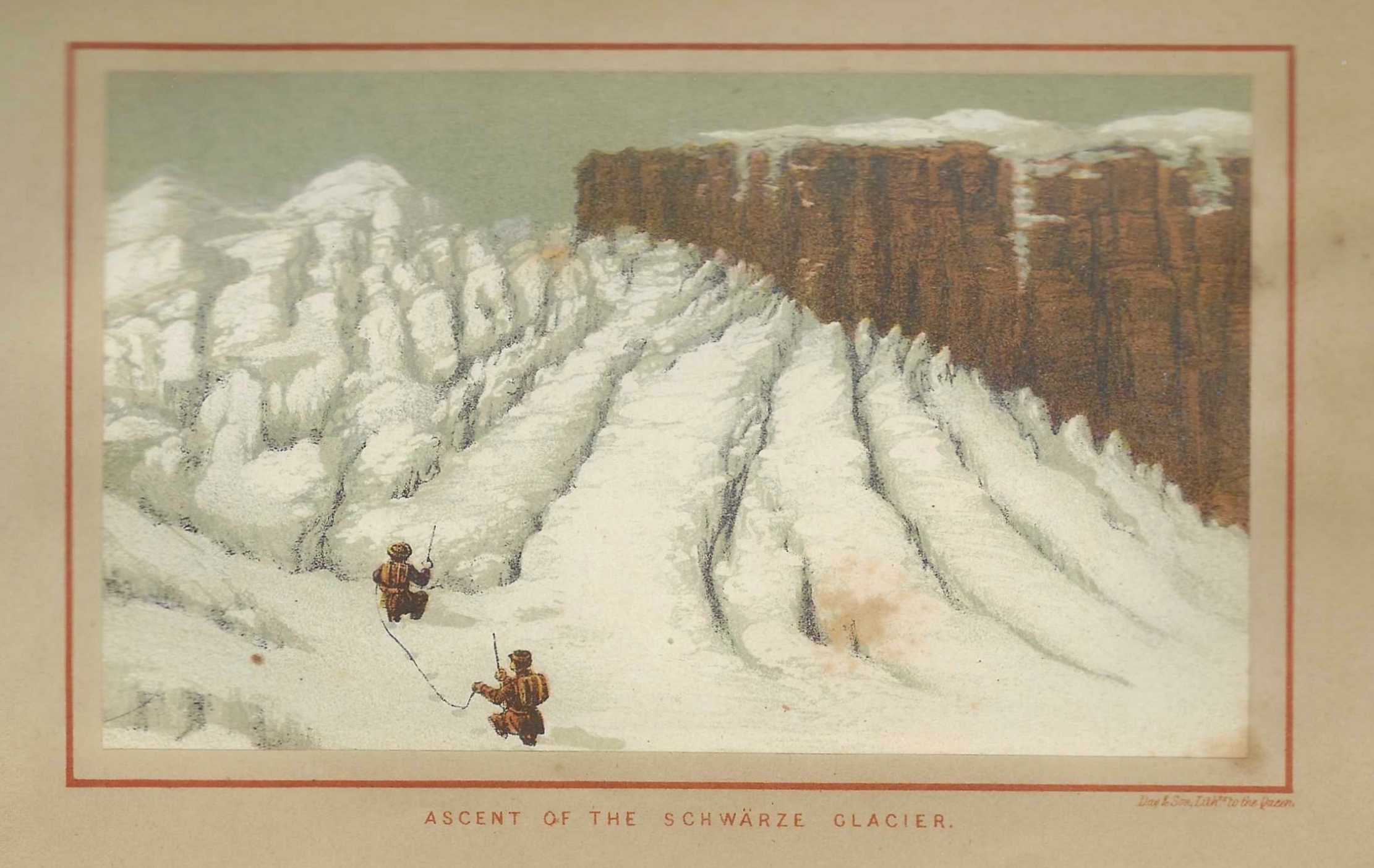
Ascent of the "Schwarze Glacier"
Illustration from Peaks, Passes, and Glaciers

During the following autumn, ad hoc gatherings ensued at Mathews's house near Birmingham, leading to the founding of the Alpine Club itself on 22 December 1857 at a dinner meeting chaired by E S Kennedy. If only we still had the wine list from that illustrious occasion at Ashley’s Hotel in London….

Now steady on, I hear you objurgate, the Alpine Clubbists were by no means the first to bring beverages into the mountains. And this one must concede. And while we’re at it, let us dispel any inference that such drinking was just a guy thing: when Henriette d’Angeville (1794–1871) climbed Mont Blanc in 1838, one of the first women to do so, her commissariat included “18 bouteilles de vin de St. Jean, 1 bouteille d’eau-de-vie de Cognac, 1 bouteille de sirop de capillaire, 1 baril de vin ordinaire.”

A view of Mont Blanc from the Jardin
Illustration from Peaks, Passes, and Glaciers

Then there was Albert Smith (1816–1860), the impresario who put on a show about Mont Blanc in London that ran for 2,000 performances over six years. The script was inspired by his ascent of the mountain in 1851 when, between them, his four guides and twenty porters had to carry sixty bottles of vin ordinaire, six of Bordeaux, ten of St George, fifteen of St Jean, three of cognac and two of champagne, to say nothing of other liquid refreshments supplied by the Hôtel de Londres at Chamonix.

After all, nobody in their right mind would drink the local water in those days. And, while we’d now buy our beers and wines at an alpine hut, those Golden Age pioneers had to carry up all their victuals to some high-mountain cowshed or bivouac à la belle étoile

(Next: the risks attendant on alcoholic alpinism are acknowledged)

Saturday, September 28, 2024

“A light grey felt hat is cool”

What ladies wear in the mountains: some hints from a hundred years ago

We raise our chapeau to Elise Wortley, who recently attempted Mont Blanc (4,805.59m) in period dress. Aiming to highlight women adventurers who achieved astonishing feats, Wortley started the climb in a bonnet, tweed dress and hobnailed boots, as worn by Henriette d’Angeville, who made the ascent in 1838. You can read more about Wortley’s venture on her own website or in her Financial Times article (subscription may be required).

"When climbing, the skirt ... must be looped up"
Illustration from the Badminton Library, Mountaineering


Just in case this retro vibe should catch on, we reproduce below the advice given on a “Climbing outfit for ladies” in the Badminton Library volume on Mountaineering, first published in 1892 and reprinted in 1901. The book was compiled by Clinton Thomas Dent, a medical man whose climbs included a first ascent of the Grande Aiguille du Dru. As a footnote reveals, though, he wisely deferred to “Mrs Jackson, Mrs Main and Miss Richardson” for the views set out here:

Women who climb should, like men, dress in such a manner that they are protected from extremes of either heat or cold. Every garment should be of wool, and the softer and lighter the material the better. The only exception to this latter point should be the skirt, and this will be found most serviceable if made of cloth, rough in texture and as thick as the wearer can get, provided it is not clumsy. A closely woven tweed is suitable. A small check pattern mends neatly if torn. Grey or brown are the most suitable colours for a climbing skirt; blue soon shows the marks of dust or stains. The skirt should be a plain walking skirt of an ordinary length, the broad hem turned outwards and with a deep border of stitching. Three yards round the hem will be found a good width for a skirt. A mackintosh bordering to the skirt is quite useless.

Mrs Main (née Elizabeth Hawkins-Whitshed) models a mountain skirt
Image courtesy of Women's Museum of Ireland

The pockets should be large and in definite places, one on either side and one at the back. They should be outside and flaps to button down. Two or more buttons are desirable on each flap, so that nothing may slip out when sleeping in huts. A small waterproof pocket in the skirt by the band is useful for carrying the bank notes current in Austria and Italy. The other pockets should be lined with sateen, and one can covered with mackintosh. When climbing the skirt must, whatever its length, be looped up, and therefore it is easy to have a skirt which, in the valleys or towns, does not look conspicuous. For looping up the skirt, the following simple plan is effective. An extra belt of strong ribbon is put on over the skirt, which is then pinned to it in fish-wife style. The length is arranged according to the requirements of the occasion. One safety: pin attaching the two sides and another fastening the back, the hem being pinned on to the outer belt, do the work. The safety pins, however, are apt to drag and tear the skirt. An equally good method of shortening the skirt is by an arrangement of loops and buttons. Strong tapes are well stitched up each seam inside the skirt, and also up the middle and back widths: each tape carries a large bone button and two tape loops not too low down. The tape gives more hold for the buttons, and prevents any of the material being torn out.

A rough cloth coat lined throughout with silk may taken in case of cold. A fairly thick Shetland shawl has many uses. It is very light and warm. Tied over the head in cold or windy weather, or in a hut at night, it is a great comfort.

Mrs Main in midwinter, probably on Piz Palu c.1898

The knickerbockers should be made of tweed, the band being lined with flannel or other woollen material. The tweed should match the skirt, and will then be found suitable either when worn, as formerly, under it, or, following the practice occasionally adopted, worn without the skirt, the latter being taken off before beginning the climb.

The bodice is an important part of the outfit, A soft grey flannel blouse, high in the neck, long in the sleeves, and loose, is the best for both heat and cold. The bodice should have breast pockets, one of them being suitable for carrying a watch.

A light grey felt hat is cool. A knitted helmet,which can be pulled over the whole head and face, the eyes only being uncovered, is a necessity in very cold weather. A large silk handkerchief is useful to tie the hat on in a high wind.

Mrs Main sets out on a winter expedition.
Image from True Tales of Mountain Adventure

Woollen stockings (one pair on, another pair in the knapsack), thick, watertight, nailed mountain boots, and cloth gaiter to button or to pull on in the Chamonix style (hooks and laces are apt to catch in a skirt are all essential. Putties, or spats and putties combined, are much to be recommended. Gloves should invariably be of wool, and of the shape worn by babies, the fingers being enclosed in a bag, and the thumb only having a separate casing. Let the gloves come well up the arms, and have at the very least two pairs with you on an expedition. A large safety hook and eye in each pair will enable them to be hung from the waist belt. A very fine woollen mask to protect the face is much pleasanter to wear than one of linen.

Lady alpinist and guide, c. 1906
Image from True Tales of Mountain Adventure

A more extensive outfit is required on a tour when access is not to be had to heavy luggage for several days. The climber may have to spend a few nights in the more civilised of the Alpine centres, or perhaps twelve hours may even be passed in such places as Geneva or Turin. It is necessary to be provided against such contingencies, and if a little thought and trouble are given to the matter, neither the weight nor the bulk of the extra garments necessary need be great.

Silk (only to be worn when not climbing) can be substituted for wool for the under-clothing, of which two complete changes are desirable, not including what is worn. A dark blue or grey silk blouse can be worn with the climbing skirt in the evenings, and a small dark felt hat, which will fold flat, and a pair of gants de suède will help to do away with the stamp of the climber. Leather soles, without any heel whatsoever, put to a pair of neat black laced shoes, will pack flat and take up very little room. The whole weight of the bundle (which can be tied up in a large silk handkerchief) need not exceed 4 1/2 Ibs., including such essentials as soap, a comb, pocket-handkerchiefs, and other small things which the experience of each climber will suggest.

References

C T Dent and other writers, The Badminton Library: Mountaineering, London and Bombay: Longmans, Green and Co, third edition, 1901. 
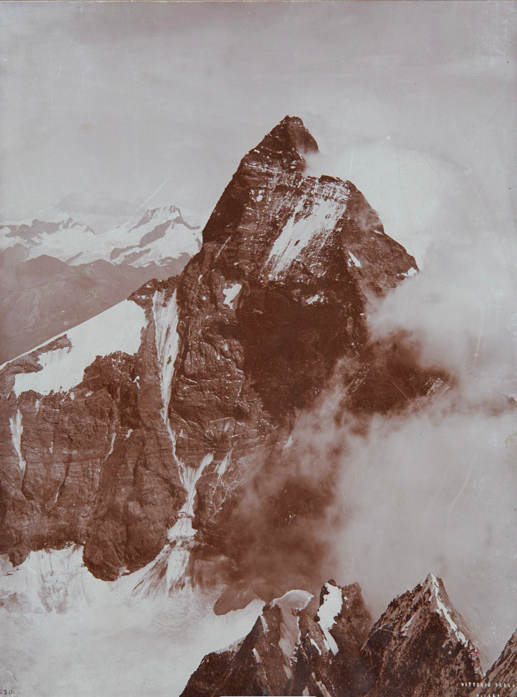
Mrs Aubrey Le Blond (also known as Mrs Main, Elizabeth Hawkins-Whitshed), True Tales of Mountain Adventure, London: T Fisher Unwin, 1906. 

You may also like: Alpine apparel in early modern Japan and Was Walter Weston a gear freak?

Sunday, March 10, 2024

Indomitable

Sorry this is a bit late for International Women’s Day. Then again, Nicole Niquille really deserves a day to herself. An interview in the latest edition of the Swiss Alpine Club’s bimonthly magazine brings us up to date with her story. 


Back in the 1980s, Niquille was one of Switzerland’s top alpinists – notice that the phrase isn’t “top female alpinists”. She went to K2 in 1985 and Everest in 1986, qualifying as a mountain guide, the first Swiss woman to do so, in the same year. “There was no feminist motive, I just wanted to live in the mountains,” she is quoted as saying in the interview.

Eight years later, on a Sunday evening in May 1994, her life changed forever. While she was picking mushrooms just a few hundred metres from her house, a falling stone hit her on the head. When she woke up in hospital, she was a paraplegic. 

During the next two years, she had to relearn everything, from speaking to moving her fingers and limbs. Despite all her efforts, she could not learn to walk again. Yet the mountains continue to give her strength: "When I freeze at night and can't pull up the blanket, I think of the nights in the airy tent on K2." 

“You never accept your disability, but you have to live with it,” Niquille says. Living with it meant, in this case, opening “Chez Nicole”, a mountain hostelry which she has run since 1997 with her husband Marco on the banks of Lac de Taney at an altitude of 1,408 metres. 

The restaurant led, in turn, to her next project. One of her kitchen helpers, a Nepalese Sherpa, told her about her sister Pasang Lhamu Sherpa. In April 1993, Pasang was the first Nepali woman to reach the summit of Everest, but lost her life while descending. 

Deciding to get involved, Niquille set up a foundation and invested 100,000 francs of her disability capital in building a hospital at Lukla, the starting point for treks to the Everest region. Opening its doors in 2005, the hospital runs on funds raised by Niquille’s foundation, about 450,000 francs annually.

Without the accident, Niquille says, she “would have led a different life and the hospital in Lukla would not exist”. For herself, she has no regrets: “There is no happiness or unhappiness in life, only people with different life stories,” she says. 

And even if she were to be offered the use of her legs again, she would accept this only every other day. “That way I would really appreciate them and I would know exactly what I had to do on the days I was able to walk.”

References

«J’ai dû trouver une utilité à ma chaise pour pouvoir l’accepter» Rencontre avec Nicole Niquille, interview by Martine Brocard in Les Alpes/Die Alpen, the bimonthly journal of the Swiss Alpine Club, edition 1/2024.

Hard core (3)


While climbing Les Ecrins by the south-east face, the extreme alpinist André Roch (1906-2002) encountered loose rock:

The climb became complicated, slabs succeeded cracks and the wall was always sheer and exposed. The clearest recollection I have of this ascent is the following. Somewhere Gréloz got up on to a big block at the foot of a wall. He was able to reach hand holds at the top of the wall and was endeavouring to pull himself up. Hardly had he taken his feet from the big block when over it toppled, disappearing into space. This time I really thought Gréloz must fall, but he remained hanging by his hands and then succeeded in pulling himself up. Once he was safe I reassured him by explaining that I had had him well belayed round a rock the whole time. It was then my turn to go up, and the minute I left my famous belay, it too disappeared into space. This goes to show that the south-east face is not exactly sound. We had a good laugh over this adventure, which had caused us considerable agitation.

References

André Roch, Climbs of My Youth, Lindsay Drummond London, 1949. Header image is a photo by André Roch of climbers on the north face of the Dent Blanche, published in Mountaineering in Photographs by André Roch, Adams and Charles Black, London 1947.

Hard core (2)


While bivouacking during the first descent of the Aiguille du Dru’s north face, the extreme alpinist André Roch (1906-2002) dreamt that the mountain itself had taken on a personality:

Sitting back to back on some stones we endeavoured to sleep, but in my state of feverish over-excitement my thoughts ran thus:

The Dru is so beautiful, so graceful, so radiant in the sunshine when he thrusts upwards into the blue sky. But now he is terrible, gigantic, furious, as he leans over us. He is a demon—a cyclops perhaps. At times it grew lighter and I could see his head, but I could not make out whether he had two eyes or only one. The black, streaming muscles of his chest, towered over us. How huge and frightening he was! Were he to see us, he would be infuriated and, with one flip, would send us down to the Nant Blanc glacier.

But, old Dru, you can’t see us, and you can’t touch us with your foolish great stones hurtling down some sixty feet wide of us. Hush! not a word—something’s going to happen. He is stirring. A fierce wind howls. It must be the hour when old man Dru takes his shower.

And sure enough, a veritable water spout poured down; and how pleased he seemed to be! Crouching on our perch we caught it full force without daring to move.

Wait a bit, Dru, old fellow; we may be small, but we still have some tricks up our sleeve and among them more than another 300 feet of rope still untouched.

Gradually the moon rose and then dawn broke. The old Dru cannot have slept much and, because of his queer notion of taking a shower at two in the morning, we hadn’t slept at all. But this was no time to argue with him. We tried to swallow some squares of chocolate, but without success. We could see the glacier, which was not far away. Beneath us opened an immense chimney some 300 feet high, down which we resumed our long series of rappels. Weakened by so many trials, feverish, stiff and trembling, we slid painfully down the length of our wet line. Beneath the continuous cascades of water that splashed the entire wall, we discovered a bed of crystals. There on a ledge I espied an enormous smoked specimen. But to get at it I should have had to stride round a tricky crack, and I preferred to give up the gem…

References

André Roch, Climbs of My Youth, Lindsay Drummond London, 1949. Header image is a photo by Georges Tairraz of the north face of the Petit Dru, published in Mountaineering in Photographs by André Roch, Adams and Charles Black, London 1947. 

Hard core (1)


The extreme alpinist André Roch (1906-2002) started learning his trade at an early age. His autobiographical work, Climbs of My Youth, explains ….

When I was ten my father had already introduced me to mountaineering. In summer we would stay at some centre for excursions and on Sundays in the spring and autumn we would explore the Préalpes or the Saléve.

One day a solitary climber had fallen on a climb on the Saléve known as the “Grande Varappe’”’ and the rescue party had brought him down on a stretcher to a quarry shed at the foot of the mountain. We were passing, and my father was called in to certify the man’s death. As my brother and I were full of ardour and enthusiasm for climbing, my father decided to let us see the body, in order to give us food for reflection. As far as I can remember the dead man was in a pitiable state, but nothing very dreadful was visible; he was tied to the stretcher and well wrapped up in tarpaulin. Half the face was smashed in, but the whole head was muffled up so that we could not see much, One leg was broken and the shoe that stuck out from beneath the wrappings could be twisted about in any direction; and this my brother and I did each in turn. The bloodstains were dry and coagulated and did not look very bad.

Nearby, over a drink, the rescuers were discussing the accident, and judging from their conversation, they had had great difficulty in.recovering the body and getting it down. When my father had finished we continued on our way. He asked us what we thought about it all, and I replied that it had rather spoiled our taste for anything much that day.

My father said nothing, but he judged that the effect had been slight and would not be lasting.


References

André Roch, Climbs of My Youth, Lindsay Drummond London, 1949. The header image is the frontispiece from this edition: Roch was as talented a mountain photographer as he was an alpinist. 

Friday, January 6, 2023

Celebrating the alpine savants

An exhibition in Geneva delves into the scientific roots of modern mountaineering – and yields insights into how science gets done

If you want to get to know somebody well, it’s best to visit them at home. And if that somebody is Horace-Bénédict de Saussure (1740–1799), who instigated the first ascent of Mt Blanc, the best place to start is probably the Musée d'histoire des sciences in his home city of Geneva. As the holder of many of de Saussure’s papers and memorabilia, the museum is currently using these to mount an exhibition on La montagne, laboratoire des savants.

De Saussure's party scales Mt Blanc in August 1787

Taking up the entire top floor of the museum’s repurposed villa, the exhibition all but brings de Saussure back to life. 

What the well-dressed alpinist wore in 1787

Visitors are received first by his frock coat and hobnailed shoes – there wasn’t much in the way of crampons in those days – and then by his devoted wife Albertine, ably re-enacted in a video display. While she reads out their correspondence, a light beam traces out her husband’s journeys of geognostic discovery on a relief map of the Alps in front of her.


This son et lumière notwithstanding, Horace-Bénédict isn’t allowed to hog the show. As promised in the exhibition’s title, savants are celebrated in the plural. Some were de Saussure’s predecessors: a display of antiquarian books includes those of alpine pioneers in German-speaking Switzerland such as Johann Jakob Scheuchzer (1672-1733), who famously documented the dragons of the Alps.

Strange encounter near Sargans by courtesy of Scheuchzer

For de Saussure, the most formative of these Swiss influencers were probably Gottlieb Sigmund Gruner (1717-1778), whose multivolume work on Die Eisgebirge des Schweizerlandes moved him to learn German, and Albrecht von Haller (1708-1777), celebrated throughout Europe for his lengthy poem on the Alps.

A glacier as seen by Gottlieb Sigmund Gruner

But it was more for Haller's botanical expertise that de Saussure looked to him. When the younger man visited Chamonix for the first time – this was in 1760 – his main aim was to collect plant specimens for Haller. But the magnificent views sparked de Saussure’s interest in finding a way to the top of Europe’s highest mountain. And the rest is history…


From the pages of De Saussure's pressed plant collection 

Next come exhibits on de Saussure’s contemporaries. These include André-César Bordier (1746-1802), whose Voyage pitoresque aux glaciers de Savoye set out one of the first theories to explain how glaciers flowed, Marc-Théodore Bourrit (1739-1819), the tireless promoter of Mont Blanc, and Louis Jurine (1751-1819), who assembled such a vast array of alpine minerals and fossils that his collection ended up at the Sorbonne.

Successors get a mention too. Here is a fine portrait of the astronomer Marc-Auguste Pictet (1752-1825), who took over from de Saussure as professor of natural philosophy at the Academy of Geneva when the older man’s health failed. There was Alphonse Favre (1815-1890), who published a three-volume geological study on the Mt Blanc range. In search of ground truth, he climbed extensively and later helped to found the Swiss Alpine Club, also serving as one of its first presidents. 

Alpine folding as modelled by Alphonse Favre

Lastly there was the great Alexander von Humboldt (1769-1859), who visited Chamonix with de Saussure’s magnum opus, the Voyages dans les Alpes, in hand (presumably only one volume at a time). Later, von Humboldt undertook his own scientific ascents, setting a world altitude record (at least for Europeans) during an attempt on Chimborazo in June 1802. De Saussure’s Voyages also furnished James Hutton (1726-1797) with some key geological evidence that he needed to nail down his Theory of the Earth (1785).


By now, your reporter was getting the picture. De Saussure didn’t work in a silo: instead he corresponded, hobnobbed and networked across the length and breadth of Europe. If he mounted higher than others – to borrow a bon mot from an eminent British natural philosopher – this was because he climbed on the shoulders of giants.

Richard Pococke in oriental dress
Image by courtesy of Jean-Etienne Liotard, via Wikipedia

Speaking of the Brits, they figure quite prominently in this exhibition. Up on the wall are portraits of William Windham (1717–1761) and Richard Pococke (1704–1765), who were among the first outsiders to tour and publicise the glaciers of Chamonix, making their visit nearly two decades before de Saussure.

De Saussure was well-known in English circles. Accompanied by Albertine, he had travelled round the country in 1768-69, visiting mines, universities and men of science and culture such as Sir Joseph Banks and Lord Palmerston, father of the prime minister. It may have been during this stay that he acquired from the workshop of John Dollond, a master optician, the fine achromatic telescope that is displayed on the museum’s ground floor.

An optic of distinction from the atelier of John Dollond

The English reciprocated these visits. In the summer of 1776, the polymathic Sir George Shuckburgh invited de Saussure on an excursion to a hill near Geneva in order to estimate the height of Mont Blanc. By triangulation, Shuckburgh arrived at a figure of 2,451 toises (equivalent to 4,779 metres), rather close to the altitude of 4,778 metres that de Saussure himself obtained just over a decade later, when he boiled up his thermometer on the summit. 

De Saussure's alcohol stove front-runs the MSR by 200 years

This prompted your correspondent to muse that, to get the measure of Mt Blanc more or less accurately, it took a joint Genevan-British collaboration. And to wonder how present-day Shuckburghs and de Saussures are going to fare in the face of take-back-control policies that stifle international cooperation. Outside the museum’s front door a drab December afternoon awaited. Across the lake, Mt Blanc was quite lost to view.

The exhibition La montagne, laboratoire des savants runs until 23 April 2023 at the Musée d'histoire des sciences, Geneva.

References

Musée d'histoire des sciences, La montagne, laboratoire des savants: Catalogue d’exposition

Horace-Bénédict de Saussure, Voyages dans les Alpes, edited and introduced by Julie Boch, Georg, Geneva, 2002

Sir Arnold Lunn, The Swiss and Their Mountains: A Study of the Influence of Mountains on Man, Rand McNally, 1963

Summoning up the very shades of H-B de Saussure

Friday, July 29, 2022

South side story (3)

Continued: Abbé Amé Gorret's first-hand account of the Matterhorn's second ascent

Starting our climb to the Col du Lion at about nine o'clock, we were at the height of the Whymper Couloir by one, where the snow falling in heavy flakes had stopped us last year. As we had stashed some wild hay in a crevice there, Bich now stuffed his shirt with it, increasing his burden by this amount. 

Below the Pic Tyndall
Image is from The Matterhorn by Guido Rey, Basil Blackwell 1946

The gullies that one has to traverse above along the Col du Lion are often very dangerous when there is a lot of snow. Such traverses over precipices don’t agree with me; I much prefer to climb. This year, however, the couloirs were easy, the snow was gone, and you just had to make sure to plant your feet solidly. Nevertheless, we thought it best to rope up a few metres apart on a long line; this greatly relieved my burden. 

Finally we got across the dip of the Col du Lion and reached the Matterhorn’s pyramid. The mountain now confronted us, and we were determined to give it our last, best efforts. I was greatly impressed and my companions too. My heart was beating violently, I could no longer keep my thinking clerar, I was all a-tremble. In fact, I was almost ready to throw my arms around this Matterhorn!

The first stretch over the pyramid is quite easy; one climbs for half an hour over the kind of loose rubble that one meets with on any mountain. We followed the ridge and in this way avoided the stonefall in the couloirs, but at the end of this stretch you have to get up through a notch that is three or four metres high. Climbing like a chimney sweep, you make progress with your elbows, knees, feet and hands. We called this place the Ciarfou or Chimney.

At one o'clock we arrived at the place where the tent had been pitched during the previous expedition. Since it was still early in the day and we were consumed by our desire to reach the summit, we wanted to pitch the tent higher up, at the Cravate or the Collier de la Vierge. But Carrel, didn’t think we could do this, since he knew the mountain better than we did. And here was the best and most comfortable place. In any case, on the following day, we would all take a blanket with us, in case we could not return to this excellent campsite and had to sleep higher up. Everyone set down his load. We unroped and got to work putting up the tent. It was pitched in a moment. But was the cook ready? And what about a drink? Let’s get ourselves a drink, and a good one!

We roped up again and climbed up along the rocks with a tin bucket to catch a small stream of water from melting snow. Water that has been flowing over the rocks is scarcely potable. It is bland, tasting like the rock itself, and must be made more palatable by mixing it with wine, sugar or lemon juice. After the meal, our two porters went down, and we contemplated the rock above us. This was an immense, almost vertical tower, flanked on either side by the void, the abyss.

"But how do we get through tomorrow?" asked Bich. "That should be obvious since we have to go uphill, up over this rock." "You’d have to be a monkey or squirrel?" "Well, let’s give it a try." For the rest of the day we gazed out over the immense panorama that unfolded before our eyes in a succession of mountains, glaciers, peaks and rocks, which were separated from each other by something hazy and indistinct so that we could not tell them apart.

In the evening, although we were on rock and at such a high altitude, the cold didn’t trouble us in the least. Our tent was very small, the four of us could only get into it when two were already lying flat on either side. The thermometer showed six degrees in the tent and a mere one and a half degrees in the open air. When the weather is fine, an evening on the Matterhorn is glorious; you see the shadows slowly rising and flooding the valleys, and when the moon rises, you can see the same valleys indistinctly, far below and at a great distance. And then you suddenly realise how high up you are .... 

(To be concluded)

References

Translated from a German version of Abbé Amé Gorret's original account in French, entitled "Victory of the Italians" in Matterhorn-Geschichten: Bergsteigerelebnisse am Traumberg, compiled by Fritz Schmitt, Bruckmann, 1991

Wednesday, July 27, 2022

South side story (2)

Continued: Abbé Amé Gorret's first-hand account of the Matterhorn's second ascent

On the morning of the 15th, everything was different. The scouts were back, sad, dejected, confused, disappointed and discouraged. They had only reached the shoulder, a few steps this side of Pic Tyndall, when Whymper and his men shouted down to them from the top of the pyramid. How must the leaders of Valtournenche have felt at that moment? We can all imagine their feelings – how they looked at each other in silence, averted their gaze and started downwards without a word. Had they spent too much time chattering and cheering before that moment?

The Matterhorn from the Dent d'Herens at 13,708 feet
Photo by Vittorio Sella, courtesy of Andrew Smith Gallery

Mr Giordano made no reproof; rather he sought to alleviate their gloom. He said only that they must at least have solved the question of whether an ascent from the Italian side was possible. But on this question they were no wiser than before the expedition. It seemed to me that the problem was now tending towards a negative solution. The engineer said to the guides: "Up to now, I have worked for the honour of being the first to make the ascent, but fate was against me and they have beaten me to it. If I make some sacrifices now, it is for you, for your honour and benefit. Do you want to make another attempt to decide the question? Then at least you’ll have no more illusions about this point!" The answers were incoherent, embarrassed, witless and discouraged.

Whymper had said, when he left the hotel of Giomein on his way to Switzerland, that you will never achieve anything with the guides with the guides of Valtournenche, they don't work for their reputations; they are just looking for a day's wage. What at first had seemed to me no more than an irritating slur now appeared to be the truth. Mr Giordano had set out an offer for the sake of my country that would never be made again. My country had suffered an injury to its honour, it had lost a prize. I was in agonies.

"So you renounce the Matterhorn, you won’t make another attempt? Well, I will go, and who will follow me?" he said. Replied Jean-Antoine Carrel, the Bersagliere: "I for one have not given up; if you go or if the others want to go up again, then I am with you at once." - So now we are two, who else is coming? - Not me! - Me neither. - And I wouldn't go up there again if you give me a thousand francs. - Then we'll be we will be only two, but we will go. And so the party mustered itself again.

That was on the 15th around noon. The rest of the day was spent in preparations for the departure, which was set for the morning of July 16th. In the evening we found two new companions, Jean-Baptiste Bich, called Bardolet, and Jean-Augustin Meynet, both domestic servants with Mr Favre, the hotel owner of Giomein.

Mr Giordano wanted to come with us, but the uncertainty of the route, the difficulties that we might encounter in the unclimbed part, which had always turned us back, and the fickleness of the weather forced us to reject his offer. Carrel declared that he did not feel confident enough to guide a client up there at this stage. So I proposed a condition to the group. The engineer, although deprived of the pleasure of making the ascent himself, had supplied us with everything needed. So none of us would work for a wage or any other reward; we would go of our own free will for the honour of our country, as this would be an act of national expiation.

I further proposed that our provisions would be carried up only on the first day, so that we would depend on nobody else until our return and so would not be distracted by any messages from below. We had to cross the ocean and burn our boats! My conditions were accepted. I spent the night in Avouil with my companions to finish our preparations.

We were away at four o’clock in the morning on July 16. After a pause at the chapel of Breuil, everyone garbed and equipped himself as he thought best. For my part, I donned my hunting clothes, stuffing the trouser legs into my stockings so that they wouldn’t hinder me on the climb. Then I took my beloved iron-shod stave in hand, and at half past seven o'clock we began our ascent.

A mule carried our gear to beyond the Mont de l'Eura, at the foot of the of the Tête du Lion, two hours from Giomein. After a very scanty breakfast, we divided the kit among us, since we now had to carry it ourselves. I had the ropes, Carrel his army knapsack, the four others took the rest of the supplies in sacks rigged up so that they coul carry them on their backs without being hindered while walking and to keep their hands free if they had to use them on the rocks. We had two porters with us up to the point where the tent was to be pitched. This way of carrying the sacks amused us very much, as it gave our caravan a most picturesque look ...

References

Translated from a German version of Abbé Amé Gorret's original account in French, entitled "Victory of the Italians" in Matterhorn-Geschichten: Bergsteigerelebnisse am Traumberg, compiled by Fritz Schmitt, Bruckmann, 1991