Monday, November 9, 2015

Meizan spring & autumn (2)

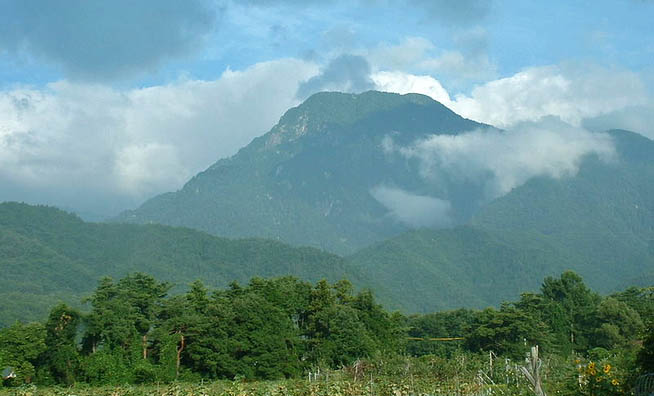
In the cloud forests of Arashima-dake

“This is our revenge attack,” said the Sensei as we scrambled aboard the van. Her turn of phrase startled me, until I realized that she was talking about our failed winter attempt, a few years ago. As Arashima-dake is a mere 1,523 metres tall, this had been a signal defeat.


Now, in mid-May, we should be able to get our own back. Though, when we parked at the hamlet of Nakande, a sprinkle of farmhouses and kura on a hillside laddered with brimming rice paddies, it looked far from certain who would be exacting the advertised revenge.


A sodden blanket of cloud had expunged all the mountains of Echizen. We set off up a forestry trail that led into a realm of dripping pines. Already, I wished that I’d greased my boots more thoroughly. For her part, the Sensei didn’t remark the weather – after all, clouds and rain come bundled with her back-of-Japan territory.


We’d decided on the longer route, a straggling ridge leading in from the west. This avoids the abandoned ski-ground that lies at the foot of the “normal route”, a field of broken dreams. And besides, the Sensei added, the long ridge has its own kind of charm as you follow it along, now rising now falling, through stands of beech that save the mountain views till last.


The mountain would certainly stay hidden today – I could hardly see the Sensei ahead, as she stepped between the first few beech trees. And, although it wasn’t actually raining, every breath of wind brought down a shiver of condensed mist droplets from the canopy.


Adequate precipitation is part and parcel of life in these parts. In his book on the 150 notable mountains of Fukui – why stop at a hidebound one hundred? – Masunaga Michio reports a legend from Wakasa Province, in the southern part of what is now Fukui Prefecture. So much gold sand is washed down from Arashima-dake, a chronicle relates, that even the trout (ayu) in its streams have golden scales.


Arashima is a mountain of undoubted character (山格), says Masunaga-san, in a nod towards its status as one of the so-called One Hundred Mountains of Japan. This judgment is backed by his many years as the venerable president of Fukui’s oldest mountaineering club. And a good part of the mountain’s character can be ascribed to the wild extremes of weather that the ceaselessly eddying Siberian highs and lows haul in from the Sea of Japan.


Masunaga-san has experienced Arashima-dake in all her aspects. His first climb was on a crystalline October day; under a sky as clear as a bell-note, he saw the Northern Alps strung out in the distance, like a string of snowy pearls. One winter, he made a solo ascent, through frosted beech groves swaying in the blizzard, to summit snows that merged into the racing clouds.


Early summer is a quiet season. Apart from the occasional sussuration of falling droplets, only a distant cuckoo broke the silence. The mist kept us focused on foreground details – last year’s sasa leaves carpeting the black mud of small swamps that lay across the path. Here and there in the drifting fog, a pink or white blur hinted at clusters of mountain rhododendrons in bloom – this time, Shakunage-daira, the junction of the two main ridge routes, would live up to its name.


The summit was socked in, making the recently installed panorama board on the summit particularly redundant – the view hardly reached as far as the shrine, just across the clearing. There was no reason to hang about; perhaps Arashima had won this revenge match after all.

We didn’t look back until we were half-way down the ridge, pausing for breath and an industrial-strength onigiri, on the small eminence known as Ko-Arashima. Only then, for the first time that day, did we see our mountain – the clouds had started to lift.


A snow gully seaming the summit flank reminded me of Nihon Hyakumeizan – in the relevant chapter, a relative of Fukada Kyūya tells him that, when just enough snow is left to make a Y in the gullies on this side of the mountain, that's how the fishermen used to know it was time to start catching ayu – those gilt-edged fish again – in the Kuzuryū River.

"But they wouldn't have talked about a Y-shape in the old days," queries the Hyakumeizan author.

"That's right. They called it a deer's antler," comes the reply.

Antler was the right word, says Fukada. And, in fact, a long snowpatch just like the prong of an antler was glittering there now, for us as it was for him.


Thursday, November 5, 2015

Meizan spring & autumn (1)

Taking the measure of Mt Hino, a Meizan in miniature

“I have to work tomorrow, but you can climb Hino-san,” the Sensei had said as soon as I’d stepped off the plane. And now, next morning, we were at the drop zone and the van’s door was sliding open: “There you go – just two hours up, one down, so you won’t need much food,” she said, handing me a map and a packet of peanuts. “See you on the other side.”


With that she was off, and I was left to confront Mt Hino. Rising all of 794 metres above the blue rooftiles and telephone wires of suburban Takefu, could this eminence really be a Meizan, a famous mountain of Japan, as advertised? From the carpark, there wasn’t much to see: just a wooded ridge, with no hint of the pyramidal profile that supposedly makes Hino the “Mt Fuji of Echizen”.

The path started diffidently, slipping between two houses into an unkempt pine grove. Then the forest gloom lifted to reveal a pair of stone lanterns and, beyond, the sunlight filtering through old trees onto a lightly steaming shingled roof. If such a Shrine from Central Casting stands at its foot, I began to realise, there must indeed be something to Mt Hino.

Curving across the head of a gully, the track angled towards the ridge. A glimpse of the sky showed a halo ringing the sun, always a bad sign in these parts. “Here in the North Country it is rarely possible to say whether it will be fine or cloudy on the morrow,” says the local meteorologist quoted by Bashō in his Narrow Road to the Deep North. Perhaps it was as well that the Sensei had pointed me up a small mountain.


Somewhere below the ridgeline, I happened on the first of Hino’s way stations – like Mt Fuji or any other self-respecting sacred mountain, there are ten “gome” on the way to the top. Here, every station is marked by a placard hand-painted by the children of a local primary school. Irritatingly, each tells you how much further it is to the summit.

Soon after the "400 metres to go" mark was a signboard marking the spot where women in former days had to turn back - aligning Hino-san with more famous sacred mountains such as Omine in the Kansai region.

Near the top, the path gave way to bare rock. Further progress was enabled by slimy footholds, worn into the slope by generations of pilgrims or perhaps placard-painting schoolchildren. This is the kind of place it’s usually better to climb than descend.

 As it happened, Fukada Kyūya had to descend this mauvais pas, shod only in lightweight "Caravan" shoes. Had I arrived here about half a century earlier, I might have met him and Mrs Fukada coming the other way. The Hyakumeizan author records in an essay on two Fukui mountains, written in the mid-1960s, that he had been attending a middle-school reunion at Awara Onsen and decided to take in Hino-san the next day, possibly in a slightly hung-over state.

Fukada was traversing the mountain in the opposite direction from mine – because his wife Shigeko first wanted to pay homage to the memory of Nakatomi no Yakamori, a minor official who was exiled in about 740 AD to the hamlet of Ajimano, at the eastern foot of Hino-san.


Nobody knows what Nakatomi did to deserve his banishment, but his name will live forever as the co-author of a series of sixty-odd poems, collected in Book XV of the Manyōshū, that he exchanged with his wife, a clerk in the Imperial Treasury, who was left stranded and bereft in the distant capital.

From a few of these finely turned tanka, it may be surmised that Nakatomi drew little comfort from gazing up at the rugged skylines of Echizen Province:

In blue-earth Nara
The great avenues run smooth
Fine to walk on
But these stony mountain trails
Make hard going for my stumbling feet.

(Aoni yoshi/Nara no ōchi wa/yukiyokedo/kono yamamichi wa/yukiashikarikeri)

Translated by Edwin A Cranston: A waka anthology: volume 1: A gem-glistening cup, Stanford University Press.


Now, apt quotations from the Manyōshū, some quite recondite, run like a motherlode through Japan’s most famous mountain book, all the way from the chapter on Adatara in Tōhoku (“If you leave your bow of Andatara spindlewood too long/You will never string and draw it with an easy swing …”) all the way to Ishizuchi-yama on Shikoku.

So perhaps it was Shigeko who mined this ore for the hard-pressed Hyakumeizan author, always scrambling to meet his monthly editorial deadlines. As Fukada’s essay records, at the time of their Mt Hino ascent, she was making a special study of Japan’s oldest collection of poetry. Was it on this very mountain excursion that she tipped her husband off about the the Manyōshū, and its treasury of mountain references?


These musings were interrupted by the summit. The path led through a torii to an open grassy knoll surmounted by a shrine. Just below was a shelter for ceremonies: a signboard requested that visitors refrain from using it for profane purposes, such as partying or worse.


Several pensioners – this was a weekday – were already admiring the view out over the Fukui plain. One wandered over and took charge: “Now you should visit the real summit,” he said, leading the way through some bushes to the trig point. On the way back, we passed a new-looking monument of polished obsidian. “It commemorates the yamabushi,” explained my guide.

The monument piqued my interest – the yamabushi were the mountain mystics and pilgrims, adhering to a syncretic Buddhist and Shintō faith, who opened up many of Japan’s sacred mountains. Were there still yamabushi in Fukui, I wondered. My guide thought not. But, if not, who installed that handsome stele of obsidian, and why?


These were interesting questions but, alas, there was no time to pursue them. While we were talking, the gathering veil cloud had snuffed out the last glow of the sun. I bowed to my guide and hurried off down the eastern ridge. The steep and slippery mountain trail, to say nothing of its pendent spiders’ webs, was certainly harder going than a smooth avenue in blue-earth Nara. But it wouldn’t do to keep the Sensei waiting.

Wednesday, October 21, 2015

Matterhorn versus Mt Fuji

Or can there be “Meizan” outside Japan? Text of a presentation given at the Japanese Alpine Club in Tokyo on 16 October.

Ladies and gentlemen of the Japanese Alpine Club, friends and fellow mountaineers. It is a privilege to be invited to speak in these surroundings. The Club is so deeply woven into the history of Nihon Hyakumeizan – its author was after all your 1,586th member – that a pilgrimage to your offices must be deeply meaningful for any fan of Fukada Kyūya’s most famous book.

Woodprints by Yoshida Hiroshi
Today, the question is whether there can be “Meizan” in countries other than Japan. This interesting topic was suggested by Ohmori Hisao-san in his recent review of the English version of Nihon Hyakumeizan in the JAC newsletter. But, before I try to answer that question, let me say a few words about the translation.

Two decades ago, I spent six years in Tokyo working for foreign banks. It was an average commercial banker’s life except at weekends, when I was a very average all-round mountaineer – belonging to a club affiliated with the Japan Workers’ Alpine Federation (the Shinjuku bloc), and going out every weekend, in a weatherbeaten Subaru, to yama-ski, rock-climb, sawa-noborise, or do alpine routes.

At that time, we had no special interest in “Meizan”. I knew the word, of course, and bought a copy of Nihon Hyakumeizan, but there was no time to read more than a few chapters. It was only when I moved to Switzerland that I had enough leisure to read more. And, although Switzerland has great relief, I sometimes felt nostalgic for the Japan Alps.

One day, I translated the Hakusan chapter to see what it would sound like in English – and then I realized that Nihon Hyakumeizan is a masterpiece. With the help of a friend at Fukui Jin-ai University, we decided to translate the whole book. Soon we were e-mailing and Skyping almost every day. Then we got married.

1. How to translate “Nihon Hyakumeizan”?
If you translate Nihon Hyakumeizan, you first have to translate the title. Soon after the project started, I was able to discuss that question with Fukada Shintarō, the author’s son, over coffee at a Renoir café in Tokyo.


“Famous mountain” is somehow not right, Fukada-san thought. So, in the end, the title of the book in English is just “One Hundred Mountains of Japan”. We didn’t so much translate “Meizan” as skirt the question altogether.

The basic problem, as Ohmori-san points out in his book review, is that there is no equivalent word for “meizan” in any European language. Not in English, nor in German or French or Italian. The word doesn’t exist because the concept doesn’t exist.

2. What is a ‘Meizan’ anyway?
So, before we can go looking for Meizan outside Japan, we have to ask what a Meizan is. How do you recognise one when you meet it?

“Meizan” as a word comes from China. I’m not sure how old the word itself is, but the concept goes back to China’s Warring Countries period (475-221 BC). That was when people started talking about the country’s Five Great Peaks (五岳). Later on, these eminences were joined by Four Sacred Mountains of Buddhism (四大佛教名山) and a similar set for Taoism (四大道教名山). Today, there is Gazetteer of China’s Famous Mountains (中国名山志), published by the China National Microfilming Center for Library Resources – in sixteen volumes. We surmise that China has a lot of Meizan.

Ur-Meizan: The Purple Heaven Palace on Mt Wudang, China
In Japan, the definition of Meizan has varied over time. In the afterword to Nihon Hyakumeizan, Fukada Kyūya mentions Tachibana Nankei’s discussion of mountains (“Meizanron”) in his Tōyuki, the account of a journey to eastern Japan that the writer made in 1785. Nankei names 25 mountains, starting with Fuji, Hakusan and Tateyama, the so-called Sanreizan, or three great sacred mountains of Japan. Indeed, most of the mountains in his list had religious traditions. But Nankei never says exactly what he means by the word Meizan.

About a century later, the journalist and pundit Shiga Shigetaka published his Nihon Fūkeiron (1894), a ‘theory of the Japanese landscape’. His purpose was to illuminate the national character of the Japanese by highlighting what is special about their surroundings. And, for Shiga, what differentiates Japan’s landscape is its volcanic features– plutonic rocks, hot springs and eruptions. So Meizan are necessarily volcanoes. No other type of mountain appears in the book’s woodprint illustrations.

Not everybody agreed with Shiga’s take on Meizan, even at the time. The Kojiruien was a 51-volume collection of historical documents that was compiled between 1879 and 1914 under the initial direction of Nishimura Shigeki, an official at the Ministry of Education. The encyclopaedia contained a list of 102 mountains, divided into high peaks, volcanoes, and “famous” mountains (Meizan) such as Arashiyama in Kyoto, Kasugayama in Nara and Obasuteyama in Shinano. These are exclusively places that appear in classical poetry. Few or none are volcanic, and most are low (less than 1,500 metres).


However, Nihon Fūkeiron was much the more influential book. A best-seller, it told Japanese readers what they wanted to hear about themselves at a time of unequal treaties and the war with China. A young bank clerk, Kojima Usui, bought a copy in 1896 and was inspired to climb Yari-ga-take. On the strength of this experience, he later introduced himself to Walter Weston, the mountaineering missionary, who suggested the idea of an alpine club.

In October 1905, Kojima and six companions founded the Sangaku-kai, Asia’s first alpine club – this was 110 years ago almost to the day. And Weston and Shiga were elected as the new Sangaku-kai’s first honorary vice-chairmen. This is not to say that Kojima was in complete agreement with Shiga on the subject of Meizan. In an essay about the "Characteristics of the Japanese mountain landscape", he explicitly distances himself from the Nihon Fūkeiron author:-

Unlike previous theorists of the landscape, I don’t favour volcanoes as special to the exclusion of all other mountains, nor am I taken with the idea, like some young people today, of excluding the volcanoes from the Japan Alps, as if they were some kind of unwanted stepchildren.

Writing half a century later, Fukada Kyūya inherited Kojima’s more balanced view of what makes for a Meizan. Published in 1964, that former year of the Tokyo Olympics, Nihon Hyakumeizan features about 45 volcanoes and 55 other mountains. You might almost say that this all-embracing view of Meizan reflects the liberal and inclusive Zeitgeist of the middle Shōwa years.

Fukada also took the trouble to carefully define what he meant by a Meizan. This is a brief excerpt from the afterword to his book:

First, a mountain must have stature … Mountains, like people, must have character.

Secondly, I attach great weight to a mountain's history. No mountain with deep and long-standing links to humankind could be excluded from my list …

Thirdly, a mountain must have an air of distinction. A mountain with this quality calls attention to itself as surely as a distinctive work of art …. What I look for is an extraordinary distinctiveness.


Apropos extraordinary distinctiveness, I took this picture (above) a few years ago, on an early-morning flight between Tokyo and Osaka. Out of a misguided sense of mischief, I leaned forward and asked the two young ladies sitting in front of me what this mountain might be. Gratifyingly, I got a response that was every bit as incredulous as one might expect. Obviously, the question was absurd. For this Meizan has it all – stature, history and a limitless air of distinction. As Fukada wrote, “Fuji is there for everyone and yet, soaring into eternity, stands for something beyond any man's grasp.”

3. So can you have Meizan outside East Asia?
Having pinned down what we mean by a Meizan, we can turn – belatedly – to the question whether they exist anywhere other than in Japan and China. Fortunately, Fukada Kyūya himself provided a clear answer to that question. When he died in 1971, he was working on a series entitled Sekai no Hyakumeizan, or One Hundred Mountains of the World. The plan was to publish three ‘meizan’ articles a month in Gakujin, a mountaineering magazine. The 41 peaks written up by the time of his death were later published as a book.

Looking at the European Alps, Fukada anoints Monte Rosa, the Marmolada, Mt Blanc, and the Schreckhorn as World Meizan – but, surprisingly, not the Matterhorn. It’s probably fair to assume that Fukada would have included this eminent 4,478-metre peak at a later stage. Be that as it may, this year happens to be the 150th anniversary of the Matterhorn’s first ascent, so I will ask here if the Matterhorn actually qualifies as a Meizan – using Fukada’s own criteria.


Viewed as a cultural property, the Matterhorn has a lot in common with Mt Fuji, the Meizan of Meizan. For a start, there are Matterhorns all over the world, just as local “Mt Fujis” outcrop all over Japan. Ama Dablam is the Matterhorn of the Himalaya, Mount Assiniboine is the Matterhorn of the Rockies, Yari is the Matterhorn of Japan, and so on. So the Matterhorn lacks nothing in the way of “stature” or “distinction”.

But what about its history? Ever since that fateful ascent on July 14th, 1865, the Matterhorn has played a central part in the history of mountaineering. Before that date, though, the mountain was almost invisible to the world. It doesn’t even appear on a map until about 1680 – and, even then, not under its modern name. Local people called it simply the “Horu” (horn) or, on the Italian side, “La Becca” (the rock). Indeed, they still do.

Astonishingly, the earliest depiction of the Matterhorn that I can find is this watercolour (right) by the Zurich-based patrician and pioneer geologist, Conrad Escher von der Linth. It was painted on August 14, 1806. Compare that with Mt Fuji, which has appeared in poems and paintings, many of them masterworks, for more than one thousand years.

Before the eighteenth century, most European scholars and travellers didn’t go far out of their way to look at mountains. Unlike in Japan and China, mountains had little religious significance. In fact, they were seen mainly as useless and dangerous places, as suggested by this fourteenth-century painting of St Nicholas rescuing a traveller in mountainous terrain. In alpine countries, what people were interested in were passes through the Alps, not the Alps themselves.

This started to change in the eighteenth century, as natural philosophers started to take an interest in mountains as places for experiment, or as sources of insight into the origins of the earth. That was what the Swiss scholar Horace-Bénédict de Saussure was looking for when he crossed the pass below the Matterhorn in August 1789. In fact, it was Saussure who invented the modern form of the French name of the Matterhorn: Le Cervin. Two years before, he had made one of the first ascents of Mt Blanc. Not “because it was there”, but to do experiments and study the mountain.


Scientists had a lot to do with the modern exploration of the Alps. Granted, Edward Whymper, who made the Matterhorn’s first ascent, was an artist by profession. But his rival was John Tyndall, a physicist who originally came to the Alps to study glaciers. Although he lost out on the Matterhorn, Tyndall managed the first ascent of the incomparably beautiful Weisshorn a few years prior to Whymper’s triumph and tragedy. Alpinism and science were deeply intertwined in those early days.

By contrast, Japan’s high mountains were first climbed for completely different reasons – and more than a millennium before the high Alps were ascended. According to Nihon Hyakumeizan, Hakusan was opened in the first year of Yōrō (717) by the monk Taichō. Mt Fuji too was almost certainly first climbed for religious reasons, probably in the tenth century, although nobody knows whether the first ascent should be ascribed to the mountain mystic En-no-gyōja or, more likely, a monk with a name like Ransatsu or Konji.

If we stopped here, we might conclude that Meizan is a concept that makes sense only in East Asia, where mountains have a lengthy and rich cultural presence. The exploration of the high Alps had to wait for the advent of modern science, while the motive for early Japanese mountain-climbing was mainly religious. As for the Matterhorn – and the same is true for the rest of the high Alps – it goes only two-thirds of the way towards qualifying as a Meizan. Stature and an air of distinction it has in spades, but the historical and cultural backstory is sadly lacking.

4. Meizan everywhere?
I wonder, though, if matters are really so simple. Not all Japan’s mountains have a long history, even those featured in Nihon Hyakumeizan. Just look at the mountains that Fukada selected in Hokkaidō, for example.


As Fukada notes in his write-up of the very first one: “The earliest reference to Rishiri that I can find is from Makino Tomitarō writing in the second issue of Sangaku, the Japanese Alpine Club’s journal, in its first year of publication. This botanist and his party climbed the mountain from Oshidomari in August 1903 …” So, Rishiri-dake may have even less history than the Matterhorn.


A lack of history doesn’t mean that the mountain isn’t appreciated by the people who live at its foot. When Makino’s party reached the summit of Rishiri-dake, following the faint trace of a path and after spending two days on the mountain, they found a small wooden shrine, showing that local people had already been there.

Some years ago, I climbed Rishiri-dake for myself, in early winter conditions. When I reached the summit, a rather opulent shrine loomed through the freezing fog. Particularly noteworthy were the boat propellers attached to its base, like votive offerings. That suggested to me that the shrine was put there and kept up by local people, looking for help with the fish catch or the kombu harvest.

Much the same is true of the cross on top of the Matterhorn (below). It wasn’t installed by order of some remote government agency or church authority. Instead, the villagers of Zermatt and Valtournanche, at the mountain’s foot, decided around 1900 that their local ‘Horn’ or ‘Rock’ should have a cross.

With the costs shared by both the Swiss and the Italian villages, the cross was fabricated in Italy and its parts hauled up the mountain in the course of two summer seasons by a team of twelve mountain guides. And there you can see it to this day, with the Latin names for each village worked into the crossbar: Patrumbor and Vallistornench. Perhaps people feel about their local mountains in much the same way, whether they live in Japan, Switzerland, Italy or anywhere else.

It’s time to close. Maybe we should leave the last word to Luc Meynet, a figure in the Matterhorn’s history who has been all but ignored in the razzmatazz of this 150th anniversary year. Meynet (right) was neither mountaineer nor guide – he was a humble cheesemaker from Breuil, the village on the Italian side of the mountain. From time to time, he accompanied climbing parties as a porter, to earn some extra money so that he could look after his deceased brother’s children. On steep ground, he used to console himself that “we only die once”.

In this picture by Edward Whymper, he’s carrying the English alpinist’s tent, during an attempt on the southern side of the mountain in 1862. Meynet didn’t accompany the first ascent party in 1865. But, ten years later, he did reach the summit, in the company of an Italian group. When he reached the top, he is reported to have said “Now I can die happy, for I have heard the angels singing.”

Luc Meynet had no word for “Meizan”. Yet here, I venture to suggest, was a man who perfectly understood the meaning that lies beyond.

Thank you.

Tuesday, July 21, 2015

The days the rope broke

An eerie fascination with severed cordage cuts across all cultural barriers

On 14th July, 1865, at 3.45pm - the exact moment would be imprinted for ever on the face of a smashed pocket watch belonging to one of the victims - Douglas Hadow slipped from his stance on the Matterhorn's icy upper slopes, cannoned into the expert guide Michael Croz, who was trying to place the young Englishman's boots into secure holds, and precipitated what is probably the most famous disaster in mountaineering history.

The Matterhorn accident 
Edward Whymper and two Swiss guides, the Taugwalders, father and son, survived only because the rope linking them to their falling companions snapped like twine when the load came onto it. The weak rope, which can still be inspected in Zermatt's alpine museum, became a focus of the official enquiry and much subsequent speculation - why had the Taugwalders used it when, according to Whymper, the party still had plenty of stronger cordage on hand?

In the end, the Taugwalders were acquitted of blame, but the lingering damage to their reputations was so severe that the elder man emigrated to America, only returning to Switzerland shortly before his death.

Now, on the 150th anniversary of the Matterhorn's first ascent, a Swiss TV documentary has sought to rehabilitate the Swiss guides. They used the weak rope, so the journalists hypothesise, because Whymper had hastily cut his way out of a "good" rope, a few hours before the accident, so that he could race Croz up the final snowslopes to the summit. So Whymper himself was to blame for the Taugwalders' actions, by ruining one of the party's stronger ropes.

Whymper's ropes in the Zermatt alpine museum

Strange to say, this theory had a previous airing - exactly fifty years ago. To mark the "Matterhorn centenary" in 1965, the eminent ski-mountaineer and travel entrepreneur Sir Arnold Lunn brought out a book with that title. In it, he takes more or less the same line as this year's Swiss documentary makers - that Whymper created the problem for which the hapless Taugwalders took the rap.

For his pains, Lunn earned himself a stern riposte from two writers in the Alpine Journal, the official voice of Britain's Alpine Club. In reviewing Matterhorn Centenary, D F 0 Dangar and T S Blakeney pronounced as follows:-

A story that Lunn seems to wish to accept as true is the yarn that Whymper had himself cut the rope, at the time when he and Croz were preparing to race to the summit of the Matterhorn . Hearsay stuff of this sort cannot be accepted; it came to one of us from G. E. Howard, who had had it from A. E. W. Mason, who said he heard it said by Whymper after a very good dinner, where the wine had flowed freely. Almost anything might be said or thought to be said in such circumstances; we would need to know, before taking it seriously, how sober the diners were, Mason as much as Whymper. Did Mason hear Whymper aright? Did he recount what he heard aright? Considering the utter needlessness of cutting the rope on this occasion - it would be much simpler to loosen the knot than to have to grope for a knife and then cut the rope and considering the improbability of Hudson standing by silently, and not objecting to the cutting taking place, we submit that, unless it can be well authenticated, to accept this story is simply absurd.

Far be it from this blogger to rekindle a controversy that is best allowed to smoulder out. Instead, the aim of this post is to highlight the emotions and symbolism that swirl around the humble alpine climbing rope. What is it about a rope? The idea that one might break is enough to send a frisson down the spine of any climber. As for deliberately cutting the rope - embodying as it does the ties of trust and mutual reliance that bind a mountaineering party together - the mere thought conjures up a sensation of almost metaphysical horror.

Be that as it may, scholar-alpinist Claire Éliane Engel noted in 1950 that the Zermatt affair had touched off an entire subgenre of mountain literature, all of it revolving around severed ropes. According to her seminal A History of Mountaineering in the Alps:

The Matterhorn accident suggested a new and exciting notion to non-climbers. Alpine ropes are liable to break or be cut, though it is surprising to think of the violent jerks they can sustain. Thus it came about that the cut rope became one of the typical features of novels written by non-climbers, and occasionally by a climber. In Tartarin on the Alps, Alphonse Daudet has the rope simultaneously cut by the two men who are tied to it. The cut rope makes a majestic reappearance in one of the short stories of La Croix du Cervin, by Charles Gos - a story which greatly agitated the guides of Zermatt. It comes out again in the fantastic setting of Rex Warner's Aerodrome, where the villain of the plot, having had his rope duly cut by his rival, falls an unrecorded number of hundreds of feet without being killed.

Had Mrs Engel published her history a few years later, she could also have mentioned Japan's best-known mountaineering novel in the paragraph above. For Inoue Yasushi's Hyōheki (The ice wall) also hinges on the failure of a climbing rope.

The story was serialised in the Asahi Shimbun for two years before Shinchōsha published it in book form in 1957. Later, the novel was to spawn two different TV dramas and a full-length feature film. Commercially speaking, it was almost certainly among Inoue's most successful productions.

The action unfurls when top alpinists Uozu Kyōta and Kosaka Otohiko attempt a first winter ascent on the fearsome east face of Mae-Hodaka. Just before they reach the summit, in a blizzard, Kosaka takes a fall - and vanishes into the abyss. The rope has broken! Or has it? The climbers were using one of the new nylon ropes, supposedly indestructible, and people soon start to suspect that the rope didn't break of itself. Was it cut, indeed?

Just before the accident, Kosaka had confided in Uozu that he was having an affair with a wealthy businessman's wife, and soon Uozu too finds himself more closely involved with the glamorous Minako than is altogether prudent. Meanwhile, it emerges that the company that employs Minako's husband supplied the nylon fibres to the manufacturer of the lethal rope...

Leaving these romantic and melodramatic embellishments aside, Inoue took the mainspring of his plot directly from real life. On the second day of 1955, first-year university student Wakayama Goro was climbing with two colleagues on the east face of Mae-Hodaka when he slipped. The 8mm nylon rope, guaranteed to take a strain of one ton, parted where it ran over a rock above Wakayama's head, causing him to fall to his death.

Scene of the real-life 1955 accident on Hodaka-dake

A public controversy now erupted. The victim's brother, an engineering graduate, demonstrated that an 8mm nylon rope would fail under just body weight if it ran over a sharp edge. For its part, Tokyo Rope insisted that its nylon ropes were many times stronger than the old-style hemp climbing ropes, and held a public demonstration in April 1955 to prove the point. This made it seem as if Wakayama's mountaineering club, the Ganryō-kai, had been mistaken to question the safety of nylon ropes.

The Ganryō-kai's next step, in July 1956, was to self-publish a 310-page report on its concerns about nylon ropes, which it sent to mountaineering organisations and publishing companies. At first, official bodies including the Japanese Alpine Club, took little notice. However, Inoue Yasushi appears to have heard of the report and to have interviewed Wakayama's brother and another member of his party while researching Hyōheki.

Hyoheki: the Saturday TV drama version

Meanwhile, the Ganryō-kai's case was strengthened by several more accidents involving rope failures. Japan's Ministry of International Trade and Industry later estimated that up to 20 climbers might have lost their lives in such accidents. Yet it wasn't until June 1975, more than twenty years after Wakayama's fatal fall, that Japan became the first country in the world to introduce official safety standards for climbing ropes. By that time, it was no longer regarded as safe to climb on 8mm ropes, even if they were doubled up for use as twin ropes.

There is a curious echo of the "nylon rope affair" in Nihon Hyakumeizan (One Hundred Mountains of Japan), which like Hyōheki, was published by Shinchōsha. The chapter on Hodaka-dake ends with a threnody on the mountain's dangers:-

Not a few have failed to return. Ōshima Ryōkichi and Ibaraki Inokichi are just two who gave up their lives on Hodaka. Winter climbing too takes its annual toll. Kosaka Otohiko and Uozu Kyōta are two more names, albeit fictional, in a roll that will never end. And with its cruel beauty the mountain will continue to lure men to their doom.

References

Schweizer Radio und Fernsehen, Tatort Matterhorn, documentary broadcast on 13 July 2015

A Word For Whymper: A Reply To Sir Arnold Lunn, by D F 0 Dangar and T S Blakeney, Alpine Journal, 1966

Hyōheki (The ice wall), by Inoue Yasushi - available in German translation as "Die Eiswand".

Nihon Hyakumeizan by Fukada Kyūya, translated into English as "One Hundred Mountains of Japan", University of Hawaii Press, 2014.

Saturday, June 27, 2015

Ariake-yama (2268m)

Being a translation of the “lost chapter” from the original Nihon Hyakumeizan series in Yama to Kōgen magazine.

In the old days, a “meizan” was an attractively shaped mountain that loomed over one of the main highways. By “attractively shaped”, I mean that people of that era favoured regularly shaped mountains, like Mt Fuji, as they had yet to discover the beauty that resides in deformity. In those days, scarcely any mountains of the future Japan Alps made it onto the honour roll of notable mountains, because they were either too remote from civilisation or too uncouthly shaped. One of the few exceptions was Ariake-yama.

Ariake-yama and its triple-crowned summit (Wikipedia)

Today, rather few people know Ariake-yama. Of those who do, not many pay the mountain much regard. And, although the ridgeways between Yari-ga-take and Tsubakuro may be crowded enough to qualify as an Alpine “Ginza”, fewer still pay much attention to Ariake-yama even when they find it rearing up at them on their way to the foot of Tsubakuro. Rather, their eyes are drawn to the more imposing heights beyond. Ariake, it seems, has been consigned to the meizan of past ages.

In former times, though, people would direct their gaze not to those indistinct higher peaks but to the shapely mountain right in front of them, revering Ariake-yama as the Mt Fuji of Shinano Province. In an age when the Northern Alps were still “terra incognita”, Ariake was celebrated by no less a poet than Monk Saigyō:

In Shinano on a day
It sent me awestruck on the way 
To Hosono, the sight 
Of mighty Ariake on the right

And then there are these lines by Monk Yūgyō:

By this moon’s kindly light
 I will not lose the narrow
 Road to Hosono, although
 It leads me under Ariake’s height

Ariake-yama seen from Otensho-dake; print by Yoshida Hiroshi

According to an old chronicle, the mountain was opened in the second year of Daidō (807), when the great avatar Tohanachi Gongen was enshrined there at a place sacred to Ame-no-Uzume, where this goddess of dawn, mirth and revelry had manifested herself as a Buddha to save all living things. The mountain was once called Tohanachi-dake or “Door Away Peak”, in honour of the legend in which the sun goddess Amaterasu shut herself up in a cave and was coaxed out again when the goddess Ame-no-Uzume performed a comical dance. At which the god Tajikarawo-no-mikoto wrenched away the cave’s door and hurled it to earth at this very spot.

I came across this chronicle, the Record of Ariake’s Inauguration (Ariake Kaizan Ryakki), in Mr Kumahara Masao’s book on the dawn of Japanese mountaineering. By this account, the mountain mystic Yūkai, finding it lamentable that people had altogether given up climbing this sacred mountain, set out with his youngest brother in the sixth year of Kyōho (1721) together with fifteen or so villagers from the hamlet of Itadori at the mountain’s foot, and found his way over trackless slopes to the summit. There they stayed overnight and descended the next day.

The first path up the mountain was presumably opened on this occasion, as the chronicle says. And after a small shrine was installed on the summit, people came every summer, from far and wide, in droves to climb the mountain.

For evidence that this custom lasted into the Meiji period, we need look no further than Walter Weston, the mountaineering missionary and so-called Father of the Japan Alps, who climbed Ariake on August 14, 1912, in the first year of Taishō. Presumably he’d heard of Ariake’s reputation as a “meizan” of long standing. Most people associate Weston with Mountaineering and Exploration in the Japanese Alps (1896), and rather fewer are aware of his later book, The Playground of the Far East (1918), which also concerns itself mainly with the mountains of Japan. This is probably because there is no translation. It is in this later book that he describes his ascent of Ariake.

Weston came to Nakabusa-onsen with the intention of climbing Ariake and Tsubaruko-dake. He was accompanied to the hot spring village by the guide Nemoto Seizō, with whom he’d climbed Myōgi, but set out for the mountain with the landlord of his inn too, as well as three more people; a journalist, a photographer and an artist who happened to be staying there.

The artist, as I learned only a few years ago, was none other than Ishida Ginshō, who is still alive and well in Kiso. From the sketchbook that Mr Ishida took with him on the Ariake climb, and still has in his possession, we see that there was a proper shrine on the summit and that, just beside it, Weston and his companions stretched themselves out on a rock to rest. According to Ishida, Weston was a real gentleman and chanted the mountain pilgrim’s traditional refrain, rokkon shōjō (may the six senses be purified) as they climbed.

In his book, Weston records that they reached the summit in less than three hours, walking up a forested path to reach a summit “bellevue of unusual interest”. As we’ve noted, Ariake was one of the first mountains in the Northern Japan Alps to be opened. Yet it has since so far fallen out of favour with the times that it hardly features even in guidebooks. I’ve heard too that the path has become horribly overgrown. When seen to best advantage, though, from somewhere due eastwards along the Takase River, the summit appears to wear a triple crown and elegantly trails its ridges to right and left. And then it’s easy to understand how Ariake came by its title of Shinano-Fuji.

References

Ohmori Hisao, Yama no tabi, Hon no tabi (A journey in mountains and books), Heibonsha 2007.

Fukada Kyūya, Hyakumeizan igai no 50 meizan (百名山以外の名山50), Kawade Shobō Shinsha.

See previous post for the story of how this essay was dropped when the original Hyakumeizan series was republished in book form. But why was it dropped? History does not, it seems, relate. You decide...

Wednesday, June 24, 2015

Hyakumeizan 101

On chance and contingency in one man's choice of Japanese summits

The One Hundred Mountains of Japan were never meant to be definitive, even if they're now marked on every Japanese hiking map. When Nihon Hyakumeizan came out in 1964, the author Fukada Kyūya said that, if the book were reprinted, he might well change a mountain or two. His contemporaries didn't take his list too seriously either. The whole idea was no more than "the witty conceit of a literary man", as scholar/alpinist Imanishi Kinji remarked.

Iwasuge-yama in Nagano - once a Meizan, but no more (photo: Wikipedia)
Imanishi was right. No list of mountains based on purely subjective criteria could possibly be definitive. Fukada chose his mountains for their stature ("height alone is not enough"), their historical significance, and their "air of distinction". He did stipulate a minimum height of 1,500 metres, but even that was negotiable - two of the one hundred, Tsukuba and Kaimon, come in below this bar.

In the afterword to his book, Fukada makes it clear that his choice is an entirely personal one. Moreover, his taste in mountains may well have changed with every peak he climbed:

Ex-Hyakumeizan:
On the way to Hoken-dake.
When asked which mountain is my favorite, my answer is always the same. It is always the mountain I have last climbed, the one that has left the freshest impressions on my senses. It is probably the same with the above-mentioned mountains. If I had climbed them more recently, they might well have been included in the list. Choosing among favorites is always difficult.

Choosing is always difficult: Fukada's words are borne out by the pre-history of his most famous book. He made his first attempt at selecting one hundred eminent mountains in the late 1930s. Of the twenty or so that he wrote up before the series was abandoned (and the magazine folded), four didn't make it into the canonical post-war Hyakumeizan - for those who might like to climb them, the ones that fell by the wayside were Iwasuge-yama, Hōken-dake, Tarō-yama, and Yu-no-maru.

As related elsewhere on this blog, what we know as today's Nihon Hyakumeizan started as another, completely new, series of monthly articles, published between 1959 and 1964 in Yama to Kōgen magazine. Then these articles were collected in a book. But not quite all of them - for some reason, Fukada decided to drop one of the magazine articles and replace it with an essay about a different mountain.

The "new" mountain is Oku-Shirane-san (Chapter 37 of the book), a volcano in the Nikkō region. And the one that was dropped was Ariake-yama, in the Japan Northern Alps. That, of courses, raises an intriguing question -why was Ariake, a handsome triple-crowned peak, deep-sixed? So that readers can make up their own minds, a translation of the original article will be published on this blog soon.

Or, better still, you could climb the mountain yourself. You might think of it as Hyakumeizan number 101.

References

Ohmori Hisao, Yama no tabi, Hon no tabi (A journey in mountains and books), Heibonsha 2007.

Thursday, June 11, 2015

Rationalism and respect

One need not preclude the other, especially in the high mountains

"Police in Malaysia have arrested a British woman and three other western tourists after they posed naked on top of the country's highest mountain in a stunt that some indigenous people believe may have caused a deadly earthquake days later." So begins the Guardian's story about last week's incident atop Mt Kinabalu (and you can read the rest of the report here for yourself).

Bare summit: Mt Kinabalu without tourists (Wikipedia)
To some, it might seem quaint that tourists can be thrown in the clink for dissing a geological feature, even one as high and magnificent as Kinabalu (4,095 metres). And they might find it even more bizarre that the tourists' antics could be blamed for a natural disaster that killed 18 climbers a few days later. One wonders, for example, what the religious commentator Richard Dawkins - recently interviewed, by exquisite irony, in the very same newspaper - might make of this.

To a meizanlogist, though, the Malaysian story comes as less of a surprise. After all, you only have to leaf through Japan's most famous mountain book to find similar episodes. Take Banryū, for example, the Buddhist monk featured in the Yari-ga-take chapter of Nihon Hyakumeizan. After making the mountain's first ascent, in 1828, he wanted to rig the rocky spire with chains, so that his followers could climb it safely. But the local villagers stopped him because, at the height of the Tempo Famine, they blamed his mountain-climbing for their bad harvests.

Nor was this an isolated incident. When, sixty-odd years later, Walter Weston wanted to climb a nearby mountain, the same villagers, or their descendants, reacted in much the same way:

The mountain-loving Anglican missionary came as far as the foot of Kasa-ga-dake in 1892 and the following year, but on both occasions superstitious villagers prevented him from climbing it. It was only on his third visit, in 1894, that he succeeded, on August 1, in attaining the long-sought peak. He was accompanied by a young hunter who laughed at the villagers' fears. Weston loved the rustic simplicity of Japan's mountain villages, but the inhabitants of Gamata believed that demonic spirits haunted Kasa's precipices and ravines. If a stranger were conducted thither, some fearsome tempest would lay waste their village, or so they feared. In the second decade of the Meiji period, people in most remote villages would have believed something of this sort.

Writing in 1964, Fukada Kyūya, the Hyakumeizan author, seems to imply that such beliefs are extinct. And, in some wealthy industrialised countries, they may be just that. Elsewhere in the world, however, the Malaysian incident suggests that they are in good health. In fact, one might expect to find such beliefs anywhere that people feel their survival depends on the bounty, not to say the whims, of nature.

The people who live at the foot of Mt Kinabalu were certainly shocked by the behaviour of the Western tourists. They probably felt a taboo had been broken. Their reactions reminded me of an episode written up by the explorer and ethnographer Knud Rasmussen after his 20,000-mile sledging expedition through the North American Arctic between 1921 and 1924.

Photo from "Across Arctic America" by Knud Rasmussen
Rasmussen undertook this journey to study the intellectual and spiritual lives of the Eskimo peoples. He was particularly interested in the superstitions and taboos of his hosts. The easy bit was to find out what those beliefs were: everyone could tell him what must be done or avoided in any given situation. The difficulty came when he asked them the reasons for their actions. In fact, the Eskimos seemed to regard him as unreasonable for asking them to justify their rites and ceremonies. Until, one evening, one of Rasmussen's Eskimo companions suddenly rose to his feet and invited him to step outside:

It was twilight, the brief day was almost at an end, but the moon was up, and one could see the stormriven clouds racing over the sky; every now and then a gust of snow came whirling down. Aua pointed out over the ice, where the snow swept this way and that in whirling clouds. "Look," he said impressively, "snow and storm; ill weather for hunting. And yet we must hunt for our daily food; why? Why must there be storms to hinder us when we are seeking meat for ourselves and those we love?"

Why?

Two of the hunters were just coming in after a hard day's watching on the ice; they walked wearily, stopping or stooping every now and then in the wind and the snow. Neither had made any catch that day; their watching had been in vain.

Why?

I could only shake my head. Aua led me again, this time to the house of Kuvdlo, next to our own. The lamp burned with the tiniest glow, giving out no heat at all; a couple of children cowered shivering in a corner, huddled together under a skin rug.

And Aua renewed his merciless interrogation: ''Why should all be chill and comfortless in this little home? Kuvdlo has been out hunting since early morning; if he had caught a seal, as he surely deserved, for his pains, the lamp would be burning bright and warm, his wife would be sitting smiling beside it, without fear of scarcity for the morrow; the children would be playing merrily in the warmth and light, glad to be alive. Why should it not be so? "

Why?

Again I could make no answer. And Aua took me to a little hut apart, where his aged sister, Natseq, who was ill, lay all alone. She looked thin and worn, and too weak even to brighten up at our coming. For days past she had suffered from a painful cough that seemed .to come from deep down in the lungs; it was evident she had not long to live.

And for the third time Aua looked me in the face and said: "Why should it be so? Why should we human beings suffer pain and sickness? All fear it, all would avoid it if they could. Here is this old sister of mine, she has done no wrong that we can see, but lived her many years and given birth to good strong children, yet now she must suffer pain at the ending of her days? "

Why? Why?

After this striking object lesson, Rasmussen and Aua returned to the hut, and renewed their interrupted conversation with the others. "You see," observed Aua, "even you cannot answer when we ask you why life is as it is. And so it must be. Our customs all come from life and are directed towards life; we cannot explain, we do not believe in this or that; but the answer lies in what I have just shown you. We fear! We fear the elements with which we have to fight in their fury to wrest out food from land and sea. We fear cold and famine in our snow huts. We fear the sickness that is daily to be seen amongst us. Not death, but the suffering . And therefore our fathers, taught by their fathers before them, guarded themselves about with all these old rules and customs, which are built upon the experience and knowledge of generations.'' (Across Arctic America, Chapter IX, Faith from fear.)

Aua's explanation was reasonable enough from his point of view, Rasmussen had to conclude.

When it comes to rites and ceremonies, the true heirs of Aua may not be the Arctic's present-day inhabitants. Rather, they might be found among modern mountaineers. For, in truth, we are a superstitious and ritualistic bunch. Just look at all those lucky miniature teddy bears dangling from backpacks everywhere. (Be honest, now: would you leave home without yours?) And that seems to hold whether the mountains are in wealthy countries or less developed ones.


Blessing the ropes at Valtournenche (from Matterhhorn: Eine Besichtigung)
On the Italian side of the Matterhorn, for instance, the mountain guides take their ropes to be blessed by the priest of Valtournenche every autumn. There's a similar ceremony in rural Japan, I've heard. In the Himalaya, the Sherpas won't start up a mountain until they have conducted a puja. And rather few of their foreign clients would skip these purification ceremonies, even if such rites are not part of their culture at home.

The upshot is that mountaineers - like the Eskimo hunters described by Rasmussen- must deal with a world that is largely beyond their control. And when all those storms, seracs, crevasses, and avalanches are ranged against you, it seems reasonable - rational, even - to ask for all the help you can get. One might call it the alpinist's version of Pascal’s famous wager.
Yes, it may be that, rationally speaking, it’s impossible to offend a mountain. Any disciple of Richard Dawkins would hasten to reassure you on that point. But who would want to take the chance that they might be wrong. Anyway, it never hurts to show a mountain a little extra respect.

The news about the Kinabalu incident reached this blogger on a stiflingly hot evening. A few hours later, a tremendous thunderstorm broke. For the space of an hour, the lightning was almost continuous – the sort of display that is supposed to happen only in the tropics. In a nearby town, a woman and her daughter drowned trying to get their car out of a flooding underground garage.

After the storm, we swept the shredded leaves off our balconies, and got back to work, no doubt contributing our daily share of greenhouse gases poured into the atmosphere to further rile it. Eleven million tonnes of them according to my back-of-the-envelope calculation, just in one day. Yet, this being an advanced country, nobody suggested that the city's morals were to blame for the storm, still less that Nature needed to be propitiated.

I mean, that really would be irrational.

References

Knud Rasmussen, Across Arctic America, University of Alaska Press

Fukada Kyūya, One Hundred Mountains of Japan (Nihon Hyakumeizan), University of Hawaii Press

Michael Ganz, Marc Valance, Heinz Dieter Finck, Matterhorn: Eine Besichtigung, Werd Verlag

Envoy

"Naphta’s malicious wit lay in ambush, to spy out the weaknesses of the nature-compelling forces of progress, and convict its standard-bearers and pioneers of human relapses into the irrational. Aviators, flying men, he said, were mostly a bad lot, untrustworthy, above all exceedingly superstitious. They carried mascots on board with them, pigs and ravens and such-like; they spat three times in different directions, they wore the gloves of flyers. How could such primitive unreason be reconciled with the conception of the universe which underlay their calling. The contradiction diverted him, he held forth upon it in extenso…."

                                                 - Thomas Mann, The Magic Mountain