Friday, March 18, 2016

Climb Japan!

Book review: how the 10 Classic Alpine Climbs of Japan were scaled and selected

For five sweaty hours, unforewarned that a bridge and much of the path had long ago collapsed, we struggled along a gorge called the Tenjō (Heavens Above!). And this was just the approach to our climb. Alas, Kindles didn’t exist in those days. If they had, we could have downloaded Tony Grant’s 10 Classic Alpine Climbs of Japan and saved ourselves a world of hurt.

Recently released as an e-book, Tony’s book points you up some memorable routes. Just as importantly, it tells you how to get to and from the climbs safely. If you want to scale Yari’s Kitakama Ridge, for example, you’d be well advised to avoid Tenjō-zawa and, instead, to make a slightly less gnarly approach from the east. Naruhodo; had we but known…

Experience is needed to write a guidebook like this. Tony arrived in Tokyo with more than a decade of mountaineering behind him. Starting with a Plas-y-Brenin rock-climbing course in Wales, he gained multi-pitch experience in Poland’s Tatra mountains during a posting with the British Council, a cultural agency. While with the Warsaw University Alpine Club, he took a winter mountaineering course with a Himalayan veteran, who habitually free-soloed icy gullies alongside his roped-up students.

Tony Grant
By way of short postings to Bangladesh and Azerbaijan, Tony arrived in Tokyo nine years ago. He now supervises the development of English-teaching apps for the British Council. Despite the Council’s best efforts, though, the English language has yet to seep far into the Japanese climbing scene. So, when Tony arrived, he found next to no resources for foreign climbers either in print or on the web.

Unfazed, Tony did what many gaijin climbers do. He got in touch with one of the Tokyo-based international hiking clubs, and started cragging with two of its leading rock-climbers. He also hooked up with well-known mountain bloggers, Chris White and Hanameizan. Not all these early forays were successful: “In my first few years in Japan,” he recalls, “we’d often be scrabbling around at sunrise for the start of the climb and finding ourselves up the wrong gully.”

One breakthrough came when Tony met a Japanese musician and alpinist on a hike. A few days, later, the British Council’s receptionist called Tony to say a gentleman had left a carrier bag for him – which proved to be full of old guidebooks. These were eye-openers to what Japan has to offer in the way of alpine climbing. At the same time, there were some gotchas – the books were in Japanese, route descriptions were outdated, or said little about those all-important approaches and descents.

Shirouma Main Ridge - a classic 

Such lacunae led, at least once, to harrowing episodes. Topping out of Tanigawa’s classic Nanryō route, Tony and his companion decided to climb onwards to the ridge above. They thought it would take an hour, at most. Vertiginous rakes of slippery grass, head-high weeds, slimy fixed lines that might or might not hold, and rock steps forced them to triple that estimate and more. “Never again,” says Tony.

To save others from repeating such epics, Tony distilled his experiences into a blog, Climb Japan. And the blog, in turn, has flowed into his e-book. (There's now a print version too.) As you'd expect from the blog, the route descriptions are well illustrated, complete with strategic arrows overlaid on images to point out key turnings and directions. Excuses to find yourself fossicking in the wrong gully at sunrise just got fewer.

Astride Kita-dake Buttress (photo courtesy Chris White)

How did Tony pick out the ten routes from the much greater number he’s climbed? “Apart from the three routes on Tanigawa, a lower mountain,” he explains, “they’re huge natural lines that run right up to the top of peaks that rise past or close to 3,000 metres. They’re all lines that any mountaineer would want to climb.”

Also, he adds, all ten are on mountains that belong to Japan’s famous One Hundred Mountains. If you need to know what the Hyakumeizan are, Tony has added a brief explanation within the “Japan Extra” sections of his book. These are ten essays that accompany the guidebook chapters, each focusing on a special aspect of the Japanese mountains. The monkeys, snow ptarmigan and kamoshika get mentions, as do practical matters such as mountain huts and hot springs to soak in after your climb.

Guidebook author in his natural habitat.

If Tony ever expands his book, there are quite a few more classics he’d like to include – among them, the Genjirō, Komado and Yatsu-mine ridges on Tsurugi, and the Hida Ridge on Hodaka’s Gendarme, another of those compelling lines to the sky. And then there is the unique Japanese river-climbing sport of sawa-nobori – one famous river gorge, that of Oren-dani on Kaikoma, does make an appearance in Tony’s book, albeit as an ice-climb. But the next project, he hints, might be a guide to climbing on Yatsu-ga-take, a rugged extinct volcano near Tokyo best known for its winter routes.
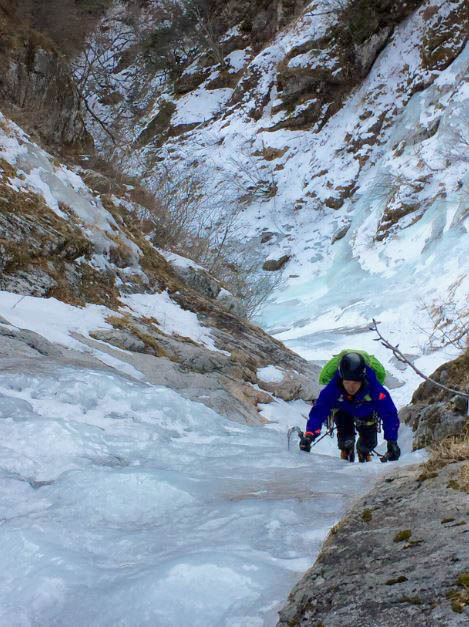
Ice is nice too.
Nobody would dispute that routes such as Kitadake Buttress or Tsurugi’s Chinne – both feature in Tony’s book – are magic lines. Even their names– Chinne as in Gross Zinne, Buttress as in Lochnagar – invite comparison with European classics. But such comparisons might be misleading, Tony suggests. For, if you choose to climb the Japanese classics, don't expect to waft by cable-car onto retro-bolted tracts of sun-warmed granite.

“Chamonix this isn’t,” says Tony. “The rock is often poor quality, and it tends not to take trad gear, leaving you dependent on crummy pitons. But once you’ve got a handle on it, it develops a character of its own – horrendous in situ pro, tatty slings, grassy slabs, and huge runouts are among the recurring motifs. Anyone coming from abroad will be guaranteed an intense cultural experience.”

Now, thanks to Tony’s efforts, the Japanese alpine climbing experience can be downloaded by a new generation of foreign climbers.

Wednesday, March 9, 2016

On writing and climbing

Wisdom from the latest edition of Alpinist magazine

It is not possible to write well without reading well. They go hand-in-hand like rope and rock. And, just as it is not possible to climb well without climbing meticulously, it is not possible to write well without writing meticulously, which inevitably requires many drafts. This is the craft. To refine over and over. To distill. Sloppy writing is as abhorrent and doomed to failure as sloppy climbing. 

What matters most in the mountains is economy. Moving quickly, efficiently, and thoughtfully. So too in writing. Occam's Razor should shave every sentence. And just like a good hand jam, you can feel a good sentence. It is secure, unadorned and moves the reader forward with unaffected grace. 

Strunk & White is right: the elements of style are clarity, precision and a reliable ear. You acquire these by years of reading and revising until the rhythm of your sentences becomes as natural as footfalls along an alpine path. "Writing good standard English is no cinch, and before you have managed it you will have encountered enough rough country to satisfy even the most adventurous spirit."

Similarly, writing maxims, which we writers regularly fail to live up to, apply equally well to climbing. For example, replace the word "writing" with the word "climbing" in the following literary axioms: don't talk about what you're going to write, write it; what's wrong with your writing is what's wrong with you; don't take your writing too seriously, lightheartedness is its own salvation; finish what you start; practice, practice, practice.

Mark Jenkins, The Bighorn Writers Convention, Alpinist 53

Tuesday, February 16, 2016

Images and ink (25)


Image: View of Mt Fuji, by Yoshida Hiroshi (1876-1950)

Ink: Preface to "Fuji-san" (2012) by Randy Taguchi:

What do the Japanese cherish and protect as a spiritual sanctuary? For a great many people, the answer is Mount Fuji. 

Mount Fuji occupies a strange and wondrous place in the Japanese imagination. When you set your eyes on its shining, majestic beauty, you feel a sense of gain for some reason. You can't help but tell someone that you saw the mountain today, and that it was lovely to behold. The beauty of Mount Fuji lifts your spirits, telling you that everything is all right, telling you to choose life. I wonder how many lives have been saved in this way. 

How many Japanese hearts Mount Fuji has inspired with hope for so long now. I wrote this anthology of stories as an expression of my veneration and appreciation for this life-affirming mountain; it is my personal tribute to Fujisan. 

Even as the times change, Mount Fuji continues to remain divine and awe-inspiring throughout the ages. We keep looking up at it with genuine gratitude in our hearts. And this simple act, I believe, is in itself a true way to pray.


Saturday, February 13, 2016

Being with the mountain

On December 21 last year, one of Japan’s top alpinists fell to her death from a winter climb on Kurodake in Hokkaido. Besides a glittering Himalayan track-record – for which see Ed Douglas’s tribute in the Guardian – Kei Taniguchi left behind a remarkable testament to her philosophy of mountaineering. This took the shape of an essay in Mountain 52, published just days before her death. Thanks to the generosity of Katie Ives, the magazine’s editor, you can read the full article online. It was the closing paragraphs that especially caught my attention:-

After decades of visiting the great ranges of the world, I've learned that I care most about the mountains of Japan. Each season, they reveal different faces. In winter, they wear only snow and ice and rock. They become luminous and quiet—although it's not easy to reach their heart in the deep drifts and the storms. A meter of snow can fall overnight. A swift blizzard can trap you. You inevitably have to face your weakness. How will you overcome it? The answer lies somewhere between the austerity of nature and your own ability. It's as if the entire scheme of existence plays out in a brief period of time. This harsh grace helps me grow the most.

From spring to autumn, there's an abundance of life. It's then that I like to be in the mountains by myself, catching fish, drinking stream water and picking mushrooms, nuts and wild grapes. I long to cross range after range, to venture ever deeper into the cradle of the wild.

The mountains have taken some of my friends' lives. But they have also shown me new life: the births of animals; the budding of flowers; the spreading of the vast, open air. The new dreams of lines and art that some- one might create—those are also essential elements of this vitality. For a climber, if there is no artistry, no beauty in alpinism, then there is no life.

In Japan, people have worshipped mountains since ancient times. These days, I enter the hills wishing to be accepted by the
yama no kami, the mountain gods. I ask to return safely, to be given some experience of beauty and to be taught some good way to shape my own life.

Wednesday, February 3, 2016

Meizan spring & autumn (5)

Failing to see Mt Fuji from Hakusan's separate mountain

Was it really necessary to get up two hours before daylight? I may have been rash enough to put the question to the Sensei over our pre-dawn cup of coffee. “You’ll see,” was all she said.


Soon after daybreak, we were walking up through a shadowy forest. The sun had yet to climb over Chiburi-one, the ridge we were heading for. Now I was beginning to understand the early start – geographically speaking, Bessan may be only an appendage to the Hakusan massif. Yet, as the name suggests, it is a “separate mountain”, and to climb it, you need to raise yourself through much the same interval – sixteen hundred vertical metres – as for Hakusan.

In the half-light, the huge trunks rose around us like columns in a Romanesque cathedral. The Sensei pointed out a particularly magnificent tree. It’s a konka, she said. Eh, I asked, what kanji do you spell that with? She gave me a funny look. Ah, naruhodo, a conker.

We stopped to fill our water bottles at a spring from central casting – a little rill of snow-chilled water, clear as crystal glass, burbling out from under a mossy arch of boulders. No wonder the trees like it here. As we climbed on in the growing light, the giant horse-chestnuts, oaks and katsura gradually gave way to beech trees.

On the ridge proper, we passed through a stand of maple, their leaves backlit a dramatic yellow against the liquid-blue autumn sky. Now we were in the realm of the kōyō, the autumn colours for which Japan’s mountain forests are justly famed.


But – or was this just a nostalgia attack? – perhaps those autumnal ochres and maroons and crimsons weren’t flaring quite as they used to. Stripping off another layer of fibre-pile, I wondered if it was just too warm to start the leaves turning properly.

We sat in a beech grove, sipping the cool water, munching sweet natto, and looking out at the white fringing to Hakusan’s summit crest yonder – yesterday’s clouds must have sprinkled down a little snow, the year’s first.

A clatter of rotor blades cut into our musings – a dun-coloured helicopter, a military spotter, choppered its way up the valley, then circled back. This hatsu-yuki no longer belonged to us.

Refreshed, we climbed into the realm of the dake-kamba, the rosy-barked high mountain birch. An exposed path led across a flank of the ridge. Fortunately, the black earth of the path was dry. Then suddenly we left the trees and moved up onto a grassy hogsback.


There’s sometimes a large snake here, sunning itself, said the Sensei, whose encounters with the local wildlife include quite a few bear and viper sightings. Privately, I hoped it was too late in the year for such denizens, but you never know your luck in these warming times.

Lunch was taken on a comfortable rock slab beside the refuge hut, some two-thirds of the way up the ridge. Beside the hollow-log water-trough, a sign invited us to clean our boots with the washing-up brushes provided. The idea, it explained, was to stop alien seeds from the lowlands migrating into the alpine zone. Truly, times have changed around here.

Again our musings were interrupted – this time, the whup-whup of rotor blades came from a big Bell helicopter, complete with chin-turret for its gyro-stabilised cameras. Apparently, a visit from NHK. And already the craft was sashaying to and fro across the summit ridge opposite, reeling in footage of the year’s first snow for the evening news show.

When the whine of the twin turbines had died away, we pried ourselves off our sun-warmed slab and turned to the last part of our climb. End-on, the top of Chiburi-one looked almost alpine. Soon our boots crunched through the first shards of ice while, all around, the creeping pine boughs that fringed the path rustled and whispered as they shed last night’s frozen snow.

On the col, a cold wind blew. Taking shelter in a hollow, the Sensei delegated the summit push to me. Ten minutes along the level ridge I came up to a small shrine, fringed with icicles – it’s said that Taichō Daishi, the monk who “opened” Hakusan in that first year of Yōrō (717) also pioneered the Chiburi ridge route to this subsidiary peak.


Beyond a summit marker inscribed with our height – 2,399 metres – the rocky spine of Honshū floated above a blue gulf of low-level haze. My gaze tracked rightwards from the hacksaw serrations of the Northern Alps – yes, there was the pimple of Yari and the statelier domes of the Hodaka massif – across a gap to Ontake, isolated and aloof – and then further still, southwards, to the indistinct ripples of the Chuo Alps.

Those ripples … I wish I’d looked harder in that direction. According to Michio Masunaga in his magisterial book on the mountains of Echizen, an Edo-era scholar named Kuroda Tomoari (1792-1859), who climbed Bessan in search of medicinal herbs, reported that he saw Mt Fuji from here.


Is this really possible? By consensus, Japan’s highest mountain can’t be seen from the top of Hakusan, fully 300 metres higher than Bessan, because the line of sight is blocked by Ontake. As for Bessan, Masunaga-san says that Mt Fuji would simply be hidden by the earth’s curvature; he himself, in a lifetime of mountaineering, has never seen the mountain from Bessan.

Hoping to settle the question, I later looked at my copy of the Handbook for Climbing Mt Fuji. Unfortunately, this invaluable reference just muddies matters further - it has a map that suggests that Mt Fuji can indeed be seen from the prefectures of both Fukui and Ishikawa, in which the Hakusan/Bessan massif stands. But, if so, where are those lofty viewpoints?


There was no time to pursue such enquiries now. The Sensei would be freezing in her bower of creeping pine, and we’d better be heading down – the sun was already westering tendentiously towards the Japan Sea.


Sixteen hundred downward metres are hard on the knees. Ours were laughing, as the Japanese say. Yet we managed to keep the sun in the sky until the lowermost woods. Then he dipped below the ridge and we were left darkling. Stars were pricking through the forest canopy by the time we reached the Sensei’s van. There was no need to ask again why we'd got up so early.


Sunday, November 22, 2015

Meizan spring & autumn (4)

Kyōgatake: a volcano that has taken the vow of silence

If you want to get to know a mountain, it’s best to visit in the company of its local guardians. So I leapt at the chance to inspect Kyōgatake with members of the Fukui Mountaineering Club, including its venerable president, Michio Masunaga. Appropriately, the summit we meant to climb is the highest that lies wholly within the borders of the club's home prefecture.


Skippping the first few hundred of Kyōgatake's 1,625 metres, we parked the cars half-way up Hozuki-one (“Moon-keeping ridge”). Clouds loured over the plain below, just as you'd expect from Hokuriku weather in October. A rainbow flickered out over nearby hills and rain started to spot.


We set off past a sign warning us about the vipers. Although snakes aren’t the most likely source of toxin in this season: “Don’t touch that, or you’ll come out in a rash,” said the Sensei, pointing to a shrub with crimson leaves. It seems that urushi, the plant that provides the resin for lacquer ware, has much the same effect on human skin as poison ivy. I took a photo for future reference.


Only one, mind, as Masunaga-san was setting a brisk pace up front, belying his 82 years. Indeed, this being a Monday, almost everybody in the group was of pensionable age, except for the Sensei and myself. Yet we didn’t manage to catch up with the advanced guard until they stopped for a breather. We nibbled hill food under two intertwined trees that go by the name of “Adam and Eve”.

This nod in the direction of religious syncretism could mislead. As the Hyakumeizan author points out, the mountain names around here are firmly in the traditional camp. “In front of Hakusan,” Fukada Kyūya writes in his essay on Arashima-dake, “are arrayed the lesser peaks of Hō-onji, Kyō-ga-take, Aka-usagi-yama, and Gankyōji, the playground of the Fukui Mountaineering Club. The Buddhist names of many of these mountains are said to trace out the route that Monk Taichō took when he made the first ascent of Hakusan.”


Kyōgatake means ‘Sutra Peak’, suggesting that a religious scroll might have been buried there. Lending credence to that theory, a sutra case was discovered near the summit in 1997, stamped with a seal that indicated that it had been brought here from Kai Province some time after the second year of Dai’ei (1522). A racier account of the name’s origin has the monks of Heisenji bringing their precious scrolls up here to burn when their monastery was sacked.


We recommenced our walk in a file no less disciplined than the far-famed “Kolonne” of the Swiss Alpine Club – the Sensei and I tried not to straggle this time. Just after we emerged from the trees on a grassy ridge, Masunaga-san stopped again. But this time it was for edification, not refreshment.

Here was the perfect place – our leader extended a ski-pole in a proprietorial manner – to observe where Kyōgatake’s ancient crater had collapsed, sending debris cascading down into the plain. That was in Jōmon times, about five to seven thousand years ago, about a million years after Kyōgatake's eruptive heyday.


I was impressed. Hearing that Kyōgatake had once been a volcano was like discovering that some placid senior citizen, a pillar of the local community, was notorious in his youth for a blazing temper and riotous excess.

Actually, you could extend that remark to the whole landscape we were looking at – yonder was Arashima-dake, apparently a model of orographic sobriety. But if you’d been standing here 20 million years ago, say the savants, you would have seen eruption after eruption. Later, the volcanic edifice crumbled away, but the day was saved for future Hyakumeizan enthusiasts when a bleb of igneous rock welled up to form today’s peaceable summit. So today you start climbing the mountain on volcanic debris and end up on top of a granitic dome.

A little later, plumes of steam and smoke would have billowed from a seawards direction as red-hot lava surged out into shallow coastal waters. Then these effusions hardened and crystallised into elegant hexagonal pillars of basalt. Today, you can watch crack-climbing fans clambering up them at Tojinbō, Echizen’s answer to the Giant’s Causeway.


Masunaga-san had timed his briefing well. A little further on, we clambered up a wooden ladder past a wall of gritty grey and unmistakably volcanic rock – like frozen porridge – showing through the russet and yellow foliage.

Another steep slope led up to an intermediate top known as Shakushi-dake, which may have been the original name for the whole mountain. From here we could look down into the hollow left by the crater collapse – so much like a Lost World under these overcast skies that all it needed to complete the scene was a brace of pterandons flapping their way up out of the mist-raking treetops on leathery wings.


On the far side of Shakushi is another col. It was here that “a long time ago” Masunaga-san had bivvied in a snowhole during a winter climb of Kyōgatake. They’d started from the ski-ground at Rokuroshi and took the whole day to get this far, using a rope to traverse the narrow parts of the ridge.

Reading this account in Masunaga-san's book on 150 mountains of Fukui, I was reminded that these mountains have a bipolar character, balancing a benign face during the warm seasons with arctic asperity in mid-winter.

As he and his companions climbed the mid-winter mountain, he only sound was the crunch of their traditional snowshoes (kanjiki) biting into the drifts. The snow-laden trees merged into the mists, blurring the world into a milky whiteness: “It felt as if, little by little, we were being absorbed into the landscape.”


Another steep slope took us to the true summit. Once again, the Sensei and I found ourselves scrambling to keep up as, gripping handfuls of sasa or a grimy rope, we A-zeroed ourselves up the muddy runnel of a path.

Inland, the clouds had completely blotted out the most eminent Meizan of the whole Hokuriku region. Yet we didn't miss the view much. Geologically speaking, Hakusan is a mere upstart when compared with the ancient heritage of our own peak. Sometimes, maturity has its charms too.

Wednesday, November 11, 2015

Meizan spring & autumn (3)

Fujisha-ga-dake: following in the footsteps of Fukada Kyūya

Maitta, na. The poem wasn’t there – there was still a wooden post in the ground, but both plaque and poem were gone. Oh no, said the Sensei. I can’t say I was bothered, though. It was too splendid a day to worry about one tanka or haiku more or less.


Sometimes I suspect that Hokuriku folk are playing the Seattle game – they talk up their fogs, mists, rains and snows to put off potential migrants from the overcrowded cities on the Pacific coast – who might otherwise surge over the mountains, in zombie-like hordes, and turn these rural provinces of Ura-Nihon into another concrete wasteland...


But, if that really is their game, they’ll need to keep quiet about days like this one. The morning shrugged off its last mists as the Sensei drove her van up the mountain road. A sturdy suspension bridge took us across a reservoir’s tea-green snowmelt and then in the strengthening day we’d rambled up through the beech woods.

On this May morning, the light roared vertically down onto our summit from a cloudless zenith. The glare picked out every leaf and shrub in hyper-real viridian. Westwards, the ultramarines of the Japan Sea merged into an azure sky.


Was it a day like this when Fukada Kyūya, the future Hyakumeizan author, was captured by the mountains? “My hometown is Daishōji, in Ishikawa Prefecture,” he records in an essay on the mountains of Echizen, “but my mother was from Fukui, and that’s why I went to Fukui Middle School (today’s Fujishima High School). So the blood of both Kaga and Echizen courses through my veins. And, in my final year at primary school, the first mountain I ever climbed was Fujisha-ga-dake, which straddles the border between the two prefectures. Although it is only 942 metres high, the mountain that overlooks my hometown is elegantly formed.”

Fujisha-ga-dake, a "Fuji-imitating peak"
(Photo courtesy of Yama to Keikoku magazine)

In the next paragraphs, Fukada explains what set him on the path towards his famous One Hundred Mountains:

People don’t just fall in love with mountains. They need some kind of impetus. In my case, somebody praised me for being a strong walker – if you want to get somebody to do something, the first thing to do is flatter them. In my hometown, there was a lad called Inasaka Kenzō, five years older than me, who was already studying medicine in Kanazawa at the time I started middle school. Ken-chan was a mountain-lover who was already doing climbs in the Northern Alps, and it was this great sempai who first taught me mountain ways. And a good guide is the second thing you need if you’re going to really get involved with something.


On this blindingly bright top, the first thing that involved me was to slap on more sun-cream. And the second was to sit down on a convenient log and sink my teeth into one of the Sensei’s industrial-strength onigiri – we’d had an early start. Around us, couples and families were spreading out picnic cloths and tucking into their Hello Kitty lunch boxes – Fujisha is still a good mountain for children. Primus stoves were roaring too, so that sybarites could sip hot soup or filtered coffee while gazing out into the blue distances.

Equipment choices were simpler in Fukada Kyūya’s youth:

I climbed many of our local mountains while I was in middle school. For seven and a half sen, you could buy a sheet of the Army General Staff’s 1:50,000 scale maps, and I liked to mark mine up with red pencil lines to show where I’d been. There were still no rucksacks and so I just slung my schoolbag over my shoulder and set off in straw sandals and leggings. By the time I went on to high school in Tokyo, I’d fallen completely in thrall to the mountains.

In high school, he fell for poetry too. Under the nom-de-fudé of Kyūzan (“Nine Mountains”), he churned out haikus and, with friends from his native Hokuriku, started a school literary journal. His enthusiasm for seventeen-syllable effusions faded after he moved on to Tokyo University – short stories and novels were more the thing now – but he kept composing the odd verse all through his life. It was one of these later poems that the Sensei wanted to show me. Somebody had recently put it up on this mountaintop, she said.


We walked over to a neighbouring clearing but found it empty, except for that telltale post. The poem had flown. Or somebody had taken it down. Probably Fukada would have preferred it this way – not a few of his Nihon Hyakumeizan chapters end with acerb comments on people who try to embellish mountaintops with statues, monuments and other tat: “You never saw such things in the old days and, speaking for myself, I prefer my summits unencumbered with them,” he wrote in the chapter on Senjō-dake.

In the end, we didn’t need a text – the Sensei discovered that she could remember the poem and, on the way down the mountain – note to potential visitors from Omote-Nihon: this path is horribly slippery even in fine weather – she recited it to me:-

山の茜を顧みて/一つの山を終りけり/何の俘のわが心/早も急かるる次の山

Yama no akane wo kaerimite/hitotsu no yama wo owarikeri/nan no toriko no wagakokoro/hayamo isogaru tsugi no yama

Still the evening peaks are burning
And though our climb is hardly done
My captive heart’s already yearning,
Aye desperately, to find our next one.

When the meaning of these words had trickled through, I looked at the Sensei with amazement. It was as if old Fukada had just read our minds. “So, where will you take us next?” I asked.