Monday, November 29, 2021

Fact into fiction

How a mountain writer of the belle époque borrowed from real life

Mountain writers who climb at a high standard often seem to emphasise the dark side of alpinism. Think Joe Simpson in Touching the Void, or Mark Twight in Kiss or Kill: Confessions of a Serial Climber.
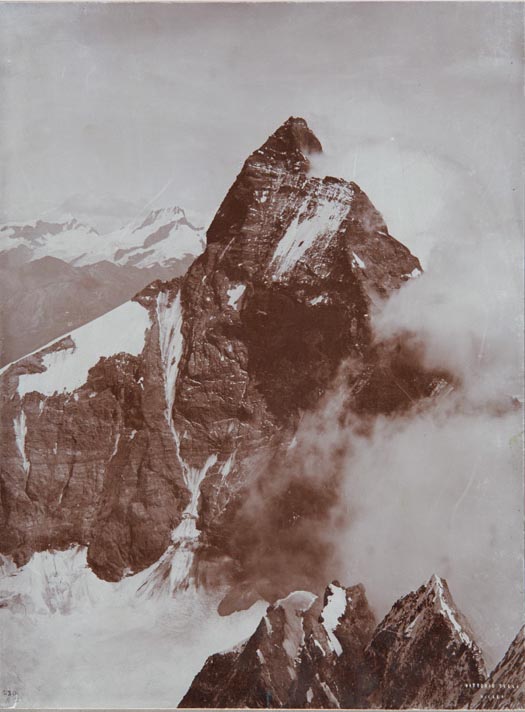
The Matterhorn's west face, seen from the Dent d'Herens
Photo by Vittorio Sella, courtesy of Andrew Smith Gallery

I
n an earlier generation,the Swiss author and alpinist Charles Gos (1885–1949) was no exception to this pattern. Alpine Tragedy, his account of 25 selected mountain accidents, delivers amply on its lugubrious title; a subsequent novel has two of its three protagonists fall to their deaths from a north face, and Gladys, the heroine of the eponymous short story translated for this blog, meets her end in a rockfall.

For the time – Gladys is set at the end of the belle époque – Gos's creation is an unusual figure, even in fiction. We are first properly introduced to her as an accomplished concert pianist, playing at a soirée hosted by a senior personage of Britain’s Alpine Club, but it is in the mountains that her star burns brightest. With her husband, the Count of Fairness, she blazes a trail across the Alps. And what a trail:

… the couple continued a brilliant series of ascents: the Aiguille Verte by the Moine ridge, the Géant by the north face, the Dent Blanche by the Ferpècle ridge, the Dent d'Hérens by the hanging glacier that leads up to the Tiefenmattenjoch (the latter, a new route, if I'm not mistaken), and many other expeditions, all first-rate …

What is more, all these first-rate expeditions are conducted without guides – a more remarkable circumstance before the First World War than in the cash-strapped years that followed it. Gos even permits himself a brief disquisition on authentic guideless climbers as compared with less qualified ones:

A true guideless climber must bring together physical stamina and moral strength, which is a fundamental quality as necessary, if not more so, than instinct (which cannot be learned) when it comes to finding the least dangerous line or the best chimney in the middle of a cliff, or the strongest snow bridge on a glacier, or the slope least prone to avalanches.

Guideless climbers fall into two categories, the real ones and the make-believes. The former are as good as the best guides, or almost so; the second kind are just favoured by luck; let’s call them honorary guideless climbers. The Fairnesses clearly belonged to the first category, demonstrating their mastery, almost coquettishly, with a boldness that bordered on heroism.

Alas, fate all too soon catches up with the guideless couple. Descending from the Matterhorn’s Z’mutt Ridge one autumn afternoon, they are avalanched in the Penhall Couloir, a snow gully that seams the mountain’s western face. The Count staggers away to find help, while the heroine is left unconscious in the snow…

The Penhall Couloir on the Matterhorn's west face
Photo by Vittorio Sella, courtesy of Andrew Smith Gallery

It’s hardly surprising that Gos was well-qualified to describe this scene. He knew the terrain well, having himself led what was probably the first guideless ascent of the Z’mutt ridge. And the accident to which he subjects his heroine came straight from a real-life disaster that happened some decades before.

Just like the Count and Countess of Fairness, the Austrian alpinist Guido Lammer and August Lorria – two leading proponents of guideless climbing – were descending the Penhall Couloir when they were avalanched. And just like the fictional couple, Lammer had to leave his companion lying senseless in the snow while he hastened down the glacier to find help at the Staffel Alp hut. Like Gladys, Lorria was rescued, recovered and later wrote up his experience, in his case as “An accident on the Matterhorn in 1887”.

Of course, fiction is very far from fact. In some respects, Charles Gos cleaves closely to the historical accident – the effects of severe concussion are one detail that he carries over into his short story. But other aspects of the 1887 accident – such the NDE-like thoughts that pass through Lammer’s mind as the avalanche carries him down – are left unexploited. As must always be the case, the consummate artist abstracts as much as he borrows from the real world.

References

Gladys, the second story in La Croix du Cervin (1919), a collection of alpine fiction by Charles Gos (1885-1949). Translation (c) Project Hyakumeizan.

An account of the 1887 accident taken from the English edition of Guido Rey’s The Matterhorn introduced and with two additional chapters by R L G Irving:

The aspect of the wall Penhall climbed is anything but encouraging, and Messrs. G. Lammer's and A. Lorria's experience of it on August 3rd, 1887, confirms the report of its difficulty and also shows up its danger. Dr. Guido Lammer described the events of that terrible day in the Oesterreichische Alpen Zeitung,vol. ix. no. 188, p. 205.

The two skilled mountaineers, without guides, were ascending the Tiefenmatten face by Penhall's route. At 1 p.m. they were on a level with the teeth on the Z'mutt spur. The face was glazed with black ice, and in a most dangerous condition. They decided to turn back. About five o'clock they were crossing the Penhall couloir when a small snow avalanche fell towards them from above. It did not strike them, but flowing down at their feet, it made them lose their balance and carried them down in a leap of 150 to 200 metres (500 to 600 feet).

Dr. Lammer related that during those very short moments a crowd of the most varied thoughts flashed through his mind with extraordinary clearness; and, while the consequences of such a fall were thoroughly evident to him he had time to think of his home, of a certain Alpine and literary controversy, of india-rubber balls rebounding with prodigious elasticity, etc. etc., all which led him to the conclusion that death by falling must be quite painless.

When at last they stopped Lammer felt an intense pain in his foot, which had been dislocated. His friend was lying motionless a short distance away. He had a terrible wound on his forehead and a broken leg; the rope, which had become much entangled during the fall, was compressing his neck; he was unconscious, and when he recovered consciousness he was seized with delirium, unbroken by any lucid interval.

Dr. Lammer attempted to drag him down-hill over the snow, but his companion howled with pain, cursed imaginary assassins, clutched himself with his hands, and rolled about on the avalanche snow. Lammer was prevented by his own condition and the difficulty of the place they were in, from making any other efforts to convey his friend downwards; he laid him on a mound of snow, threw his own jacket over his shoulders, and put his hands into a pair of stockings. He wished to tie him to a rock with the rope, but it seemed to him cruel to make it impossible for his friend to move if he should recover consciousness.

He shouted loudly and frequently for help, but no voice was heard in reply. He then descended alone, without an axe, without his coat, and without a hat; he dragged himself across the glacier to the Stockje hut on the opposite side. Finding no one there he resumed his journey, and limped and crawled, as best he could, down the long Z'Mutt glacier, till at nightfall he was knocking, quite exhausted, at the door of the Staffel Alp.

The relief party which he sent off reached the spot where Lorria was lying at eight inthe morning, and found him still unconscious. In his delirium he had torn off his clothes. Lorria suffered long from the effects of his fall.

This event was followed by a violent controversy. Some firmly maintained that the accident was due to the absence of guides, while others were convinced that it would have occurred just the same if a guide had been with the climbers. [Dr. Guido Lammer's writings show him to have had a morbid attraction for dangerous situations; hence, perhaps, the choice of Penhall's route. – R.L.G.Irving.]

Wednesday, November 17, 2021

No recovery for Switzerland's glaciers

The annual audit of snowfall, glacier wastage and permafrost depth in the Swiss Alps, as reported by the Cryospheric Commission of the Swiss Academy of Sciences

At low altitudes, the winter of 2019/20 saw the lowest level of snowfall ever. The loss of ice volume in Swiss glaciers continued in the summer of 2020, during which temperatures reached record highs. The influence of climate change on the cryosphere is very evident.

Meltwater channel on the Kanderfirn, 2018
Image by courtesy of Alpine Light & Structure

Weather and snow: little snow at low altitudes

In the winter of 2019/20, the mountains were covered with snow about two weeks earlier than normal, at the beginning of November. Record snowfalls for November occurred in some locations on the southern slopes of the Alps. 

Temperatures then reached record highs from December to February, more than 3°C over the long-term average.The following spring was also clearly too warm and characterised by a lot of sunshine. Below 1,000 metres, precipitation fell mostly as rain during the entire winter half-year. In terms of mean snow depth, this led to the winter with the least snow since measurements began, just ahead of 1989/90 and clearly ahead of 2006/07. 

At several stations, for example in Marsens/FR (718m), Einsiedeln/SZ (910m) or Elm/GL (965m), there had never before been so few snow days (days with at least 1 cm of snow). At some low-lying stations on the northern side of the Alps (eg Stans, Basel and Lucerne), no snow at all was recorded for the first time ever.

Above about 1,700 metres, however, snow depths were average in the northern Ticino and in the southern Valais, which was mainly due to the large snowfalls at the beginning of winter and in February.

Very warm between July and September 2020

With the exception of the measuring stations in southern Valais, the snow melted everywhere one to four weeks earlier than normal. The months of July to September 2020 were once again characterised by above-average temperatures. In contrast to the two previous hot summers, snow fell twice in August to just below 2000 metres. On the last weekend of September, the snowfall line on the north side of the Alps fell to as low as about 1,000 metres. Above that, 20 to 80 centimetres of fresh snow were recorded, which is unusual for this time of year, leaving the Alps in a thick white mantle.


Ice collapse on the Morteratsch Glacier, November 2011
Image by courtesy of Alpine Light & Structure

Glaciers: another 2% of ice volume lost

Between the autumns of 2019 and 2020, glacier loss continued relentlessly, but was somewhat less dramatic compared to the previous three measurement periods of 2016/17, 2017/18, and 2018/19. After average snow amounts were measured at the glaciers' elevations in early May, the summer melt was once again substantial. 

Over the entire year, low-lying shallow glaciers (eg the Glacier de Tsanfleuron/VS) showed an average reduction in ice thickness of two metres. Glaciers in southern Valais as well as in Ticino and the Engadin (eg the Findelgletscher and the Ghiacciaio del Basodino) lost only about half a metre in thickness, which can be attributed to the large amounts of snow in early winter as well as the positive effect of the summer snowfalls. 

The amount of snow on the Silvretta glacier in Graubünden was about the same as the average for the past decade. This shows that 2019/20 was not an extreme year in terms of the current situation - despite massive losses of about 2% of the remaining glacier volume in Switzerland. 

All glacier tongues are receding

The shrinkback of glacier tongues reflects weather conditions over a period of several years rather than the effects of a single year. Climatic conditions affect the position of the tongue with a varying lag depending on the tongue’s location. The fact that the autumn measurements showed a further reduction in the length of glaciers is therefore hardly surprising. 

With two exceptions, the glaciers showed a shrinkage of up to 25 metres. Massive recessions of more than 50 metres were seen at Kanderfirn/BE and Sankt Annafirn/UR. In both cases, the tongues have thinned out increasingly in recent years and have now literally disintegrated.


Block glacier in Val Sassa, 2021
Image by courtesy of Alpine Light & Structure

Permafrost: 11 metres of thaw layer on the Schilthorn 

On the 20th anniversary of the Swiss Permafrost Measurement Network Permos, all permafrost measurement parameters have reached or exceeded the record values posted in 2015.

Due to the early snowfall in autumn 2019, the permafrost accumulated a lot of heat. As a result, surface temperatures were above average, especially during the winter, while annual averages were in the range of the extremely warm years of 2003, 2015 and 2018. The high surface temperatures led to an increase in the depth of the thaw layer – the uppermost metres above the permafrost that thaw each summer. 

The previous record values were reached or exceeded everywhere, from 2.8 metres at Flüela/GR to 11 metres on the Schilthorn/BE. The latter is the deepest thaw layer ever measured in Swiss permafrost. Since the beginning of measurements in 1998, the depth at this location has more than doubled. Across Switzerland, the increase on the previous year ranges from a few centimetres to half a metre.

End of the short recovery

The short break in the warming trend that was seen after the snow-sparse winter of 2017 is definitely over. Permafrost temperatures are again similar to or even higher than in the previous record year of 2015. But the permafrost reacts to the changes at the surface only with a long lag time, implying that the warm conditions of recent years have not yet fully penetrated into the depths. 

The creep rates of rock glaciers generally follow the trend of permafrost temperatures. Compared with the previous year, they have again increased by an average of 20% on the previous year, exceeding the previous record values from 2015 in some cases.

Text: Matthias Huss, Christoph Marty, Andreas Bauder und Jeannette Nötzli


Retreat of the Forno Glacier
Image by courtesy of Alpine Light & Structure

Appendix: New radar system used to measure glacier ice depth 


Data on the extent of glaciers and their ice thickness are of interest not just to alpinists but also to forecasters of future glacier retreat and runoff, as well as for the assessment of glacier-related natural hazards. In close cooperation with Swisstopo, the Swiss Federal Office of Topography, the Swiss Glacier Monitoring Network Glamos has therefore compiled a new detailed inventory of the country’s glaciated areas. In 2016, glacier ice covered 961 square kilometres or 2.3% of the country's surface.

In addition to the inventory, a project at ETH Zurich, a new type of helicopter-borne radar was used to measure the ice depth of all larger glaciers. Ice depth measurements are now available along a total track of more than 2,000 kilometers, which makes it possible to determine the total ice volume.

The volume of all Swiss glaciers for the reference year 2016 is estimated at 58.7±2.5 cubic kilometres. Distributed over the area of the whole of Switzerland, this corresponds to a water layer 1.3 metres deep. In line with the extent of the glaciers, ice volume is concentrated mainly in the Bernese and Valais Alps, but considerable volumes are also found in central and eastern Switzerland. 

The Great Aletsch glacier – the largest Alpine glacier at just under 80 square kilometres – accounts for 11.7 cubic kilometres of ice. Thus, it alone stores about 20% of Switzerland's glacier ice. By combining these results with annual measurement data, it is possible to determine what proportion of the existing ice has been lost. The numbers are impressive: since 2000, Swiss glaciers have lost just under a third of their remaining ice mass, and in an extreme year the loss can amount to more than 3% in a single year. 

The extent of glaciers and their depths can now be can now be viewed directly on the official online map of Switzerland at map.geo.admin.ch. The map shows the most important most important parameters such as area, volume or the maximum and the average ice thickness for the respective glacier.

Source


© Die Alpen, journal of the Swiss Alpine Club, 06 2021 edition. Originally published in German. This is an unofficial translation by MAGE/Captain. Images and charts of original article are not reproduced here. 


Monday, November 15, 2021

Honouring the Hyakumeizan author's memory


Half a century has passed since Fukada Kyūya collapsed on a hike “among the mountains he loved” –the very words that should be used to describe such a fate, as he himself had once written. To mark this anniversary, an exhibition at the Fukui Museum of Literature (福井ふるさと文学館) will run until January next year.

Some might flag up an act of cultural appropriation here. For the Hyakumeizan author was born at Daishōji in neighbouring Ishikawa Prefecture, he lived for decades in Tokyo, and he died on Kaya-ga-dake (1704 metres) in Yamanashi. But Fukada’s mother came from Fukui, he went to school there, and he later anointed Arashima-dake, a Fukui meizan, as one of his hundred mountains. So this prefecture too has a claim on him.

The exhibition casts its net widely. As one might expect, mementoes of the Hyakumeizan author are on loan from the Fukada Kyūya Memorial Museum (深田久弥 山の文化館) at Daishōji. These include a manuscript of Nihon Hyakumeizan, as well as the author's pen. Awkwardly, his passport, also on show, reveals that officialdom chose to spell his family name as “Fukata”. Well, we’ll stick with the usual version here.

Other mountain authors are featured too. There is a manuscript of Nitta Jirō’s Tale of a Mt Fuji Porter (強力伝) and items related to Akutagawa Ryūnosuke, whose “Kappa” (1927) is set in the Japan Northern Alps. And there are paintings by Kushida Magoichi, who is best known for his Mountain thoughts (Yama no pensée), and images by the present-day photographer Ishikawa Naoki.

For alpinists, the holiest relic of all will be the very notebook in which Matsunami Akira scribbled his last words. Posthumously published as Fusetsu no Biwak (Bivouac in a blizzard), this is the account of a fatal attempt to traverse the entire Hodaka ridgeline in midwinter. Found by a search party on Matsunami’s body in the spring, the notebook is visiting Fukui by courtesy of the Ohmachi Alpine Museum.

Supporting events include a speech on mountains and literature by Fukui’s doyen of mountain writing, Masunaga Michio, an exhibition of photography by Ishikawa Naoki, and a showing of Hyōheki (Ice wall), the film of a novel by Inoue Yasushi that takes a broken rope as its mainspring. To round things off, there is a comedy film about people who go on a hike to a waterfall and get lost. Surely, everyone can relate to that.

“Yama ga aru kara” (Because it’s there), an exhibition at the Fukui Museum of Literature (福井ふるさと文学館), opened on 30 October 2021 and will close on 23 January 2022. See the exibition webpage for details and a programme of events.

Monday, October 18, 2021

Calling all meizanologists


A conference on Japan’s alpine culture is due to convene on November 14 and 21, both Sundays. Entitled 
The Alpine Archipelago: Surveying Japan from the Timberline, this is probably the first meizanological conference ever to take place outside Japan.

The organisers, David Fedman and Jon Pitt, both of UC Irvine, outline the programme as follows:

Taking a timberline view of Japanese society, this conference explores the place of mountains in Japanese history, literature, film, religion, and popular culture. It does so in the same spirit as Fukada Kyūya's One Hundred Mountains of Japan (Nihon Hyakumeizan): by offering detailed portraits of individual mountain landscapes and the communities in which they are embedded. Each speaker will guide us to a particular peak, showcasing not just the wide range of alpine environments in Japan but the host of methodological approaches to studying the upland areas that make up the better part of the archipelago.

The presenters are David Fedman on Petari-dake; Shayne Dahl (Harvard University) on Gassan; Alison Miller (Sewanee: The University Of The South) on Tsurugidake; Aaron Jasny (University of Maryland, Global Campus) on Yarigatake; Eric Cunningham (Earlham College) on Ontakesan; Pedro Bassoe (Purdue University) on Hakusan; Andrew Bernstein (Lewis & Clark College) on Fujisan; Joanna Linzer (Harvard University) on Dōgo-yama; Komeie Taisaku (Kyoto University) on Ominesan; and Jon Pitt on Chibusayama.


Wednesday, October 13, 2021

Last blue mountain

Absurd, it seemed. 

Yes, we got the e-mail. A late-season attempt on the NE Pillar ...
 
But, on Friday, surely the phone would ring, and the gravelly voice would ask about tomorrow. And then, before dawn, we'd be on our way again in the battered white Volkswagen – which, incredibly, was older than my weather-beaten Subaru. 

Old cars give you something to talk about: how to keep them going; the iniquities of Swiss auto repair shops; hassles at work; the key points all driven home with a broad wink and a grin in your direction. Right, but how about keeping one eye on the road, I wanted to ask – but, still, we'd get there in the end. 


Like the time we went to the Bifertenstock, a great white whale of a mountain. The cold winter air floods in and we're unloading skis and gear all over the road. This morning, maybe in March, we’ve parked in Brigels, a village in the Grisons, and there are three of us. I was the one who suggested the mountain but the plan is now being prosecuted at a different level of intensity. We even set off without a coffee. 
 
Now the sun is up and Alpinist S. is out ahead on the Val Frisal, a small outwash plain. The photo shows a small figure, red-jacketed, already half-way to the glacier. The sky is blue and there's just a wisp of cloud curling over the ridge. The image shows how misleading both photos and weather can be, because the clouds soon clamp down, an ominous-looking serac looms above, and the icy slope curves down and away below our ski-crampons. 
 
"I'm not happy about this," I say, and there's a crisp reply – "I know" – from above. 
 
We're on edge here: Alpinist S. wants to go on, I'm for turning, and Alpinist A. is hovering. Now we can hardly see each other on the rope. The weather casts its vote, and it really is time to point those skis downhill. 
 
These photos are getting to be a genre. Here's another showing the tiny red-jacketed figure, far ahead, but this time it's the Blinnenhorn in the background, the shadows borrowing their icy blue from the sky overhead. Deep blue shadows, blue-washed snow, a lemon-slice moon recumbent in the cold blue sky. Not another soul around. Somebody else’s verses float to mind: 
 
"We are the Pilgrims, master; we shall go
Always a little further: it may be
Beyond the last blue mountain barred with snow… "


Poems, as well as photos, can mislead. The red-jacketed figure is waiting – he always waits for slower companions and patiently too – because two ways lead there. There's a high road and a low one, and Alpinist S. took the high one. The high line was faster (another giant wink when we meet), hence the wait, but it led over a steep and icy slope. The low road, my choice, seemed safer, but you had to take off your skis and flounder down a gully choked and primed with powder snow. 
 
Another hour or so, and we're underneath the summit ridge. The wind is cutting, the ridge is icy, but we've left crampons and axes behind to save weight. That's enough for me; that ridge is crampon territory or none, but for Alpinist S., it's the top that counts. "I'll have a look," he says with that wink. He starts off up the ridge, propped on ski-sticks against the wind, while I fight off hypothermia. An hour or so later, we're both hypothermic. Alpinist S. got his summit and we're skiing back over the glacier. 
 
We're not home yet. Even Alpinist S. doesn't want to repeat the icy traverse, so he asks about my snow gully. "It's OK," I say. But it's not. That gully is a bomb waiting to go off. The powder's too deep, too loose to walk up; you'd sink to the waist. Without comment, Alpinist S. sets off – it's difficult, tense work laying a ski-track in that white mine-field smother. But there's no other way. At the top, there are no recriminations. There are none on our tours. 
 
Another March, we're skiing up Piz Platta, another unheard-of mountain in the Grisons, and, needless to say, from the steep side. This time Alpinist S. isn't out ahead, but only because he has a cold. As the snow clouds dissipate, the air above us glitters with diamond dust. Another crew goes off-route and has to climb a rock step in ski-boots but we find the right way, across a ledge into the summit gully, thinking instead of floundering. We have a doctor of science in the lead, you see. 

At the top is a massive summit cross, two great beams of iron-clenched pine. The golden light comes grazing across the rippled ridges. If we don't want a night epic, we'd better be on our way. The couloir is steep, but Alpinist S. strolls down it like a city street. I'm more circumspect. Some might call this steep. 

The uncompromising ethic might scare you. Or it can save your bacon. The mountains are already snowed in and it's a grey autumn day. We're making the most of it on the limestone flutings of a crag near Zurich. Left to myself, I'd take the easy route up. But you need the practice, don't you, Alpinist S. says (with another of those mighty winks), so we end up on the V+ territory on the right, rock shoes scarting off the embedded oyster fossils. Alpinist S. is doing the leading, so it's his call. It's steep, one might say. 

 We're half-way up when there's a rumble on the left. Two boulders – head-sized – are bouncing down the easy route. People start shouting; a girl's been hit on the hand. It takes twenty minutes for a helicopter to come in, put a skid on the rock terrace and take her aboard. 

Other parties abseil off. Their rats have probably had enough for today. Anyway, it's late. But we haven't finished the route. This time, I don't even suggest giving up. Waste of breath. Alpinist S. confronts the overhang and subdues it. When we get back to the packs, everyone else has gone and the chair-lift down the meadows stopped running hours ago. We walk down to the weather-beaten Volkswagen in the dusk. 
 
Of course, we wouldn't be setting out in the VW any more. Its last trip is to the Ringelspitz, on a cold November weekend. The ground is frozen hard but there's still no snow. At dawn, on our way to the ridge, we surprise a herd of chamoix. Better not to make them run, says Alpinist S., or they'll burn up their fat before the winter. On the way home in the car, a Ferrari-like roar bursts out from below decks. The exhaust has fallen off. OK, that's it for the Golf, says Alpinist S., after getting out to check: I'm taking it to the scrapyard. No sentiment for old cars. 
 
Another year, and we've both survived the summer. And then the e-mail arrives, on a bland autumn morning. At first, it seems absurd that the phone won't ring on Friday, that the old cars won't be lurching out of their parking bays, that we won't be climbing into the freezing fog or skiing down in the dark, Alpinist S. waiting for us in the distance. Now it really does start to sink in, that he won't be waiting. This time, he really did go on too far ahead. 


Tuesday, May 25, 2021

“Tozan-shi” (4) – war and restoration

An outline history of mountaineering in Japan - the roads to Japan's eight-thousander and national federations

During the 1930s, military men such as Ishiwara Kanji envisaged a “national defence state” in which all economic and social activities would focus on achieving Japan’s strategic goals. As war approached, it was only a question of time before mountaineering too fell into the maw of this totalitarian machine.

Japan's eight-thousander: Imanishi Toshio summits Manaslu in 1956

In January 1941, an umbrella organisation was set up to supervise all Japanese mountaineering activities and clubs. One purpose of this Nihon Sangaku Renmei was to promote a theory of mountaineering for the good of the imperial state (kōkoku tozandō). 


Individual mountaineers were less easily regimented. Many kept silent, or simply gave up climbing. Among the clubs that faded from the scene during this period were the Kiri-no-tabi-kai, noted for its “contemplative” approach to the hills, and Club Edelweiss, one of Japan’s first alpine associations for women.

After hostilities ended, mountaineers made up for lost time. The pioneer of winter climbing on the Hodaka massif’s Byōbu-iwa, Shinmura Shōichi made a notable winter traverse between Tsurugi and Yari-ga-take in March-April 1947, snowholing all the way. 

Two years later, attempting another long winter traverse, Matsunami Akira and Arimoto Katsumi came to grief on Yari-ga-take’s Kita-kama ridge. The diary and farewell message they left behind in their last bivouac has become a classic of Japan’s mountain literature, inspiring novels by Inoue Yasushi, Nitta Jirō and Yasukawa Shigeo.

Another Byōbu pioneer, the medical researcher and Academic Alpine Club of Kyoto member Itō Yōhei founded a new mountaineering magazine, Gakujin, in May 1947. To this day, the magazine remains the main rival to Japan’s first and most prominent mountain monthly, Yama to Keikoku, which issued its first postwar edition as early as January 1946.
 
In March 1948, Itō made the first winter ascent of a face route on Byōbu. For Itō, as for all his fellow AACK members, winter climbing was simply training for the Himalaya. In the midwinter of 1952/53, he led an expedition to Hokkaidō’s remote Shiretoko Peninsula and, in the autumn, joined the club’s attempt on Annapurna IV. They didn’t summit, but the AACK had made good on its pre-war commitment to Himalayan climbing.

Winter mountaineering was the natural preserve of the university clubs, notably Waseda’s, as the multi-day time commitment tended to exclude the salaryman climbers. These unfortunates had to make do with the cliffs of Tanigawa, which lay within weekend range. But one of them, Okuyama Akira,  was determined to give the academicians a run for their money.

Frustrated by a seeming stagnation in technical climbing standards, Okuyama mused about creating an elite climbing association, drawing the best climbers from clubs all over Japan. In January 1958, the new group took shape as the RCCII, its name harking back to the original Rock Climbing Club of Kobe, the outfit founded in 1924 by Fujiki Kuzō. The RCCII made its first mark in June the same year when they climbed an overhanging face on Tanigawa-dake, using expansion bolts for the first time in Japan.

Meanwhile, the AACK was sniffing around the foot of Manaslu, an unclimbed Himalayan eight-thousander. In October 1952, Imanishi Kinji, one of the club’s founders, led a small party to walk clockwise around the mountain, seeking a way up. Two more expeditions, now under the auspices of the Japanese Alpine Club, were unsuccessful before Imanishi Toshio (no relation) was finally able to step onto the summit in May 1956.

This triumph touched off a “Manaslu boom” in domestic mountaineering. Inevitably, as more people surged into the mountains, the accident rate boomed too. The growing casualty rate – the annual death toll from accidents almost doubled between the late 1950s and early 1960s – threw the mountaineering world’s lack of cohesion into stark relief. In fact, no central organisation had existed since the war to represent Japan’s thousands of mountaineering clubs in their dealings with the government and the public. 

What Japan needed was a European-style federation, along the lines of the Club alpin français. Or so argued Kondō Nobuyuki, a former Waseda man, mountain writer and Japanese Alpine Club member. But efforts by JAC-affiliated officers to gain influence within early attempts at a national federation met with resistance, particularly from folk who saw their club as elitist and unrepresentative.

When established in April 1960, the Japan Mountaineering Association (日本山岳協会) was conceived as the representative body for all Japan’s mountaineers. Nested within the Japan Sports Association (JSPO), it would concern itself with all domestic mountaineering matters, leaving the responsibility for overseas expeditions with the Japanese Alpine Club.

The new federation made its debut during a volatile spring. A few months after the JMA made its debut, the riots against the US-Japan Security Treaty reached their climax. Mountaineers of a left-wing persuasion felt that the new JMA was too reminiscent of the monolithic wartime Nihon Sangaku Renmei. So they countered it with an alternative structure of their own.

With support from a member of the Japanese Communist Party, as well as from the mountain writers Fukada Kyūya and Tanaka Sumie, the Japan Workers’ Alpine Federation (Nihon Kinrōsha Sangaku Renmei) was established in mid-1960. Its political affiliations aside, Rōsan would ultimately function very much like the larger JMA, representing its members in dealings with the authorities, providing them with accident insurance, and sponsoring expeditions to the Greater Ranges.

Thus, to this very day, Japanese climbers, or at least their clubs, can choose between two national mountaineering federations. Probably few reflect that this bifurcated structure freeze-frames the country’s political polarisation in the early 1960s. 

References

Main sources are Wolfram Manzenreiter’s “Die soziale Konstruktion des Japanischen Alpinismus”, Beiträge zur Japanologie, Band 36, Vienna, 2000 – this is the first and so far only study of Japanese mountaineering history in any western language – and the Yama to Keikoku illustrated history of Japanese mountaineering (目で見る日本登山史 by 川崎吉光、山と渓谷社), Tokyo 2005. 

Monday, May 17, 2021

“Tozan-shi” (3): parting of the ways

An outline history of mountaineering in Japan – divergent trends in early Shōwa

Some see the Great Kantō Earthquake of September 1923 as a cultural and political watershed, dividing the liberal Taishō years from the growing tribulations of the early Shōwa era. Its impact on the lives of individual mountaineers was devastating. It marked an end to the mountain holidays of Mr and Mrs Takeuchi, it tossed the prolific alpinist Matsukata Saburō out of his bedroom window, and it buried the writer-mountaineer Tsujimura Isuke and his family in the ruins of their house near Atami.

Climbers of the Rikkyo University expedition on Nanda Kot, 1936 

Yet it’s difficult to see any obvious inflection point in mountaineering developments. After the end of Taishō’s reign, in 1926, hard-core alpinists just kept on doing what they always do: tackling ever harder and steeper routes. As in Europe decades earlier, they now moved on from ridge- and gully-climbing to more demanding rock faces. 


The summer of 1930 showed how this drive for “variation routes” was shaping up. In July, Ogawa Tokio made his debut on the sheer cliffs of Tanigawa-dake The following summer, Ogawa went on to explore the even steeper terrain of Byōbu-iwa in the Hodaka massif. Winter climbers too made strides: between 1932 and 1934, a Waseda crew climbed several ridges in Takidani on Kita-Hodaka in the snow and ice season.

In the Southern Alps, a party from Kyoto University ventured onto the face of Kita-dake Buttress in July 1929. Ritsumeikan men put up some more new routes a few years later, but a direct ascent via the classic No. 4 Ridge had to await Oyabe Zensuke and his Tokyo Shōdai team in June 1935.

The emphasis on surmounting technical difficulties did not appeal to everybody. Some called for a more appreciative approach to mountain scenery. Itō Hidegoro, a pioneer of the Hokkaidō outback, sought to define this “contemplative mountaineering” as follows:

But, to avoid any misunderstanding, I’d like to make it clear that “contemplative” doesn’t mean walking just on low hills, or easy mountaineering, nor does it signify strolling about lost in thought or meditation like some poet or philosopher … Rather it is something that, as far as possible, should affect you to the depths of your being. Through the contemporary, specific experiences of mountaineering, we seek to approach the wider realm of nature.

The wider realm of nature was already attracting city dwellers in growing hordes. Acknowledging their needs, the government promulgated a law on national parks in 1931, later designating Unzen-dake and the Inland Sea as the first two. More significantly for mountaineers, though, the Shimizu railway tunnel was completed in the same year. This meant that time-pressed salaryman alpinists could do a climb on Tanigawa-dake at the weekend and still get back to Tokyo by Monday morning. 

The best-known salaryman climber was probably a young draughtsman who worked at the Mitsubishi marine diesel factory in Kobe. By the early 1930s, Katō Buntarō had made a nationwide name for himself as a winter soloist, mainly in the Northern Alps. In 1934, however, he started climbing with a partner. This, Fujiki Kuzō suggested, was because he had set his sights on a Himalayan expedition. 

If so, he was not the only one. After entering Kyoto University, the former stalwarts of the city’s Third High School set up the Academic Alpine Club of Kyoto. Their aim was specifically to pursue Himalayan goals. To do so, they first had to master a new set of techniques – setting climbing camps progressively higher up the mountain until the summit was in reach. 

The AACK first tested this “polar method” on Mt Fuji over the 1931 year-end. But after Japan left the League of Nations two years later, the country’s growing international isolation got in the way of everybody’s Himalayan ambitions. In the end, it was not the AACK but a Rikkyō University expedition that bagged Nanda Kot in October 1936, Japan’s first and only pre-war Himalayan summit.

This was too late for Katō Buntarō. Together with his partner, he had fallen to his death from Yari-ga-take in January that year, while attempting a midwinter traverse of the mountain’s North Ridge.  One newspaper lamented Katō’s death as the loss of a “national treasure".  If this accident felt to some like the end of an era, subsequent events more than justified their forebodings. 

References

Main sources are Wolfram Manzenreiter’s “Die soziale Konstruktion des Japanischen Alpinismus”, Beiträge zur Japanologie, Band 36, Vienna, 2000 – this is the first and so far only study of Japanese mountaineering history in any western language – and the Yama to Keikoku illustrated history of Japanese mountaineering (目で見る日本登山史 by 川崎吉光、山と渓谷社), Tokyo 2005.