1 November: we take the warning sign seriously. Citizens of nearby Katsuyama have sighted bears scores of times this autumn, and four people have been attacked. As pointman, I get to wear the bear-bell that we found a while back on Daibutsuji-yama. It chimes so melodiously, suggests the Sensei, that it might attract bears instead of repelling them. I would prefer not to test this theory.
On this fine mid-autumn day, we are in search of koyo, though the nights up here on Fukui’s hilly borders aren’t yet cold enough to turn the leaves. The foliage is still green in the beech groves we walk through on the way to Karikomi-ike. Only around the famous pond have some of the trees started to yellow and redden towards peak autumnal glory.
Fringing the pond are almost as many photographers as there are trees. Reassured by all this company, we mute our bear-bell (it is a fully featured one) and take in the scene. Mysteriously, streams flow into Karikomi-ike, but none flow out.
Legends too seem to accrete here. The mountain that floats inverted on the pond’s leaf-strewn surface is San-no-mine – the Third Peak that Taichō Daishi climbed on his way to climb Hakusan in the third year of Yōrō (717).
Inevitably, the pond too memorialises the pioneering monk. According to a helpful signboard, the neighbourhood was then much troubled with gigantic marauding serpents. But Monk Taichō corralled them under various lakes around Hakusan, a thousand of them under this very pond. Hence the name “Karikomi” for a place that “shuts in” the serpents. We cast a doubtful look at the limpid waters, but nothing stirs beneath.
Before the homeward path starts downwards, we come upon a sign warning us that, last October, a bear attacked somebody at this very spot. Theories abound as to why bears and people are crossing paths more often. One is that the warming climate has dried up the beechwoods, depriving the bears of the nuts and berries they need to survive. So, instead, they resort to people’s vegetable patches.
Back at the carpark, the numberplates tell us that Karikomi-ike has attracted visitors from far afield – several cars have come from Osaka, and one or two from Hamamatsu and Tokyo. I’m about to feel smug at the thought that we are locals. Until I remember that, two days ago, I flew in from Europe. Where is the latter-day Taichō who will help us wrestle our emissions into the ground?
The valley has a final surprise for us. As the Sensei deftly pilots her van in and out of its various headlands and re-entrants, we notice that, for all the road’s windings, the huge bulk of San-no-mine stays in view almost until we reach the main road. The ruler-straight line of the river below suggests that something more powerful than erosion has carved this valley.
A helpful signboard explains that the gorge follows a tectonic line known as the Hato-ga-yu Dislocation. It is thought to be slippage along this fault that triggered the magnitude-seven Kita-Mino earthquake in 1961. Together with a destructive typhoon at around the same time, this was the last straw for the few remaining farmers in the upper valley, which is now uninhabited. That accounts for the derelict van we have just passed, rotting under a makeshift shelter in the woods.
Halfway down the valley, at Hato-no-yu, which is not a Dislocation but rather the location of a lonely hot spring hostelry, the cars in front of us brake to a halt. A fox is trotting nonchalantly along the line of vehicles – on the drivers’ side – glancing up at the windows. He seems to be asking for something, although not as if he expects much joy.
Saturday, November 23, 2019
Friday, November 15, 2019
A meizanologist's diary (29)
31 October: stumbling, jetlagged, after the Sensei up the steep path, I fell to thinking. If one wanted to define a mountain – and some philosophers struggle to do just that – Hakusan might be a place to start. It was once higher than Mt Fuji, the savants believe. And people have been climbing it for one and a third millennia. This is a mountain with stories to tell.
Just look at that stone embedded in the path. A frozen bouillabaisse of fossilised mussels, it wouldn’t look out of place on some limestone peak in the Swiss Alps. It must have congealed in some epicratonic sea. So what’s it doing on an active volcano?
While pondering this one, we come up on the ridge. Now our way merges with the Echizen Zenjōdō, the pilgrimage route opened by Monk Taichō himself in the first year of Yōrō (717). “I like the gentle look of Hakusan from here,” says the Sensei. Mercifully, the path too moderates its angle of attack.
“Urusai!” says a middle-aged mountaineer as he passes – were we chattering too loudly? Then we realise there’s a drone buzzing about overhead. Too high to be seen, the device pesters us with its hornet-like hum all the way across Midagahara.
By the Buddhist ring of its name, this high plateau should be a place of meditative stillness – indeed, once a year, you’ll find the Zen monks of the Eiheiji temple processing across it on their annual outing to Hakusan.
We’re high enough now to see the Japan Alps straggling across the eastern horizon. The small tump at the northern end must be Tateyama. That volcano too has a Midagahara, to say nothing of other identical place names, suggesting that the Tateyama and Hakusan faiths must be intertwined.
Harried by the drone – somebody must be furnishing it with a bottomless supply of spare batteries – we come up on Murodō. On both Tateyama and Hakusan, the name once indicated a single, smoky pilgrim’s hut. Now it’s a cluster of blockhouses large enough for seven hundred hikers all at once. Is this is the Hyakumeizan effect, I wonder.
For lunch, we park ourselves on a stone revetment, out of the wind. Later, on the carefully laid stone steps leading to the summit shrine, brown crickets hop out of our way. An improbable sight for so late in the autumn. At the summit, we so far forget ourselves as to take a selfie. The granite pillar there is engraved with the characters for “Reizan” – holy mountain.
Today we’re going to inspect the crater lakes on the summit’s far side. The path leads across a snowy ridge, before winding down a gully. The second lake is called Midori-ga-ike. “And on a cloudy day it really does look green,” says the Sensei, whose native mountain this is. Today the pool outdoes the sky in a deeper shade of blue. Was this where Monk Taichō saw his vision of the Eleven-Headed Kannon? A stiff breeze chases ripples across the ultramarine waters.
On the way to the third lake, Hakusan reminds us of its geophysical agenda. A huge bulwark of lava looks as if freshly extruded from the depths.
A noticeboard tells us that it probably dates back to an eruption in 1554. Even now, the mountain still stirs occasionally in its sleep.
Back on Midagahara, we happen across the drone crew. The three young men are collecting footage for a video spectacular on Japan’s national park, they tell us, to be shown at a museum in Tokyo during next summer’s Olympic bash. Gentlemen, I hope your auditorium has good air-conditioning.
Clouds drift by as we drop towards the treeline. The woods are particoloured – part green, part brown, part gold, as if struggling towards autumn. Probably the nights are still not cold enough to turn the leaves red and yellow all at once. Climate change: another chapter in the story of Hakusan.
Tuesday, October 22, 2019
A relationship
Project HaMo (translation): falling in with a favourite mountain
What a wondrous bond a mountaineer can sometimes weave with his favourite mountain. Whether he made the first ascent, or climbed a new route or did some other great feat, their names are linked forever. The Matterhorn and Whymper – what a noble pairing is that.
One day, I’d like my name to be linked to the Cima Aeterna. But, really, this is too absurd. To think of linking one’s name to a famous mountain is sheer ambition – a mountaineer’s arrogance.
Especially when you’re well aware that you can quietly carry on the most pleasant relationship with much smaller mountains, like … and without a soul knowing about it.
Now I must confess: I was besotted with Piz Urlaun for years. I guess you’ve heard the name. And you’ll ask how on earth one can fall for such a minor neighbour of the mighty Tödi. Well, I have no idea. Could it be, perhaps, because he almost presided over an icy grave for me? That would certainly be a curious reason.
Well, I have climbed him by five different routes, again and again. Twice, we put up new lines, and once I climbed him alone – that was best of all.
A pleasant fellow is Piz Urlaun. Quite lowly, at just under 3,400 metres, yet he belongs to a noble lineage and leads a quiet, secluded life. To be up on his snowcap is enchanting, and in autumn you should see how every evening the sun glitters and glances off his steep ice spine, way over towards the Bifertenstock.
We struck up a fine friendship from the first time we met. “You, Urlaun, look over there at the lame old Tödi, who’ll put up with anything,” I said. “No, I wouldn’t stand for it myself,” came the answer from Piz Urlaun as he threw down a minatory rain of ice-blocks.
This convoy of eighty people, this human snake, that feeble Tödi lets roam over his head. Can any of them actually understand him?
Our friendship is quite different, though – isn’t that right, Urlaun? Just the two of us visit you, and quietly enjoy your favours. Not that we haven’t ever fallen out. Even the best of friends can’t get by without the occasional squabble. Just when I thought we’d be together for ever, he twice roughed me up to the point of tears. Once, to give me the brush-off, he resisted my advances with flashes of lightning that came blazing over his back. The other time, right at mid-summer, he pulled on an overcoat of snow so thick that it scared me just to look at.
Yet, quickly and stealthily, I finally made my approach. How amazed he was! Quite alone, I ran up his south flank, before it was even daylight, before he had time to open up his schrunds and crevasses in self-defence. The Biferten Glacier was still in shadow when I stepped onto his head and let out a cheer.
When he saw I was alone, he recovered from his shock and invited me to a sunny rest. From that moment, when we first conversed, stems our deep respect for each other.
Urlaun, you have granted me many rich hours. Though I’ll probably not visit you again so soon, we will often greet each other from afar. Never will I fail to send you silent thanks. And then, Urlaun, will you not cheerfully recall how much you once meant to one small human being?
References
This is an excerpt from a centennial translation of Ihr Berge (1916), a mountain memoir by Hans "Hamo" Morgenthaler (1890-1928). Translation (c) Project Hyakumeizan.
What a wondrous bond a mountaineer can sometimes weave with his favourite mountain. Whether he made the first ascent, or climbed a new route or did some other great feat, their names are linked forever. The Matterhorn and Whymper – what a noble pairing is that.
![]() |
| Approach to Piz Urlaun c. 2001 Photo by courtesy of Alpine Light & Structure |
One day, I’d like my name to be linked to the Cima Aeterna. But, really, this is too absurd. To think of linking one’s name to a famous mountain is sheer ambition – a mountaineer’s arrogance.
Especially when you’re well aware that you can quietly carry on the most pleasant relationship with much smaller mountains, like … and without a soul knowing about it.
Now I must confess: I was besotted with Piz Urlaun for years. I guess you’ve heard the name. And you’ll ask how on earth one can fall for such a minor neighbour of the mighty Tödi. Well, I have no idea. Could it be, perhaps, because he almost presided over an icy grave for me? That would certainly be a curious reason.
Well, I have climbed him by five different routes, again and again. Twice, we put up new lines, and once I climbed him alone – that was best of all.
A pleasant fellow is Piz Urlaun. Quite lowly, at just under 3,400 metres, yet he belongs to a noble lineage and leads a quiet, secluded life. To be up on his snowcap is enchanting, and in autumn you should see how every evening the sun glitters and glances off his steep ice spine, way over towards the Bifertenstock.
We struck up a fine friendship from the first time we met. “You, Urlaun, look over there at the lame old Tödi, who’ll put up with anything,” I said. “No, I wouldn’t stand for it myself,” came the answer from Piz Urlaun as he threw down a minatory rain of ice-blocks.
This convoy of eighty people, this human snake, that feeble Tödi lets roam over his head. Can any of them actually understand him?
Our friendship is quite different, though – isn’t that right, Urlaun? Just the two of us visit you, and quietly enjoy your favours. Not that we haven’t ever fallen out. Even the best of friends can’t get by without the occasional squabble. Just when I thought we’d be together for ever, he twice roughed me up to the point of tears. Once, to give me the brush-off, he resisted my advances with flashes of lightning that came blazing over his back. The other time, right at mid-summer, he pulled on an overcoat of snow so thick that it scared me just to look at.
Yet, quickly and stealthily, I finally made my approach. How amazed he was! Quite alone, I ran up his south flank, before it was even daylight, before he had time to open up his schrunds and crevasses in self-defence. The Biferten Glacier was still in shadow when I stepped onto his head and let out a cheer.
When he saw I was alone, he recovered from his shock and invited me to a sunny rest. From that moment, when we first conversed, stems our deep respect for each other.
Urlaun, you have granted me many rich hours. Though I’ll probably not visit you again so soon, we will often greet each other from afar. Never will I fail to send you silent thanks. And then, Urlaun, will you not cheerfully recall how much you once meant to one small human being?
References
This is an excerpt from a centennial translation of Ihr Berge (1916), a mountain memoir by Hans "Hamo" Morgenthaler (1890-1928). Translation (c) Project Hyakumeizan.
Wednesday, October 16, 2019
Mountains of mystery
Project HaMo (translation): puzzling out a new route in the Bernese Oberland
I’m lying on my back in front of the Finsteraarhorn hut, my face ruddy with sunburn, windlessly ensconced on the warm flagstones.
A late afternoon sun stands over the Grüneckhorn. Sailing along sluggishly before a light fine-weather breeze, shimmering clouds send down their dazzle into overstrained eyes. The Gross Grünhorn casts lengthy fingers of shadow halfway over the snowfields of the Fiescher Glacier. The lesser Grünhorn does much the same as his big brother. The obsidian pyramids of the Gabelhorn and the Kamm stare across glaringly white snowfields at the wood-shingled hut.
The hollow under the Grünhornlücke is warm enough to sunbathe in, its snowfields flawed only by the occasional early-summer crevasses and cracks, and all this framed by the sun-glazed flanks of the Weiss Nollen and the blue-violet shadows of the Grünhörnli. Behind me break the icefalls and bergschrunds of the glacier surrounding the hut.
Meltwater is gurgling stealthily somewhere. The glacier is embalmed in this Saturday afternoon silence; the only human sound is the shuffle of hut-slippers. Now and then I glance up as another chute of snow rattles down from the sunny walls of the Finsteraarhorn. Now the north wind weaves delicate strands of mist around the Bernese Oberland’s highest peak. Lying beside me are my Zeiss field-glasses – will they magnify the wonders of these mountains? As if they could.
Far back in the shadowy glacial basin silently beckons the secret of a steep, still-virgin wall. This is what brings me here. Up it soars, out of the bergschrund, through avalanche-swept gullies and black rock ribs up to the bright cornices – a full 600 metres. The southeast wall of the Hinter Fiescherhorn is still unknown to men. Is that due to its dangers and difficulties? Or has it simply not been worth the effort? Why have alpinists so far steered clear of it, although they’re usually thirsting for new routes? Well, this is my life’s highest aim, my one and only thought – until I have won through to that knowledge.
Again and again, I sweep the wall with my binoculars, searching for weaknesses. Ever and again, the light changes, constantly tricking my eager and searching gaze.
Although the day is still not over, we are trying to get some sleep, so that we can wake up refreshed in the middle of the night and get going. Going to bed so early is not easy. Light still pierces through the window shutters, annoying us. The heavy blankets are too warm. We’re still thinking about the mountain as we fall asleep – still not sure about those cornices, on the summit rocks. If the sun hits them too soon, it’ll trigger avalanches. Or stones. We need to be closer in. We’ll see tomorrow. The mountain wind tugs at the roof, as if it wants to help us.
One o’clock in the morning. The moon is a slim crescent, dull red, hanging just above the Grünhornlücke. A lake of molten silver has pooled on the firn, edged on all sides with pitch-black margins. The peaks too are touched with droplets and splashes of the noble metal.
Roped together, the two of us stumble down the snowslope, not yet frozen hard, to the silver lake. Then we plunge into the utter darkness of its shoreline. Driven by an unslakeable desire, we move over the firn, brittle as glass.
Now the lake has drained out. A last glowing bight falls along the Finsteraarhorn. When it fades out, all is dark. An ice-cold wind blows down on us. Little stones sparkle tremulously. On our left looms the dark wall of the Grünhorn peaks. Ant-like, tiny, we crawl steadily along under their feet. Flakes of snow are flung in our faces; the wind rushes in the cliffs. I think of falling stones.
Day breaks just under the bergschrund. Quick, point those Zeiss glasses at the cornice. Looks better than I thought.
So, let’s go!
The bergschrund is the gateway to a new world. We finagle our way over it onto steep, icy slopes. We need to move it out, hacking steps as fast as we can. Three hacks with the ice-axe for every step. Hard labour for hundreds of metres, racing the rising sun. Lungs heaving, we make the rock-rib leading to the summit. Now we’re out of harm’s way. And the cornice is small.
A rose-red glow wafts over the snow, rose-red glow the rocks, lighting our new route right up to the summit.
Amid the silence, a great happiness.
So you’ve solved a problem with amazing ease, simply and quickly, a problem that once looked all but impossible. Which was better then, getting to grips with the problem in all its gnarliness, scrabbling for a solution? Or feeling pleased that you’d finally cracked it? Aren’t you sorry now, just a bit, that the hapless, harmless problem has just ceased to be a problem?
References
This is an excerpt from a centennial translation of Ihr Berge (1916), a mountain memoir by Hans "Hamo" Morgenthaler (1890-1928). Translation (c) Project Hyakumeizan.
I’m lying on my back in front of the Finsteraarhorn hut, my face ruddy with sunburn, windlessly ensconced on the warm flagstones.
![]() |
| View from the SAC Finsteraarhorn Hut Photos by courtesy of Alpine Light & Structure |
The hollow under the Grünhornlücke is warm enough to sunbathe in, its snowfields flawed only by the occasional early-summer crevasses and cracks, and all this framed by the sun-glazed flanks of the Weiss Nollen and the blue-violet shadows of the Grünhörnli. Behind me break the icefalls and bergschrunds of the glacier surrounding the hut.
Meltwater is gurgling stealthily somewhere. The glacier is embalmed in this Saturday afternoon silence; the only human sound is the shuffle of hut-slippers. Now and then I glance up as another chute of snow rattles down from the sunny walls of the Finsteraarhorn. Now the north wind weaves delicate strands of mist around the Bernese Oberland’s highest peak. Lying beside me are my Zeiss field-glasses – will they magnify the wonders of these mountains? As if they could.
Far back in the shadowy glacial basin silently beckons the secret of a steep, still-virgin wall. This is what brings me here. Up it soars, out of the bergschrund, through avalanche-swept gullies and black rock ribs up to the bright cornices – a full 600 metres. The southeast wall of the Hinter Fiescherhorn is still unknown to men. Is that due to its dangers and difficulties? Or has it simply not been worth the effort? Why have alpinists so far steered clear of it, although they’re usually thirsting for new routes? Well, this is my life’s highest aim, my one and only thought – until I have won through to that knowledge.
Again and again, I sweep the wall with my binoculars, searching for weaknesses. Ever and again, the light changes, constantly tricking my eager and searching gaze.
Although the day is still not over, we are trying to get some sleep, so that we can wake up refreshed in the middle of the night and get going. Going to bed so early is not easy. Light still pierces through the window shutters, annoying us. The heavy blankets are too warm. We’re still thinking about the mountain as we fall asleep – still not sure about those cornices, on the summit rocks. If the sun hits them too soon, it’ll trigger avalanches. Or stones. We need to be closer in. We’ll see tomorrow. The mountain wind tugs at the roof, as if it wants to help us.
![]() |
| The Gross Grünhorn, seen from the Finsteraarhorn Hut |
Roped together, the two of us stumble down the snowslope, not yet frozen hard, to the silver lake. Then we plunge into the utter darkness of its shoreline. Driven by an unslakeable desire, we move over the firn, brittle as glass.
Now the lake has drained out. A last glowing bight falls along the Finsteraarhorn. When it fades out, all is dark. An ice-cold wind blows down on us. Little stones sparkle tremulously. On our left looms the dark wall of the Grünhorn peaks. Ant-like, tiny, we crawl steadily along under their feet. Flakes of snow are flung in our faces; the wind rushes in the cliffs. I think of falling stones.
Day breaks just under the bergschrund. Quick, point those Zeiss glasses at the cornice. Looks better than I thought.
So, let’s go!
The bergschrund is the gateway to a new world. We finagle our way over it onto steep, icy slopes. We need to move it out, hacking steps as fast as we can. Three hacks with the ice-axe for every step. Hard labour for hundreds of metres, racing the rising sun. Lungs heaving, we make the rock-rib leading to the summit. Now we’re out of harm’s way. And the cornice is small.
A rose-red glow wafts over the snow, rose-red glow the rocks, lighting our new route right up to the summit.
Amid the silence, a great happiness.
So you’ve solved a problem with amazing ease, simply and quickly, a problem that once looked all but impossible. Which was better then, getting to grips with the problem in all its gnarliness, scrabbling for a solution? Or feeling pleased that you’d finally cracked it? Aren’t you sorry now, just a bit, that the hapless, harmless problem has just ceased to be a problem?
References
This is an excerpt from a centennial translation of Ihr Berge (1916), a mountain memoir by Hans "Hamo" Morgenthaler (1890-1928). Translation (c) Project Hyakumeizan.
Friday, October 4, 2019
Famous mountains, forgotten mountains
Project HaMo (translation): a first ascent in the Bernese Oberland
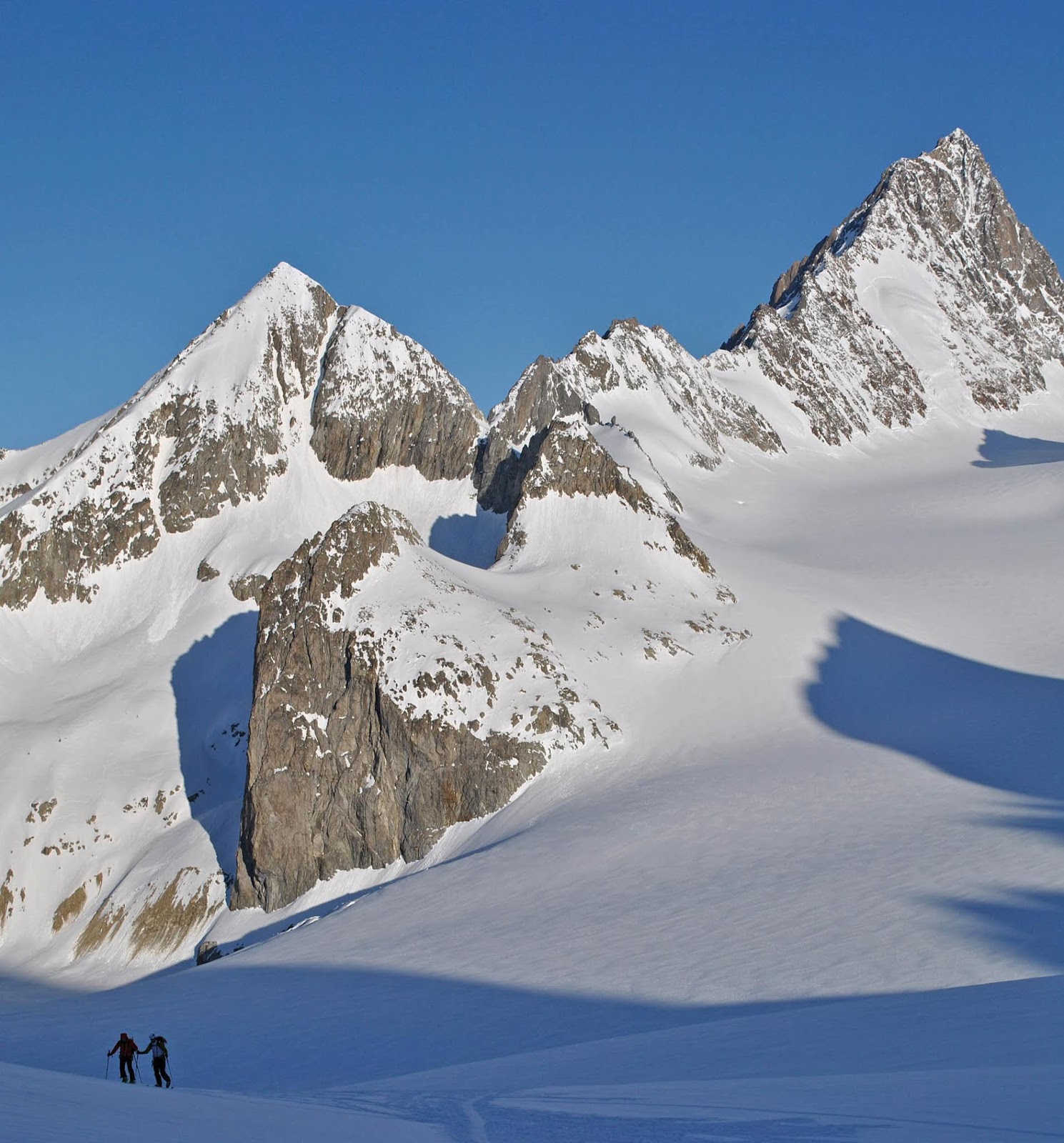
Every year, hundreds of mountaineers pass the Finsteraarrothorn by, on their way to climb the Finsteraarhorn. How many of them would take the chance to climb the forgotten peak instead of the famous one?
When she saw just the two of us coming, the Rothorn must have been amazed. Baffled, she watched us approach. Her hopes had been dashed too often. So she could hardly have expected that, from the Gemslücke col, we’d veer off the usual track towards her– merely in passing, as it were.
Did she not swoon when she suddenly realised we thought her worth spending a whole day on, just to try her untrodden ridges for size?
And did she not shrug off her clouds and fogs, just to show us that she was worthy of a visit? And what we might experience with her? Could her illustrious neighbour ever have offered such a welcome?
Summit mists
Three hours we’ve been at this. Thick, grey fog. My ice-axe hacks small notches into the ice, just enough to take half a boot-sole. Steeply upwards, from step to step, on ten metres of tight rope. Not too far left, not too far right. Yesterday, though my scope, I saw a massively overhanging cornice there. Under our boots, three hundred metres of glittering ice sweeps away. Everything is horribly deceptive in this treacherous fog. I can’t see more than a few steps ahead, but it’s brighter than ever in the valley. Flickering vaguely, off to the left, the cliff-edge dances under my eyes; surely it had to be further away. But suddenly I’m right there with my axe; my fear is that I’ve been lured onto that brittle-creaking cornice. Then I go too far over on the other side, so that my left boot can hardly clear the steep ice to land on the next hold.
The mountain’s knife-edge fades steeply into the formless grey, raking summitwards through the dense-knit vapour. But where is the top, and will we ever find it?
We could be at this for hours, fighting our way up. Or, in just a minute, the clouds could part and a ridge of fine-spun silver might usher us to a summit soaring up out of the clouds.
Then these gloomy shrouds could keep their lethal cornices and icewalls back in the depths, while the sun brightens above us and we feel ourselves shiver with anticipation.
Now we know you, Finsteraarrothorn. But may we sing your praises? Are you really worthy to be compared with your mighty neighbour? For us two, you meant more to us almost than him. We experienced you to the full, as nobody had before and nobody will ever again. When we stole up on you, you were a shy country maiden, sweeter than the great monarch beside you. Maidenhood was your charm – and we have robbed you of it.
References
This is an excerpt from a centennial translation of Ihr Berge (1916), a mountain memoir by Hans "Hamo" Morgenthaler (1890-1928). Translation (c) Project Hyakumeizan.
Every year, hundreds of mountaineers pass the Finsteraarrothorn by, on their way to climb the Finsteraarhorn. How many of them would take the chance to climb the forgotten peak instead of the famous one?
![]() |
| Finsteraarrothorn and Finsteraarhorn from the Vordergalmlücke Photo by courtesy from Alpine Light & Structure |
Did she not swoon when she suddenly realised we thought her worth spending a whole day on, just to try her untrodden ridges for size?
And did she not shrug off her clouds and fogs, just to show us that she was worthy of a visit? And what we might experience with her? Could her illustrious neighbour ever have offered such a welcome?
Three hours we’ve been at this. Thick, grey fog. My ice-axe hacks small notches into the ice, just enough to take half a boot-sole. Steeply upwards, from step to step, on ten metres of tight rope. Not too far left, not too far right. Yesterday, though my scope, I saw a massively overhanging cornice there. Under our boots, three hundred metres of glittering ice sweeps away. Everything is horribly deceptive in this treacherous fog. I can’t see more than a few steps ahead, but it’s brighter than ever in the valley. Flickering vaguely, off to the left, the cliff-edge dances under my eyes; surely it had to be further away. But suddenly I’m right there with my axe; my fear is that I’ve been lured onto that brittle-creaking cornice. Then I go too far over on the other side, so that my left boot can hardly clear the steep ice to land on the next hold.
The mountain’s knife-edge fades steeply into the formless grey, raking summitwards through the dense-knit vapour. But where is the top, and will we ever find it?
We could be at this for hours, fighting our way up. Or, in just a minute, the clouds could part and a ridge of fine-spun silver might usher us to a summit soaring up out of the clouds.
Then these gloomy shrouds could keep their lethal cornices and icewalls back in the depths, while the sun brightens above us and we feel ourselves shiver with anticipation.
![]() |
| Original illustration from Ihr Berge |
Now we know you, Finsteraarrothorn. But may we sing your praises? Are you really worthy to be compared with your mighty neighbour? For us two, you meant more to us almost than him. We experienced you to the full, as nobody had before and nobody will ever again. When we stole up on you, you were a shy country maiden, sweeter than the great monarch beside you. Maidenhood was your charm – and we have robbed you of it.
References
This is an excerpt from a centennial translation of Ihr Berge (1916), a mountain memoir by Hans "Hamo" Morgenthaler (1890-1928). Translation (c) Project Hyakumeizan.
Thursday, October 3, 2019
Four-thousanders
Project HaMo (translation): the aldermen of the Alps and their ill-kept secrets
At council, in some sun-drenched assembly hall, convene the venerable aldermen, white-bearded and surmounted with snowy periwigs, revered by all. For these are men of dignity, noblemen, the natural aristocracy of the stark mountain scene, the most exalted of their rugged tribe, overtopping all their electors by a head.
Born to their station, these worthy lords look out with a freeman’s gaze. Their mien is serious, their vestments dignified, and their steeply raked backs exude authority. Looked up to on all sides, there they stand, peerless, and yet – is there none among them who harbours no secret weakness among the highest and best of his mountain peers?
Since time immemorial, these eminences have gazed proudly over their foothills, beaming magnificently and watching over the people of the plain. Time-honoured are their titles and names. Robed in silver and rose-red gold, tilting their ridges aloft, they have stood there in earnest convocation for ages eternal.
The great mountains are the first-born of the young mountain gods. By birth and blood they were ennobled. So what need have they to exert themselves? Invincible by sheer stature, they prevail without a struggle. Those of low degree, strive as they might, could never rise against them. Yet, should one or other of these make the effort to challenge the power of those hereditary heights, what mighty giants they will meet with. Then will you see the sacred mountains of your dreams made manifest.
With their glittering locks of snow, their rivers of flowing ice, their flanks sheer to the heavens, these four-thousanders are the noblest treasures of the world. And yet – surely there is not one without some hidden flaw of weakness.
References
This is an excerpt from a centennial translation of Ihr Berge (1916), a mountain memoir by Hans "Hamo" Morgenthaler (1890-1928). Translation (c) Project Hyakumeizan.
At council, in some sun-drenched assembly hall, convene the venerable aldermen, white-bearded and surmounted with snowy periwigs, revered by all. For these are men of dignity, noblemen, the natural aristocracy of the stark mountain scene, the most exalted of their rugged tribe, overtopping all their electors by a head.
![]() |
| Eiger, Mönch and Jungfrau in an old postcard (c. 1912) |
Born to their station, these worthy lords look out with a freeman’s gaze. Their mien is serious, their vestments dignified, and their steeply raked backs exude authority. Looked up to on all sides, there they stand, peerless, and yet – is there none among them who harbours no secret weakness among the highest and best of his mountain peers?
Since time immemorial, these eminences have gazed proudly over their foothills, beaming magnificently and watching over the people of the plain. Time-honoured are their titles and names. Robed in silver and rose-red gold, tilting their ridges aloft, they have stood there in earnest convocation for ages eternal.
The great mountains are the first-born of the young mountain gods. By birth and blood they were ennobled. So what need have they to exert themselves? Invincible by sheer stature, they prevail without a struggle. Those of low degree, strive as they might, could never rise against them. Yet, should one or other of these make the effort to challenge the power of those hereditary heights, what mighty giants they will meet with. Then will you see the sacred mountains of your dreams made manifest.
With their glittering locks of snow, their rivers of flowing ice, their flanks sheer to the heavens, these four-thousanders are the noblest treasures of the world. And yet – surely there is not one without some hidden flaw of weakness.
References
This is an excerpt from a centennial translation of Ihr Berge (1916), a mountain memoir by Hans "Hamo" Morgenthaler (1890-1928). Translation (c) Project Hyakumeizan.
Tuesday, October 1, 2019
Cima Aeterna
Project HaMo (translation): a young mountaineer's fantasy
Thousands of nights, I’ve slept long and dreamlessly, slipping into nothingness one evening to be abruptly hurled back, next morning, into everyday life.
Now and then, though, rarely and unexpectedly, I have strayed off the path of dreamless sleep and, instead of sinking into blind oblivion, find myself regaled by a scene set as if for divinities.
Rapt with joy have I then beheld the Queen of Mountains, a dreamlike summit, her golden evening glow veiled by light, feathery clouds. This vision, I sensed, was reserved for my eyes alone. And with that soaring spur on the mountain’s edge, shrouded in icy mist – a god-like line for climbers – she kisses the messengers of distant stars.
Floating there, the Queen of Mountains rests on walls of chthonic rock, on the granite foundations of the world. From the depths of my dream, she soars up to the heavens. For thousands of metres, she soars straight upwards, unblemished by snow, into a summit of shimmering ice. Her feet are washed in the silvery flow of glacier streams, frozen waves that silently rush forward, and still more silently, towards the depths and my Tartarus below.
Then yearns my innermost being for the highest one, to fly up to the Cima Aeterna, all earthly sorrows cast away, light and free as desire itself.
References
This is an excerpt from a centennial translation of Ihr Berge (1916), a mountain memoir by Hans "Hamo" Morgenthaler (1890-1928). Translation (c) Project Hyakumeizan.
Thousands of nights, I’ve slept long and dreamlessly, slipping into nothingness one evening to be abruptly hurled back, next morning, into everyday life.
Now and then, though, rarely and unexpectedly, I have strayed off the path of dreamless sleep and, instead of sinking into blind oblivion, find myself regaled by a scene set as if for divinities.
![]() |
| Lhotse at sunset Photo by courtesy of Alpine Light & Structure |
Rapt with joy have I then beheld the Queen of Mountains, a dreamlike summit, her golden evening glow veiled by light, feathery clouds. This vision, I sensed, was reserved for my eyes alone. And with that soaring spur on the mountain’s edge, shrouded in icy mist – a god-like line for climbers – she kisses the messengers of distant stars.
Floating there, the Queen of Mountains rests on walls of chthonic rock, on the granite foundations of the world. From the depths of my dream, she soars up to the heavens. For thousands of metres, she soars straight upwards, unblemished by snow, into a summit of shimmering ice. Her feet are washed in the silvery flow of glacier streams, frozen waves that silently rush forward, and still more silently, towards the depths and my Tartarus below.
Then yearns my innermost being for the highest one, to fly up to the Cima Aeterna, all earthly sorrows cast away, light and free as desire itself.
References
This is an excerpt from a centennial translation of Ihr Berge (1916), a mountain memoir by Hans "Hamo" Morgenthaler (1890-1928). Translation (c) Project Hyakumeizan.
Subscribe to:
Posts (Atom)