Saturday, October 19, 2024

Pints, potions and glasses (2)

The disquisition continued: in which the risks attendant on drinking while climbing are acknowledged.

Those bottles weren’t just for bivouacs, though. During the Golden Age of alcoholic alpinism, they were equally apt to emerge from the havresac (sic) during the heat of the action. Here is J G Dodson, Member of both Parliament and the Alpine Club, tackling the Col de Miage in 1859:

We were feeling that raging thirst for inspiring which the High Alps can compete with the deserts of Mesopotamia. All the oranges, all the apples, were gone long ago; snow in the mouth brought no relief ; we must have some wine, we said to Cachat, as we paused with him to take breath at the foot of a vertical wall of rock, leaving Bohren and Couttet to go ahead and look out for a road. Cachat produced the last bottle from his store, which I put to my mouth, fondly expecting a good draught of St. Jean. It was strong luscious Muscat, one bottle of which our host had insisted on our taking, tepid with the heat of the sun and with being churned in a havresac: for all that, we drank it down like so much water, but it afforded little relief to one’s thirst. I looked at the ridge far above me, and bethought me of the bitter wish expressed shortly before concerning Mont Blanc by a gentleman toiling up it and in the agony of sinking into deep snow at every step, “You infernal mountain, I should like to have you rolled out and sown with potatoes!”


Dodson’s account appears in the Second Series of Peaks, Passes and Glaciers (1862) edited by that same E S Kennedy who chaired the Club’s inaugural meeting. Perhaps thanks to the emollient effect of the strong luscious Muscat, Dodson subtitles his piece as “A Day in a Health-Trip to the Glaciers”.

Health trip? I hear you snort: drinking while climbing is just plain dangerous. And nobody can deny that a certain degree of risk does attend this heady combination. Take the contretemps that befell one Charles Packe BA, while descending a gorge below the Portillon d’Oo in the summer of 1861:

Our stock of wine was carried in two skin bottles, with the exception of a solitary bottle of champagne, which Barrau had brought from Luchon, and which had already escaped such imminent risk of breaking, that I resolved not to give it another chance. Barrau, not at all unwilling to be relieved from his responsible charge, deposited the bottle in a natural wine cooler formed by the stream, but had scarcely done so when a sharp report announced an involuntary libation to the water nymphs of the place. The bottle had burst into pieces, and the champagne was lost to me for ever; but Barrau, with admirable presence of mind, immediately applied his mouth to a little runlet just below the scene of the catastrophe, and, I believe, pretty nearly recovered his full share of the champagne, though probably in a more diluted state than he would have chosen.

The Porte d'Oo
Illustration from Peaks, Passes, and Glaciers, Volume II

Quite distinct from the danger of involuntary libations, the wine itself could be a source of embarrassment. The experience of J F Hardy on Etna in April 1858 may be taken as typical of such disappointments:

The Doctor had very kindly presented me with a bottle of wine grown upon the mountain; and although I had originally some idea of drinking it on the summit, I felt now that, as it was highly improbable that the rest of the party would be with me there, it would be more in accordance with good fellowship to attack it at once. I announced, therefore, to the group around me the prize I had got, and the treat I intended for them, and taking from my pocket that instrument which no wise traveller is ever without, drew forth the envious cork that separated us from the promised nectar. The bouquet was peculiar, perhaps volcanic; but I passed the cup round to each in turn, commencing of course, with my fair friend. It was received by each with solemnity befitting the occasion. There was silence. The draught was too exquisite to allow of words. My turn came to drink, and I drank.

Imagine then the dismay felt by the good Reverend – for Hardy was a man of the cloth, as well as an AC founder member – when the promised nectar turned out to taste like something that “may be successfully manufactured by drowning a box of lucifers in a bottle of Cape”. 

"To enjoy the pleasant air of the peak ..."
Detail from above title page of Peaks, Passes, and Glaciers

Even during the Golden Age, some AC men did question the wisdom of imbibing while ice-climbing. Edward Schweitzer went so far as to interrupt his account of climbing the Breithorn in 1861 to “say here a few words on the injudicious habit of supplying guides and travellers with a heavy supply of food and wine”. And here, under the page rubric of “Injurious Effect of Brandy”, is what he says:

I so entirely subscribe to Professor Tyndall’s opinion, expressed in his admirable and classic work “On the Glaciers of the Alps” that I cannot refrain from repeating it here. He says, “Both guides and travellers often impair their vigour and render themselves cowardly and apathetic by the incessant refreshing which they deem necessary to indulge in on such occasions.” I observed how little food or wine Taugwalder took, and that he preferred the country wine to any stronger drink. This is the habit of all the best guides. With a roll and a piece of chocolate I have sustained myself on many a long climb, husbanding my strength by an even measured pace, and avoiding frequent draughts of water. A piece of sugar will often assuage the painful effects of burning thirst; a raisin or plum will do the same. When water is near, the addition of an effervescent powder is most refreshing but of all beverages, that which soothes me most, when much fatigued, is a slightly sweetened infusion of black tea, mixed with red wine in equal proportions. It is food and drink at the same time, and allays the irritation of the mucous membrane. Butter ought not to be omitted on a mountain excursion; with bread it is often preferable to stringy hard-fibred meat, such as is generally obtained. Brandy ought only to be used as a remedy in case of sudden indisposition. Nothing impairs the nervous powers so much as frequent potations of cognac and water; they give at first an increased feeling of activity, but, “false as the dream of the sleeper,” they assuredly leave the climber more enervated and less fit for work. A case of the kind occurred this season, and might have led to serious consequences. A young Englishman of about twenty-four years of age, the very picture of strength and health, made the passage of the Weissthor from Macugnaga. He was not much accustomed to severe mountain-climbing, and when suddenly confronted by dangerous slopes, he apprehended that his physical powers would not carry him through his appointed task, so he applied himself to frequent draughts of cognac and water, against the warnings of his guides. The result became soon apparent. They had to drag him up by ropes in an exhausted state, endangering in no slight degree the safety of his trusty conductors. In fact, as he told me himself, he had not a notion how he overcame the difficulties and gained the summit: he felt all the time in a helpless stupor.

Monte Rosa from the Gornergrat
Illustration from Peaks, Passes, and Glaciers

Schweitzer had a point of course: when the AC founder William Mathews ascended Monte Rosa in 1856 he was surprised “to see the porters throw themselves onto the snow, and one by one they dropped down exhausted and drunk . . . appearing on the mountain side in continually diminishing perspective”. But, since this was the Golden Age, Schweitzer was not one to take his own advice to excess. Just previous to the diatribe quoted above, he records that his party “partook of a small repast of bread and butter, cold meat, and a cup of Beaujolais”.

Such concerns nothwithstanding, mountaineers who embraced the true spirit of the Golden Age were apt to minimise the obvious risks of alcoholic alpinism. Here, for example, is the Reverend J F Hardy again, this time atop the Lyskamm, one of Zermatt’s trickier four-thousanders, in August 1861:

For somewhat more than half an hour we feasted our eyes with this magnificent panorama, till some one complaining that he felt cold, there was a general cry for more of the Sibson mixture. Perren, who knew the difficulties that were yet to come, was for drinking no more till we were fairly off the aréte; but his prudent counsels were laughed to scorn by the others, who declared it would be a sottise to bring wine to the top of a mountain, and then carry it down untasted. After all two bottles among fourteen were not likely to affect our steadiness very materially; and the slight stimulant would probably do more good than harm. At all events the mixture was taken as before; and then at half an hour after noon commenced the really anxious part of the expedition— the descent of the aréte.

The “Sibson mixture”, Hardy explains, was a “delicious beverage”, invented by the eponymous member of the party and consisting of “red country wine and Swiss champagne combined in equal proportions”. Small wonder that Hardy was fondly remembered by his AC colleagues as “a genial, cheery companion”.


Friday, October 11, 2024

Pints, potions and glasses (1)

A three-part disquisition, in which we celebrate the Golden Age of drinking and mountaineering.

Nobody who reads Peaks, Passes, and Glaciers, a collection of the earliest effusions "by Members of the Alpine Club", can fail to be impressed by their capacity. Not just for adventure – so much can be taken for granted in the protagonists of this heroic era – but for their consumption of alcoholic beverages. Yes, you read that right: drinking while climbing was more than merely acceptable; in those days, it was de rigueur.


For this was the true golden age of alcoholic alpinism. Strictly speaking, of course, the term “Golden Age” refers not to the potations but only to the pioneering climbs between Alfred Wills’s ascent of the Wetterhorn in 1854 and Edward Whymper’s conquest of the Matterhorn in 1865 – the phrase was coined by the controversial W A B Coolidge, an Oxford don-turned-mountaineer who doubtless enjoyed his port at High Table.

Yet alcohol stood at the very heart of this alpinistic enterprise. Paging through the inaugural volume of Peaks, Passes, and Glaciers (1859), for example, we find a “W. Mathews, Jun.” gearing up at a village in the Val de Bagnes for an attempt on the Graffeineire, or Grand Combin:

Our next step was to settle the commissariat for the three days’ march. We took six loaves of bread, a quantity of excellent cold chamois, a piece of cheese, chocolate, sugar, and ten bottles of sour white wine. Wine is always a heavy and troublesome thing to carry, but it is not easy to dispense with it, and I have always found a mixture of wine, snow, and sugar a very refreshing beverage at great altitudes. Simond was greatly dissatisfied that there was no vin rouge; “ Le vin blanc,” said he, “coupe toujours les jambes” – a result which happily we did not experience.

Now William Mathews (1828–1901) was not just any old toper. He too was at the very heart of the enterprise, having first proposed the formation of an Alpine Club in a letter to a climbing colleague in February 1857, the year after his bibulous investigations in the Val de Bagnes.

The Finsteraarhorn from the southeast
Illustration from Peaks, Passes, and Glaciers

Matters moved along during an ascent of the “Finster Aarhorn” in August 1857 by William Mathews, his cousin St John Mathews, John Ellis, E S Kennedy and J F Hardy – who wrote up the trip for Peaks, Passes, and Glaciers, not omitting details of the commissariat:

We woke on August 12th to find the clouds all swept away, and as brilliant a morning as we could desire. In the highest spirits we ate a hearty breakfast, and then descended to the kitchen to arrange about provisions. Wine in abundance, one bottle of brandy, afterwards rashly increased to two, roast mutton, roast veal, ham, sausage, cheese, bread, figs and raisins, were put together, one after the other, till the pile looked big enough to feed an army, and the corresponding arithmetic amounted to seventy-four francs. Later in the morning the guides expressed a desire for “noch ein wenig Brod und Fleisch,” and the result of our consenting to this request was that the bill was increased to 114 francs, whence I presume that the word “wenig” does not exactly correspond to our English “little”, nor do I think it would have been a difficult matter to prove, from the character of the additions which were actually made to our store, that the phrase “Brod und Fleisch” includes things potable as well as things edible.

The supernumerary bottle of spirits soon took the anticipated toll on the least reliable of the party’s guides:

He had already, in my opinion, had more cognac than was good for him, but being somewhat flustered by our objurgations, he now drew frequent and copious draughts from the dangerous flask.

Leaving two of the guides behind on a col, the party reached the summit at 11.53 – the first to do so for sixteen years – and celebrated their triumph appropriately:

A very small modicum of brandy tempered with snow was then administered to each (wine would have been better, but it would not have been possible to carry a sufficient quantity through the final climb), and we sat down to enjoy the magnificent scene around us.

In fact, they did more than enjoy the scenery, for it was during this same expedition that Mathews and his friends resolved to form what was to become the world’s first Alpine Club. And we may depend upon it that the fateful decision was adequately lubricated.

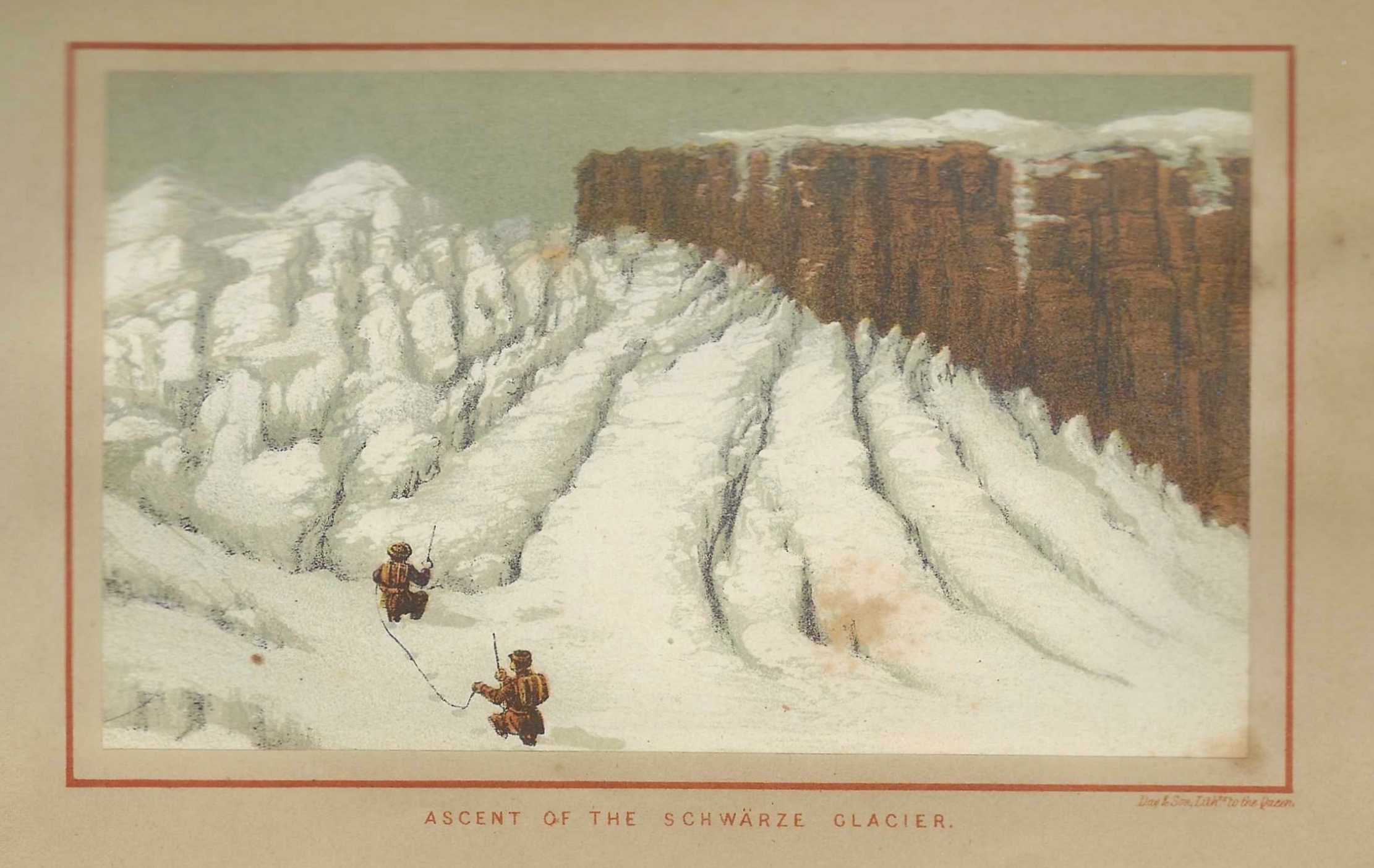
Ascent of the "Schwarze Glacier"
Illustration from Peaks, Passes, and Glaciers

During the following autumn, ad hoc gatherings ensued at Mathews's house near Birmingham, leading to the founding of the Alpine Club itself on 22 December 1857 at a dinner meeting chaired by E S Kennedy. If only we still had the wine list from that illustrious occasion at Ashley’s Hotel in London….

Now steady on, I hear you objurgate, the Alpine Clubbists were by no means the first to bring beverages into the mountains. And this one must concede. And while we’re at it, let us dispel any inference that such drinking was just a guy thing: when Henriette d’Angeville (1794–1871) climbed Mont Blanc in 1838, one of the first women to do so, her commissariat included “18 bouteilles de vin de St. Jean, 1 bouteille d’eau-de-vie de Cognac, 1 bouteille de sirop de capillaire, 1 baril de vin ordinaire.”

A view of Mont Blanc from the Jardin
Illustration from Peaks, Passes, and Glaciers

Then there was Albert Smith (1816–1860), the impresario who put on a show about Mont Blanc in London that ran for 2,000 performances over six years. The script was inspired by his ascent of the mountain in 1851 when, between them, his four guides and twenty porters had to carry sixty bottles of vin ordinaire, six of Bordeaux, ten of St George, fifteen of St Jean, three of cognac and two of champagne, to say nothing of other liquid refreshments supplied by the Hôtel de Londres at Chamonix.

After all, nobody in their right mind would drink the local water in those days. And, while we’d now buy our beers and wines at an alpine hut, those Golden Age pioneers had to carry up all their victuals to some high-mountain cowshed or bivouac à la belle étoile …

(Next: the risks attendant on alcoholic alpinism are acknowledged)

Monday, October 7, 2024

Tozan: in mountains begin responsibilities

Book review: an Aussie hiker-turned-mountaineer makes an eloquent case for questing the Hyakumeizan.

Heck, everyone knows what the Hyakumeizan are – the Japanese mountains spotlighted in a book published by a struggling ex-novelist in 1964. It’s a rare spirit, though, who can explain what compels thousands of otherwise rational folk to climb all one hundred summits at such a vast expense in time, money and boot-leather.

One who can explain is William Banff. In his recently published book, the Kansai-based English teacher sets out his starting position on the very second page:  

Ah, life in Osaka, for half a decade I’d dabbled in its delights, content to drift rudderless on a sea of all-you-can-drink booze, every so often running aground on islands of illicit pleasure, where I would allow myself to remain, happily marooned, until I felt the tentacles of commitment begin to wrap themselves around my ankles….

Until, that is, he did commit himself. Flicking through a little-thumbed Lonely Planet guide, he happened across the Hyakumeizan and felt their call. Making a start in 2007, he took time off work with the aim of climbing the full set by Christmas. That didn’t quite work out, but he still managed to complete his century over the following two years, tracking his progress in a series of blog posts – which are worth revisiting for their excellent photography.

In turn, the blog posts paved the way for a book, published this year as Tozan: A Japanese Mountain Odyssey. For those who have read the blog, the book is much more than the sum of the posts. By adding a sense of perspective to the whole campaign, not to mention a lot of detail, it makes one of the most eloquent cases for Hyakumeizan hunting that I’ve so far read.

Your reviewer first heard about this project from Willie himself, over lunch in Osaka. The book would be self-published, he said, so that he could say things the way he wanted to say them, without being censored by editors, publishers or monitors of the politically correct. And, by ****, he has made good on his promise.

It's a mercy indeed that Willie didn’t submit his manuscript to any gentlefolk publishers – you could imagine them fainting dead away after hitting just the first barrage of expletives. But, here’s the thing: if they were to read their way onwards, these gentry would find themselves reaching for their smelling salts less and less often. And, as we shall see, there might be a good reason for that.

Not even the most genteel of publishers could object to Willie’s nature writing, a vital attribute for any book that aims to distinguish one mountain from another. Here he is marching across the Oze marshes towards Hiuchi-ga-take:

Up before the crowds, I strode the boardwalks into a golden sunlit mist, crossing paths with a mere handful of lone hikers and photographers on my way north. Dewdrop-laden spiderwebs shone like diamond necklaces in the long marshland grasses that masked the slow northward creep of the waters beneath. In places where the water deepened, the grasses would part to reveal blue, waterlily-dotted pools …

But it’s as a raconteur that Willie really hits the ball out of the park. Take the episode in what purports to be the Kobushi-ga-dake chapter, where he describes himself sneaking into the woman’s section of a pharmacy in a bid to buy nylon stockings. It’s all the fault of an ex-US Army colleague who advised as follows:

“Yeah man.” He sucked the life out of a can of black coffee. “My old sergeant swore by ‘em. Nylons are the best way to stop blisters caused by new boots. ‘Wear ‘em under your socks. They reduce friction,’ he said. ‘But if I catch any of you m***********s puttin’ on lipstick, there’ll be hell to pay!’”

Fukada Kyūya, the original Hyakumeizan author, famously described mountains as people. Where Willie excels, though, is describing people as people. And it is these pen portraits of hut wardens, taxi drivers and fellow hikers that give life to vignettes such as the one above. Suffice it to say that this reviewer hasn’t LOLed as much since reading Will Ferguson’s Hokkaido Highway Blues.

As David Lowe notes in his excellent review over on Ridgeline Images, Tozan is a long book – it handsomely outhefts Hokkaido Highway Blues. It is also just as well produced; self-publishing no longer means shonky. On the contrary: as a physical book, Tozan is more elegantly presented than the products of many so-called publishing houses. What kept me turning over the 500-plus pages, though, was a sense of development. There is more here than just a series of amusing anecdotes.

Willie starts on his Hyakumeizan campaign as a self-confessed mountain neophyte. This opens the door to a picaresque catalogue of foul-ups and faulty planning. But by his 47th summit – fittingly, this is Mt Fuji – he’s starting to get the hang of things. He can still miss the right trail but, whereas “A couple of weeks earlier, I would have howled to the heavens in fury … I’d harnessed an inner calm which allowed me to maintain some semblance of even temperament.”

This is just as well, since Willie embraces a rigorous climbing ethic. He steels himself to reach the true highest points on mountains such as Rishiri-dake, Daisen and Asama, all of which involve a degree of personal risk. On Hodaka, he and his companion save the life of a lost hiker by sharing their tent with him. By mountain 57, which happens to be Myōkō-san, he’s starting to ask himself “Who will I be when I walk out of the mountains?”

So what does he learn during his Hyakumeizan campaign? Camping below Mountain 100, Ōdaigahara, Willie answers the question like this:

I’d set out with no preconceptions of finding myself or any of that belly button-baring nonsense. But I had learned lessons – it was impossible not to. My Japanese had improved – a bit, I suppose. I’d visited some spectacular places. I feared the outdoors less yet respected it more. I’d learned to listen to my gut. I could push myself when previously I may not have, but hold off when something unfathomable didn’t feel right …

Not only that but he gets his life sorted too. Starting out as a fancy-free bachelor, he ends the book with a wife, a kid and Lego spilt all across the rug in front of the sofa. Now can the One Hundred Mountains really do all that for a man? Readers, you will have to pick up the book and decide for yourselves.

And then, be warned, you may be inspired to pick up your pack and follow in Willie’s bootprints. Like he says, “The first steps are the hardest, and things won’t necessarily go to plan, but it’s no good rotting in a nursing home forgotten by your kids with nothing but job performance reviews to reminisce over, is it?”

Mate, you couldn’t put the case for the Hyakumeizan fairer than that.

References

William Banff, Tozan: A Japanese Mountain Odyssey – Willie Walks, Bozu Books, 2024.

Will Ferguson, Hokkaido Highway Blues: Hitchhiking Japan, Canongate Books Ltd, 2000.


Saturday, September 28, 2024

“A light grey felt hat is cool”

What ladies wear in the mountains: some hints from a hundred years ago

We raise our chapeau to Elise Wortley, who recently attempted Mont Blanc (4,805.59m) in period dress. Aiming to highlight women adventurers who achieved astonishing feats, Wortley started the climb in a bonnet, tweed dress and hobnailed boots, as worn by Henriette d’Angeville, who made the ascent in 1838. You can read more about Wortley’s venture on her own website or in her Financial Times article (subscription may be required).

"When climbing, the skirt ... must be looped up"
Illustration from the Badminton Library, Mountaineering


Just in case this retro vibe should catch on, we reproduce below the advice given on a “Climbing outfit for ladies” in the Badminton Library volume on Mountaineering, first published in 1892 and reprinted in 1901. The book was compiled by Clinton Thomas Dent, a medical man whose climbs included a first ascent of the Grande Aiguille du Dru. As a footnote reveals, though, he wisely deferred to “Mrs Jackson, Mrs Main and Miss Richardson” for the views set out here:

Women who climb should, like men, dress in such a manner that they are protected from extremes of either heat or cold. Every garment should be of wool, and the softer and lighter the material the better. The only exception to this latter point should be the skirt, and this will be found most serviceable if made of cloth, rough in texture and as thick as the wearer can get, provided it is not clumsy. A closely woven tweed is suitable. A small check pattern mends neatly if torn. Grey or brown are the most suitable colours for a climbing skirt; blue soon shows the marks of dust or stains. The skirt should be a plain walking skirt of an ordinary length, the broad hem turned outwards and with a deep border of stitching. Three yards round the hem will be found a good width for a skirt. A mackintosh bordering to the skirt is quite useless.

Mrs Main (née Elizabeth Hawkins-Whitshed) models a mountain skirt
Image courtesy of Women's Museum of Ireland

The pockets should be large and in definite places, one on either side and one at the back. They should be outside and flaps to button down. Two or more buttons are desirable on each flap, so that nothing may slip out when sleeping in huts. A small waterproof pocket in the skirt by the band is useful for carrying the bank notes current in Austria and Italy. The other pockets should be lined with sateen, and one can covered with mackintosh. When climbing the skirt must, whatever its length, be looped up, and therefore it is easy to have a skirt which, in the valleys or towns, does not look conspicuous. For looping up the skirt, the following simple plan is effective. An extra belt of strong ribbon is put on over the skirt, which is then pinned to it in fish-wife style. The length is arranged according to the requirements of the occasion. One safety: pin attaching the two sides and another fastening the back, the hem being pinned on to the outer belt, do the work. The safety pins, however, are apt to drag and tear the skirt. An equally good method of shortening the skirt is by an arrangement of loops and buttons. Strong tapes are well stitched up each seam inside the skirt, and also up the middle and back widths: each tape carries a large bone button and two tape loops not too low down. The tape gives more hold for the buttons, and prevents any of the material being torn out.

A rough cloth coat lined throughout with silk may taken in case of cold. A fairly thick Shetland shawl has many uses. It is very light and warm. Tied over the head in cold or windy weather, or in a hut at night, it is a great comfort.

Mrs Main in midwinter, probably on Piz Palu c.1898

The knickerbockers should be made of tweed, the band being lined with flannel or other woollen material. The tweed should match the skirt, and will then be found suitable either when worn, as formerly, under it, or, following the practice occasionally adopted, worn without the skirt, the latter being taken off before beginning the climb.

The bodice is an important part of the outfit, A soft grey flannel blouse, high in the neck, long in the sleeves, and loose, is the best for both heat and cold. The bodice should have breast pockets, one of them being suitable for carrying a watch.

A light grey felt hat is cool. A knitted helmet,which can be pulled over the whole head and face, the eyes only being uncovered, is a necessity in very cold weather. A large silk handkerchief is useful to tie the hat on in a high wind.

Mrs Main sets out on a winter expedition.
Image from True Tales of Mountain Adventure

Woollen stockings (one pair on, another pair in the knapsack), thick, watertight, nailed mountain boots, and cloth gaiter to button or to pull on in the Chamonix style (hooks and laces are apt to catch in a skirt are all essential. Putties, or spats and putties combined, are much to be recommended. Gloves should invariably be of wool, and of the shape worn by babies, the fingers being enclosed in a bag, and the thumb only having a separate casing. Let the gloves come well up the arms, and have at the very least two pairs with you on an expedition. A large safety hook and eye in each pair will enable them to be hung from the waist belt. A very fine woollen mask to protect the face is much pleasanter to wear than one of linen.

Lady alpinist and guide, c. 1906
Image from True Tales of Mountain Adventure

A more extensive outfit is required on a tour when access is not to be had to heavy luggage for several days. The climber may have to spend a few nights in the more civilised of the Alpine centres, or perhaps twelve hours may even be passed in such places as Geneva or Turin. It is necessary to be provided against such contingencies, and if a little thought and trouble are given to the matter, neither the weight nor the bulk of the extra garments necessary need be great.

Silk (only to be worn when not climbing) can be substituted for wool for the under-clothing, of which two complete changes are desirable, not including what is worn. A dark blue or grey silk blouse can be worn with the climbing skirt in the evenings, and a small dark felt hat, which will fold flat, and a pair of gants de suède will help to do away with the stamp of the climber. Leather soles, without any heel whatsoever, put to a pair of neat black laced shoes, will pack flat and take up very little room. The whole weight of the bundle (which can be tied up in a large silk handkerchief) need not exceed 4 1/2 Ibs., including such essentials as soap, a comb, pocket-handkerchiefs, and other small things which the experience of each climber will suggest.

References

C T Dent and other writers, The Badminton Library: Mountaineering, London and Bombay: Longmans, Green and Co, third edition, 1901. 

Mrs Aubrey Le Blond (also known as Mrs Main, Elizabeth Hawkins-Whitshed), True Tales of Mountain Adventure, London: T Fisher Unwin, 1906. 

You may also like: Alpine apparel in early modern Japan and Was Walter Weston a gear freak?

Thursday, September 12, 2024

Victor de Beauclair’s last climb

Book review: Emil Zopfi’s new documentary novel recreates a tragic story from the Belle Époque of climbing and ballooning

But were they really a pair? Visitors who step into Zermatt’s churchyard see them at once – the twin headstones leaning tenderly towards each other, one for Irmgard Schiess (b.1903) and the other for Victor de Beauclair (b. 1874). Both died on 15 August 1929, “am Matterhorn”. Noting the age gap of almost three decades between these ill-fated rope partners, most visitors just sigh, shake their heads and move on – leaving the question unanswered.

The gravestones of Irmgard Schiess and Victor de Beauclair

But not Emil Zopfi, a prominent Swiss writer on mountains and mountaineering. Taking as his challenge the almost complete lack of accessible public information about the couple – just try Googling them – he has recreated their lives and times in a documentary novel, Victors letzte Fahrt (Victor’s last climb). Along the way, he sheds plentiful light on the origins of ski-mountaineering, high-altitude balloon flying, and alpine climbing without guides.

Victor de Beauclair in 1898

Despite the French-sounding surname, Victor de Beauclair was born in Cantagalo, Brazil, where his father, an expatriate German doctor, had a practice. The family returned to Germany in 1878, settling in Freiburg im Breisgau, not far from the Swiss border. Zopfi suggests that this early deracination left de Beauclair somehow adrift – he never gave up his Brazilian passport, never married and never stayed long at any address.

In 1892, de Beauclair started his first year at Zurich University. His medical studies did not prosper, then or later. A glance at his alpinistic record suggests why. By 1896, de Beauclair had started to build up an impressive list of both summer and winter ascents. This was the year when he made the first ever ski ascent of a Swiss three-thousander, the Oberalpstock, with Wilhelm Paulcke, Peter Steinweg and Erwin Baur.

On the Oberalpstock in 1896:
From left to right: de Beauclair, Steinweg, Baur, Paulcke

Another notable first was the first ski traverse of the Bernese Oberland’s central glaciers, undertaken over four days in January 1897 with Paulcke and three more companions. Again, Paulcke was the moving spirit, having pioneered ski-mountaineering in the mountains around Freiburg. The geologist even designed his own improved ski binding for the Oberland tour – one of the book’s revelations is that modern alpine ski-touring was effectively invented in the Black Forest.

The Bernese Oberland traverse team:
From left to right: Paulcke, de Beauclair, Mönnichs, Ehlert, Lohmüller

As a member of this Freiburg-based group, de Beauclair soon became an acknowledged expert and evangelist (“Wanderprediger”) for ski-mountaineering. In 1899, he was elected into the Academic Alpine Club of Zurich, a club set up a few years before specifically for student alpinists who preferred to climb without professional guides. 

Two years later, de Beauclair helped to found the Skiclub Zürichs, serving as its first president – later he co-founded the Schweizer Skiverband, a national federation, too. And in 1902, in a neat twist on the guideless theme, he ran the first ski course for the Bergführer of Zermatt.

Pioneering a new mountain sport came with the inevitable nemesis. In January 1899, during a ski-tour on the Susten Pass, an avalanche overwhelmed Gustav Mönnichs and Reinhold Ehlert, two of de Beauclair’s companions on the Oberland traverse. De Beauclair spent several days that winter searching for them, but the bodies appeared only when the snow melted in June.

Yet it may have been a summer accident that more decisively changed the trajectory of de Beauclair’s career. In 1907, an afternoon storm trapped three prominent AACZ members near the Matterhorn’s summit, one of them dying during the forced overnight bivouac. Zopfi suggests that the accident helped to hasten de Beauclair’s drift away from the club’s orbit. 

In any case, he’d already made his final breach with Zurich University – without qualifying as a doctor – and he’d taken up a new form of high-altitude pioneering. In fact, de Beauclair’s first flight with his new gas-filled balloon “Cognac” had taken place as early as August 1906. A companion on two of these early flights was Heinrich Spoerry, the AACZ member who would perish on the Matterhorn the following summer.

"Cognac" at the "Eigergletscher" station, 1908

In 1908, “Cognac” lifted off from the meadows beside the Eiger rack-railway’s Eigergletscher station and landed the following day at Gignese in Italy. Depending on how one defines the term, this was the first transalpine flight by any kind of aircraft. Alas, the following year, the balloon was lost at sea after another transalpine flight, when de Beauclair had to ditch it in the Gulf of Genoa. This reverse didn’t stop him from co-founding a Zurich-based club that is still flying gas balloons more than a century later.

He kept climbing too. In 1911, he made a first ascent on the west face of the Mönch, one of the Bernese Oberland’s four-thousanders, in the company of the guide Fritz Steuri, who would later win fame with Maki “Yūkō” Aritsune on the Eiger’s Mittellegi Ridge. There was also a professional reason to focus on this region, since he was now working as the secretary of the Jungfraubahn rack-railway company. Then, all too suddenly, the Belle Époque was over.

Since records for the 1914-17 period are thin, it’s hard to say whether Victor de Beauclair had a good war. As a Brazilian national, he was exempt from the fighting. But many of his former climbing companions found themselves in uniform, whether in neutral Switzerland or in the armies of the warring powers. Several failed to return from the conflict, and those who did had experienced things that would forever put a distance between them and their former climbing partner.

When the smoke cleared, the world had changed. Balloons were “cold coffee”; now it was heavier-than-air craft, piloted by younger men, who made the dramatic flights over the Alps. But de Beauclair was still an acknowledged alpinist, and it was as a rope partner and ski tour leader that he got to know Irmgard Schiess and her twin sister, Herta (known to family and friends as Spatzi and Hatzi) together with their father, Erhard, also a keen mountaineer.

And so we come to 15 August 1929, when de Beauclair reached the summit of the Matterhorn with Herta, Irmgard and the guide Andreas Kohler. Descending in two rope pairs, the party was already within sight of safe ground when de Beauclair pulled on a loose rock and fell down the east face with his rope partner, Irmgard. “Once again the Sphinx of Zermatt has demanded her toll …” began the eulogy written by a friend and quoted in full by Zopfi.

It would have been a considerable feat just to ferret out the facts of de Beauclair’s life, of which the above is the barest summary. But Zopfi has done much more – he has fashioned these facts into a convincing narrative arc.

Writing in the dramatic present, and ranging boldly back and forth through time, he assembles a series of tableaux that gradually build up a portrait of the protagonist and other dramatis personae. Everything moves inexorably and logically towards that fatal rendezvous in Zermatt.

As in a well-crafted film, the focus changes constantly. Some scenes are recreated in exquisite detail, elsewhere an entire world war passes by in a couple of pages. In part, this zoom technique reflects the variety and variability of Zopfi’s sources – books, archives, genealogies, and conversations with descendant families – for the source materials are part of his narrative too.

In this, he is ahead of the game. At the very university once attended by Victor de Beauclair, a current professor of modern history calls for “a greater acknowledgement of authorial metadata in the writing of history” – in other words, historians should be more open about how they go about selecting and using their archives.*

This is exactly how Zopfi works. The author is present in his work, starting with an account of his own fateful encounter with the “Sphinx of Zermatt” in the summer of 1964. And so are his sources: take the scenes in the book’s early pages in which he recreates the Whitsun weekend of 1929 when de Beauclair led a ski-touring group that also included the Schiess twins. “And you, my young friend, will write up this trip,” says the fictional de Beauclair, clapping a young writer named Alfred Graber on the shoulder. Of course he will. For it is Graber’s memoir that Zopfi will tap for this scene, almost a century in the future.

Victors letzte Fahrt is the work of a master craftsman. Or Zopfi might perhaps prefer the analogy of a gifted route-finder, given that he spent many years at the extreme end of the Swiss climbing scene. The narrative technique is polished, and the action, as in all the best novels, driven by psychological insight. The book should be read by anybody interested in “how it was” within alpinistic circles during that faraway era.

After all that, may we still ask if Victor de Beauclair and Irmgard Schiess were really a pair? Suffice it to say that Zopfi addresses the question with all the subtlety that the sources demand and allow. And circling back to those twin gravestones in Zermatt, he concludes the book with a thunderclap revelation. As to its nature, your reviewer isn’t saying. You’ll have to read the book for yourself ….

References

Victors letzte Fahrt (Victor’s last climb) is a biographical novel by Emil Zopfi, published in 2023 by AS Verlag, Zurich (269 pages, German language). It includes an appendix with a comprehensive chronology of Victor de Beauclair’s life, lists of persons and families involved, and a comprehensive bibliography.

*See epilogue in Martin Dusinberre, Mooring the Global Archive: A Japanese Ship and its Migrant Histories, Cambridge University Press, 2023.


About Emil Zopfi

Born in 1943 in the canton of Zurich, Switzerland, Emil Zopfi studied electrical engineering and worked as a development engineer and computer specialist at the Federal Institute of Technology (ETH) Zurich and in industry. His first novel was published in 1977. Since then, he has written several more novels, as well as crime stories, mountain monographs, radio plays, children's books, press articles and columns.

His subject matter includes mountains, nature and mountaineering, computers and technology, history, politics and autobiography. “Zopfi's work revolves around the self-awareness of people in extreme situations, including those arising from social and political issues” (Swiss Lexicon).

Together with his wife Christa, he has run creative writing seminars for thirty years and written books on this topic. Zopfi has received a number of awards for his works, including from the City and Canton of Zurich, the Swiss Schiller Foundation, the Swiss Young People's Book Prize, the Swiss Alpine Club, the Canton Glarus Culture Prizes and the King Albert I Mountain Award.

Like Victor de Beauclair, the subject of his recent documentary novel, Zopfi is a member of the Academic Alpine Club of Zurich, founded in 1896, and might be described as the unofficial doyen of its small but active arctic/mountain literature cadre.

Tuesday, September 10, 2024

“The attack was quite too dreadful for words”

Recent run-ins with a Norwegian eagle lend credence to an old report from the Maritime Alps

A young golden eagle has been killed after reportedly attacking and wounding at least four people, including a bike courier, in a large area of central and southern Norway, reports the Guardian. 

Copperplate by Gustave Roue in La Suisse illustrée (1872)

This strange episode recalls a tale told by the redoubtable alpinist and mountain photographer Mrs Aubrey Le Blond in her book Adventures on the Roof of the World (1907), a catalogue of mountain accidents and derring-do. The following excerpt comes from a chapter headed "Some terrible experiences":

To be bombarded by falling stones in the Alps is bad enough. To be hurled from one’s foothold by a flock of eagles seems to me even more appalling. Though on one occasion, when on the slopes of a bleak and rocky peak in Lapland, in company with my husband, a pair of eagles came screaming so close to us that we drove them away by brandishing our ice-axes and throwing stones at them, I did not till recently believe that there could be positive danger to a climbing party from an onslaught by these birds.

It was only a few weeks ago that taking up one of Messrs Newnes’ publications I came upon an account of a tragedy in the Maritime Alps caused by an attack from eagles. On applying to the editor of the magazine in question, he kindly allowed me to make some extracts from a striking article by Mons. Antoine Neyssel. This gentleman with a friend, Mons. Joseph Monand, was making a series of ascents in the Maritime Alps with Sospello as their headquarters. From here they took a couple of guides and got all ready for a climb on the following morning, 23rd July. During the evening the amazing news reached them that a postman, while crossing a high pass, had been attacked and nearly killed by eagles. They at once went into the cottage where the poor man lay unconscious on two chairs, a pool of blood beneath him and his clothes torn to ribbons. A few days later he died from the terrible injuries he had received.

Though much shocked at the sad event, the climbers believed that their party of four would be quite safe, for each man had an ice-axe and some carried rifles. So the next morning they set out, and, ascending higher and higher, reached the glacier and put on the rope. They had forgotten all about the ferocious birds when suddenly, as they traversed the upper edge of a crevasse near the summit of their peak, the leading guide stopped with an exclamation of horror. Close to them the ground was strewn with feathers and marked with blood, doubtless the spot where the postman was attacked.

They passed on, however, and remembering that they were a party of four, felt reassured. But soon after weird cries came to their ears from below, followed by the whirr and beating of great wings. Looking cautiously over the abyss, they saw a fight of eagles in progress; feathers flew in the air and strange sounds came out of the seething mass. It seemed to rise towards them, and in their insecure position on the edge of a crevasse, they were badly placed to resist an attack. The foot-hold was of frozen and slippery snow.

Suddenly the eagles burst up and around them. The guides immediately cut the rope and each person did what he could to save himself. “Wherever possible,” says Mons, Neyssel, “we simply raced over the frozen snow like maniacs. In another moment they dashed upon us like an avalanche. I heard a shot —I suppose Monand fired, but I did not: I do not know why.

“The attack was quite too dreadful for words. Speaking for myself, I remember that the eagles struck me with stunning force with their wings, their hooked beaks, and strong talons. Every part of my body seemed to be assailed simultaneously. It was a fierce struggle for life or death. Strangely enough, I remember nothing of what happened to my companions. I neither saw nor heard anything of them after the first great rush of the eagles. It is a miracle I was not hurled to death into the crevasse.

“Do not ask me how long this weird battle lasted. It may have been five or six minutes, or a quarter of an hour. I do not know. I grew feebler, and felt almost inclined to give up the struggle, when the blood began to trickle down my face and nearly blinded me. I knew that every moment might be my last, and that I might be hurled into the crevasse. Strangely enough, the prospect did not appal me. From this time onward I defended myself almost mechanically, inclined every moment to give up and lie down.

“I gave no thought to the guides and my poor friend Monand. If I am judged harshly for this, I regret it; but I could not help it. All at once I heard loud, excited voices, but thought that these were merely fantastic creations of my own brain. In a moment or two, however, I could distinguish a number of men laying about them fiercely with sticks, and beating off the eagles.”

The villagers, having watched the ascent through a telescope had come to the rescue and had saved the lives of the writer and his two guides. His poor friend, however, was dashed into the crevasse, at the bottom of which his body was found five days later.


References

Jon Henley, "Golden eagle killed in Norway after attack on toddler in farmyard", The Guardian, 9 September 2024.

Mrs Aubrey Le Blond (Mrs Main), Adventures on the Roof of the World, London: T Fisher Unwin, 1907.

Header illustration is from Alexandre Scheurer, "Aasfresser mit schlechtem Ruf: Der Bartgeier zwischen Mythos und Realität", Die Alpen, November 2019. The article mentions an alleged attack by a vulture: "The best known and by far the most frequently cited case is probably that of June 2, 1870 in the Bernese Oberland (M. A. Feierabend, Die Schweizerische Alpenwelt, 1873). At that time, a 14-year-old boy was violently attacked with wing flaps, claws and beak and was seriously injured in the skull, back and chest. After his recovery, he went to the Bern Museum, where he identified his attacker among the local birds of prey: an adult bearded vulture."


Saturday, August 31, 2024

A meizanologist's diary (77)

7 April: “Today we will commit hanami,” says the Sensei. OK, maybe not her actual words, but that’s the gist. Borne on a warm south wind, the cherry blossom front has rolled into our city; hanami will not be denied. Don’t get me wrong: I’m all for cherry blossoms. After all, there’d be no little cherry trees without them. It's just the in-your-face evanescence that's vaguely unsettling. Couldn’t they last a bit longer? Or just get it over quicker?


Ineluctably, we find ourselves cycling across the city. Some kiloparsecs from home – it must be the hottest day of the year so far – we reach a distant river embankment. So distant that few people are about, although one family is already setting out a picnic under the trees. Not a single petal falls; we’re at peak hana.


This is an avenue of recently planted young trees – except for the pair at the end of the row, which were apparently rescued from somewhere else. Wizened and crooked, the two old trees lean towards each other like an elderly couple. Perhaps a young couple took their first kiss under them, suggests the Sensei. Not impossible, I reply, unsure where this exchange will lead.


We cycle back along the river, starting up a flurry of bank martins. Early summer is upon us, even if a sun halo overhead hints that the fine weather won't last. Closing on the town centre, we hit the core hanami scene. Citizens of all ages stroll under the luminous billows, their conversation hushed. Meanwhile, the scent of searing squid-on-stick wafts up from the temporary alleyway of booths set up on the river bank below. Still not a petal falls. 


On the way home, the streets are deserted: everybody is out appreciating the cherry trees. By chance, we pass a small temple. It advertises itself as a branch temple of the famous local “main mountain”. An open gate welcomes us into a courtyard filled with sunlight and a graciously spreading shidare-zakura. Nobody is about, and with every breath of wind, petals come scattering down from on high.


All too soon it’s time to board the train for KIX. The cherries bloom all the way down Lake Biwa. Dusk starts to fall as the Haruka slides through the badlands of southern Osaka. There’s one last glimpse of an empty playground, a dusty rectangle walled in by concrete blocks, and guarded left and right by two cherry trees in full flower, as if by a duo of Deva kings. For a moment I think I'm starting to understand hanami, and then the show is over for another year ....