Tuesday, August 8, 2023

Funiculars on Mt Fuji (2)

Continued: could a light railway be built on Japan’s top mountain - in order to save it?

Growing international tensions put paid to the 1940 Tokyo Olympics as well as any further thoughts of building a railway on Mt Fuji. But the enthusiasm of the projectors was only briefly dampened. As early as 1946, the businessman Iwao Kōtarō (1894-1953) envisaged building a gigantic wind turbine on the summit. With blades spanning a hundred metres, this apparatus would generate power for a funicular dragged uphill by a “mole-type cable”.


Iwao’s proposal died with its protagonist. The debate, however, rumbled on. In its August 1949 edition, Yama to Keikoku, then as now Japan’s most popular mountain magazine, challenged its readers with the question “Fuji cable [car], yes or no”. Opinions were solicited from a panel of the great and good in Japan’s mountain world.

Leading off on the ‘yes’ side was Nonaka Itaru (1867-1955), who back in 1895 had won fame for himself and his wife Chiyoko by his attempt to overwinter atop Mt Fuji to make weather observations. This is what he said:

A Mt Fuji cable car was first envisaged by an Italian 50 years ago, and I thought that this would be most helpful for my winter sojourn up there. But the proposal did not come to anything, and since then there has been plenty more smoke, but no fire. The idea has always succumbed to the tyranny of practical thinking and died. And so it has been to this very day. But on this occasion, the three prefectures are working together, not contending with each other as in the past, and specific discussions are being held

If the YamaKei feature is anything to go by, it seems that the scientific temperament generally favoured the idea of a cable car. Also lining up in support were Makino Tomitarō (1862-1957), known as the father of Japanese botany, and the distinguished geophysicist Tanakadate Aikitsu (1856-1952). Tanakadate said that, not only did he support a cable car, when the time was ripe, but he’d even toyed with the idea of getting a concession for one back in 1895-96, so that he could use it to fund Nonaka’s summit observatory.

As if to complete this triumvirate of scientific talent, Imanishi Kinji (1902-1992), the scholar-alpinist who famously challenged Darwin’s interpretation of natural selection, weighed in. Now that anybody could look down on the mountain from an aeroplane, he opined, it was “odd to keep thinking of Mt Fuji as a sacred summit”, adding that the more people who could make the ascent by cable car, the better.

By contrast, many of the literary types stood aghast. A leading opponent was Tanabe Jūji (1884-1972), the Wordsworth scholar who had let Yama to Keikoku’s founder use the title of his mountain memoir as the masthead of the new magazine. Mountains are not just about the summit view, he said. Rather, it is their general aspect that counts. And surely one could think of better places to put a cable car than Mt Fuji …

Uno Kōji (1891-1961), as one might expect from the author of a novella called Love of Mountains, was even more succinct: “As for the thought of putting a cable car up Mt Fuji, I am absolutely against it.”

In 1956, the conservationists won a partial victory when the Ministry of Health and Welfare stepped in. By designating the slopes above Mt Fuji’s fifth station as a candidate for a special protection area, the officials effectively put them off-limits to would-be railway entrepreneurs.

But the projectors too were appeased when permission was granted for a 30-kilometre-long road up to the fifth station on the Yamanashi side. This project became the Fuji Subaru Line, opening in the Tokyo Olympics year of 1964 – the annus mirabilis that also ushered in the Shinkansen, the Mt Fuji summit radar installation and the publication of Japan’s most famous mountain book.

May 1964: the Fuji Subaru Line road is opened with a parade of Subaru cars
(Photo: Subaru Web Community - see note below)

Soon enough, there were two roads – the south-side “Skyline” from Fujinomiya opened in 1969 – but even this couldn’t stop the train promoters: Fuji Kyūko, the local railway company, proposed one in 1964, aiming to facilitate “one-day mountaineering in high heels”. A decade later, however, it withdrew its project application for fear that it “might unexpectedly disturb the delicate balance of nature at high altitudes”.

Of course, the mountain roads were already doing just that. More visitors meant more litter and more sewage, while the exhaust fumes from the nose-to-tail bus convoys added to the pollution that assails the forests on Mt Fuji’s lower slopes.


So what about replacing the road with a railway? That was the aim of Nagasaki Kōtarō, who in 2019 was elected governor of Yamanashi, by tradition a construction-friendly prefecture. In his view, a light railway, powered by green energy, could be built over the existing Subaru Line route. This would do away with road traffic, at least on the mountain’s east side, and it would also make it easier to manage visitor numbers.

Compelling as these arguments may be, they have their critics. Unsurprisingly, one of them hails from Mishima, on the opposite side of the mountain. You could equally well curb the hordes of climbers by limiting bus journeys, points out Watanabe Toyohiro, an environmental scientist quoted in the Mainichi Shimbun.

A railway would also necessitate snowsheds, Professor Watanabe adds, blighting the landscape even more than the road does. And, finally, before a railway can be thought of, there remains a considerable backlog of projects to be completed as a condition of Mt Fuji’s selection as a World Heritage site, such as a new visitor centre.

To mark Mt Fuji's tenth year as a UNESCO cultural heritage site, the Yamanashi authorities have recently revived Governor Nagasaki's proposal for a light railway. Predictably, this move has triggered all the usual reflexes. All in all, we surmise, it may be quite a while before we see any light railway, or funicular or cable car, climbing the flanks of Japan's top Meizan. Still, one can always keep the debate alive….

References

Mainichi Shinbun, Fuji ni keburuka, ukande wa kie (“Cable cars on Mt Fuji float up and fade away”, Yama wa hakubutsukan (“Mountains are museums”) series, 10 February 2021.

Shimizu Masakatsu, "Opinion divided over possible railway for Mt Fuji", The Japan News/Yomiuri Shimbun, 21 June 2023.

Sugiyama Jun’ichi, Fuji-yuki no testudo wa jitsugen suru no ka – kako no rekishi was kanko vs shizen de semegiai (“Will a railway to Mt Fuji ever be realised – the past history is a clash between tourism and nature”), Business Media Makoto, 7 June 2013.

Yama to Keikoku magazine, Fuji keburu no zehi (“Fuji cable [car], yes or no?”), edition no 125, August 1949.

Note


For the opening ceremony of the Fuji Subaru Line on 27 May 1964, just before the Tokyo Olympics, the makers of Subaru cars provided 20 convertible Subaru 360 convertibles and 20 Rabbit scooters as parade vehicles. The Subaru 360s carried up some well known sumo wrestlers, including then ozeki Sada no Yama, Kitanofuji, Tsunenishiki, and Wakanaruto, escorted by about 150 other Subaru cars driven by members of Subaru clubs in the Kanto and Tokai regions. “On this day alone, the Fuji-Subaru line was filled with Subaru cars” says this post on the Subaru Web Community’s website


Wednesday, August 2, 2023

Haversacks instead of helicopters

Some years ago, while visiting a mountain hut in the Tanzawa mountains west of Tokyo, we helped solve a logistical problem. Stopping by the river at the mountain’s foot, we filled some bottles with water – the empties had been left out for us on a table – and carried them up to the hut with us. This helped Kusano-san, the hut warden, weather a dry autumn.

Bring your own firewood: the Bietschhorn Hut
Photo courtesy of Academic Alpine Club of Bern

Now some Swiss mountain huts are applying the same bring-it-yourself ethos. The idea here is not to solve a water problem but to cut down on expensive and polluting helicopter flights. Starting in 2021, the Academic Alpine Club of Bern has asked guests to bring up loads of firewood to its Bietschhorn hut from the roadhead at Ried – a small shed has been built there for the logs.

And the guests seem to be obliging. In the 2022 season, visitors to the Bietschhorn hut carried more than a ton of wood up the 1,400 metres of ascent to the hut. Encouraged by this success, the club now plans to provide its Schmadri and Engelhorn huts with woodsheds – in fact, the shed for the Engelhorn Hut will be shared with the Swiss Alpine Club’s Dossen Hut, whose approach path also starts in Rosenlaui.

The SAC Dossen Hut c.1928

Elsewhere, the Swiss Alpine Club is taking a different approach to replacing helicopter flights. For its Gspaltenhorn Hut, for example, it invites its local members to take part in an annual “supply hike” to bring up firewood, syrup and cheese – the fifth such event took place in late June this year. 

The SAC Gspaltenhorn Hut, c.1928

Other SAC huts operate more informally. Visitors ask the hut wardens what they need when booking their stay, then pick up the goods at a local store before starting the approach hike. 

In Switzerland, the bring-it-yourself movement harks back a long way. In the early days of mountain huts, intending guests carried up their own food – and sometimes the fuel too. Then, either they cooked their own meal, or handed the ingredients over to the hut guardian, who cooked for them. There were no helicopters in those days…

References

Barbara Ehrensperger, “Schweiss statt Kerosin: Wie man Berghütten umweltfreundlich beliefert”, Blick newspaper, 14 July.

Sunday, July 30, 2023

Funiculars on Mt Fuji (1)

Many have proposed railways and cable cars, but nobody has built one – yet.

Mt Fuji recently opened for its tenth summer season as a UNESCO world heritage site. Yet officials are already fretting about overcrowded huts and paths, to say nothing of the perpetual traffic jams at the fifth station bus terminals. Some might be musing that Mt Fuji would be better off with an efficient mass transport system.


If so, they are not the first to think such thoughts. Proposals for mountain railways on Mt Fuji go back more than a century. In 1908, Saburi Kazutsugu (1864-1924) suggested one from the Shizuoka side. Nobody at that time could have been better qualified to build it. As a railway engineer, Saburi could point to an impeccable track record, so to speak; he ended his career as president of the Korean Railway Company. 

He also had a convincing “hook” for the project, which he aimed to complete in time for a world fair commemorating the 50th year of Emperor Meiji’s reign. But that anniversary never happened, and nor did the railway.

Nobody was in the least discouraged. The Taishō period (1912-26) saw three separate proposals, starting with a mountain railway project in 1914, and two cable car schemes, in 1922 and 1924. Like Saburi’s, all these projects would have started on the mountain’s south-facing slopes.

Thus, it was all but inevitable that somebody would soon champion a route from the eastern side – as if to re-enact the age-old rivalry of the towns that presided over Mt Fuji’s two main pilgrimage routes: Fujinomiya in Shizuoka Prefecture and Fuji-Yoshida in Yamanashi.

Yamazaki Kamekichi
(Photo: Citizen)
The most ambitious east-side proposal came from Yamazaki Kamekichi (1870-1944), a precious metals tycoon and Tokyo politician. Yamazaki was accustomed to thinking big: among his other achievements, he founded what later became the Citizen watch company. In 1935, he sketched out a cable-drawn funicular railway that would start in Fuji-Yoshida and run in a tunnel, buried some 40 metres deep, all the way up to the summit.

To let passengers catch their breath on the journey, the funicular would also feature a stop at the fifth station. “Women and children should be able to make the ascent,” Yamazaki said, adding that foreigners too would find the service useful, as they rarely had time to climb Mt Fuji on foot. As for the mountain scenery, the tunnel would leave it undisturbed.

Yamazaki too had a hook: he meant to open his funicular in time for the Olympics scheduled for Tokyo in 1940. As for the engineering challenge, a mere funicular seemed eminently fungible when set beside the proposals for a Japan-to-Korea undersea rail tunnel that were floating around at the time.

Yamazaki’s plan found some unexpected supporters. One was Fujiki Kuzō, the journalist and pioneer rock-climber. When interviewed for a travel magazine, Tabi, he pointed out that Nikkō, Mt Kōya and Kyoto’s Atago-yama all had cable cars, so why not Fuji too? (The media of the day seem to have applied the word “cable car” indiscriminately to both aerial ropeways and cable-drawn funicular railways that ran in tunnels).


Others were less convinced. The heavyweights of the Japanese Alpine Club, who had helped to face down Saburi’s plan, now lined up against this one. Kanmuri Matsujirō, best known as the pioneer of the Kurobe River, expostulated that a funicular would open the way to “geisha girls and drunken revelry” on the summit. The club’s elder statesman, Kojima Usui, chimed in too: “Mt Fuji is not a matter of profit and loss: it is a national treasure and a natural masterpiece.”

In the end, the all-powerful Home Ministry spoke for all the naysayers: “One can hardly approve of slithering (‘sura sura’) up the nation’s most sacred mountain in a cable car, where traditionally people have sweated their way to the top, chanting ‘rokkon shōjō’ in order to purify their souls,” fumed an official.

And, with that, the Yamazaki plan was kicked into touch. And so too was an entirely separate – and rather prescient – proposal to build a road to the fifth station….

Friday, July 28, 2023

Ontake reopens; stay alert

Restrictions on hiking to the summit of Mt. Ontake, a volcano in central Japan, will be lifted from tomorrow, Saturday 29 July, reports the Mainichi Shimbun. The summit area has been closed to hikers since the deadly eruption in 2014, in which more than sixty people lost their lives.

Fumaroles on Ontake, summit region, c.1992

From 10 am Saturday, entry will be allowed to a ridge that connects the 2,936-metre Otaki peak to the highest 3,067-metre Kengamine peak, an area particularly affected by the volcanic disaster, the newspaper says, adding that access to some hiking paths near the summit will remain restricted.

The 2014 disaster – a so-called phreatic eruption – was all the more devastating because of a complete lack of warning signs. In its wake, Japan’s Home Ministry and its Meteorological Agency issued a leaflet for hikers to raise awareness of volcanic hazards. Now that Ontake is open again, it might be time to take another look at those guidelines.

References

Mainichi Shimbun, "Entry bans around Mt. Ontake summit to be lifted after 2014 eruption", 26 July edition.

Hazard alert: Japan’s authorities issue volcano safety guidelines for hikers”, One Hundred Mountains (this blog), May 2017.

Monday, July 10, 2023

Mountain chapels: a user’s guide and other matters

A tourist brochure introduces the cultural life of an alpine community

Map-reading errors can be productive. I made several on my way over to Vals – disgraceful, I know – causing me to miss the mid-afternoon bus from this remote village in the Swiss canton of Graubünden. So, while waiting for the last one, there was plenty of time to browse through the tourist office’s brochure, which was conveniently on offer beside the bus stop.

A view of Vals in late autumn
Image by courtesy of Alpine Light & Structure

If glitzy hotels and high-octane après-ski are what you seek, then Stories of Vals won’t be for you. Instead, this unusual brochure introduces, season by season, the village’s fifteen mountain pastures, the people who farm them, the cuisine, the trails, the architecture and some of the architects, including a two-man partnership from Japan. Winter sports do get a look-in, although the cable car technician who introduces them strikes a note of diffidence that you might not hear in Zermatt:

Vals is only a small skiing area. Alongside the cable car, we operate three button lifts. That’s how it used to be in a lot of skiing regions. We are ‘retro’ in the truest sense of the word, which makes us special – places like this are not easy to find any more.

Mountain chapels get many more pages than skiing does. In addition to the village church, there are 14 chapels scattered around the 176 square kilometres of the Vals district. It falls to Matthias Andreas Hauser, the parish priest, to take us on a tour. Places of worship have been built wherever people live and work, including up on the summer alps, he explains.

But the chapels are more than just branch offices of the parish church. As Hauser recalls

As kids we never entered chapels in groups; the chapel was a personal thing. In one time of adversity, I visited the chapel in Camp, offered up a two franc coin and beseeched Mary mother of God to help me find a missing watch – a gift from my godfather on the occasion of my first communion. I never would have dared to do such a thing in the village church, the home of the Lord, who made me nervous. In a chapel, you felt much closer to the beloved saints … These chapels were always a personal space, offering a kind of private audience with the representatives of heaven.

Charmed by the mountain landscapes, and probably the chapels too, outsiders are apt to tell the Valsers “You live in a paradise” (see page 79). If so, it’s a paradise that was hard won. As the brochure explains, the village was first settled by emigrants from the Valais region some 700 years ago, making it a German-speaking enclave in Switzerland’s mainly Romansch-speaking Surselva district.

The newcomers had to make do with the inhospitable upper reaches of the valleys they settled, as the low ground was already occupied. Which may have instilled a culture of making the best out of whatever comes to hand. This is the story behind the village’s thermal baths, one of its most unusual attractions – hot springs are relatively uncommon in this part of the world.

In the early 1980s, the Hotel Therme was racking up such heavy losses that its house bank – one of Switzerland’s largest – leaned on the community to take it over. And this the villagers did, although not before beating the price down by a handsome amount.

The Vals community then signed up a gifted but volatile architect to make something special out of the thermal baths. After an expensive and tenterhook decade, a radically new hot spring building duly emerged, helping to put Vals on the map for tourists everywhere.

But not too much on the map. To keep their village the way they like it, the Valsers have hit on an elegantly simple formula: 1,000 people; 1,000 sheep (there are some cows too) and 1,000 guests at a time. On a summer evening, there must also be a good thousand swifts and swallows too, wheeling over the roofs and dipping low over the river.

I still had a few pages to read when the evening postbus arrived. The first kilometres of the road down to the valley run through a precipitous gorge, carved by the river into beds of slate laid down in some ancient ocean trench.

Before leaving the parish altogether, the driver eased the bus past a chapel that abutted on the road. In the old days, says Father Hauser, the path down to Ilanz actually ran right underneath the chapel, through a tunnel of brickwork. 

In the mountains, as you know, wayfarers need all the protection they can get. Especially if their map-reading is so-so...

References

Stories of Vals, published by Visit Vals AG, translated from the German-language original, introduced by Stefan Schmid, Director of Tourism – thanks to Marisa Schmid for sending Project Hyakumeizan a back-up copy.

Wednesday, June 21, 2023

The canal across the Alps

The man with a plan to send barges sailing over high mountain passes

Caminada is the name to conjure with as you come down into Vrin. There are thirty-one of them in the phone book, which is a good number for a small village that sits high up in a southern valley of Switzerland’s Romansch-speaking region. And that doesn’t include an eponymous architect, also a native, who has designed a new charnel house for the churchyard.

The village of Vrin: a centre of the Caminada clan
Photo: Alpine Light & Structure

One skull the charnel house doesn’t contain is that of Pietro Caminada (1862-1923). Probably lacking a farm to inherit, his father left Vrin at an early age to seek his fortune in Milan. 

Pietro Caminada
(Wikipedia)
In turn, Pietro left Milan as a young man to try his luck in Rio de Janeiro. During his decade and a half there, he made his name as an engineer – Leonardo da Vinci was an inspiration – putting a tramway across the city’s Arcos da Lapa aqueduct, remodelling its harbour and drawing up plans for what later became Brasilia. 

Returning to Milan in 1907, together with his wife and three daughters, he turned to an even more ambitious project – to build a canal across the Splügen Pass between southern Switzerland and Italy. 

By spanning the Alps, this waterway would allow barges to sail from the River Rhine, via Lake Constance, all the way to the river systems of northern Italy. The economic advantages were obvious: water transport was by far the cheapest way of moving bulk goods from one place to another, as it probably still is.

No less obvious was the challenge. The Splügen Pass tops out at over two kilometres above sea-level. If you push a modern-day car too hard up those ladders of hairpin bends, this is more than high enough to toast your engine (trust me on this). And even if a canal could be built there, you’d need a staggering number of conventional locks to gain the necessary height – making the passage far too laborious for economical use.

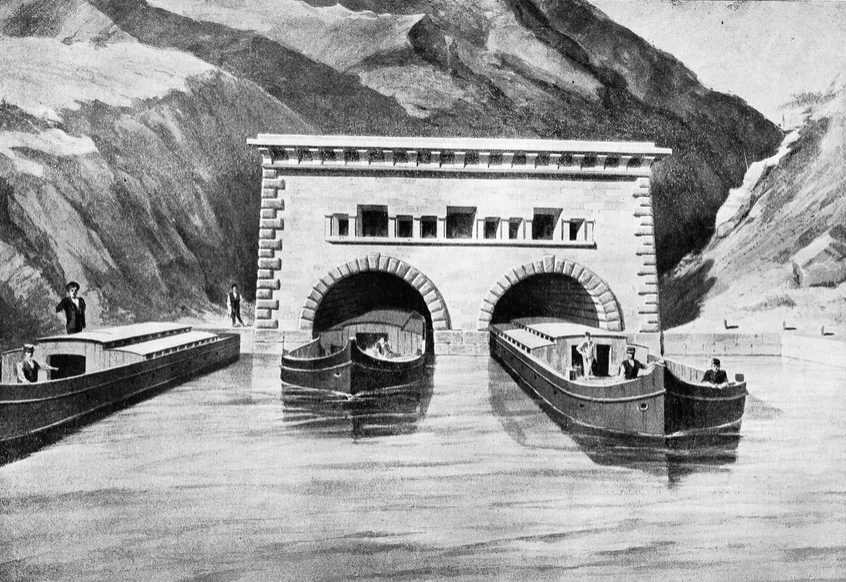
The transalpine canal, as it might have looked
(Wikipedia)

Caminada was not the first to dream of building a transalpine canal – more than a century before, the Austrians had mused about linking up their far-flung territories by driving a waterway from the Inn Valley over Switzerland’s Maloja Pass as far as Lake Como. 

And as long ago as 1638, work had actually started on a canal between the Swiss lakes of Neuchâtel and Lake Geneva. Here too, the ultimate aim was to let barges float all the way from the Netherlands through to the Mediterranean, by linking up the Rhine and the Rhone Rivers. Vestiges of the uncompleted Canal d’Entreroches can still be seen today.

As one barge goes up, another comes down

But the Italian engineer was the first to think through the alpine lock problem. After each lock, Caminada envisaged, barges would enter a long sloping tunnel. As water was pumped in, they would float forwards and upwards along the tunnel until they reached the canal’s next level. To conserve water, the tunnels would be built in pairs, so that the water draining out of the “down” tunnel would help to fill the “up” tunnel.

His timing too was perfect: the Splügen proposal burst into public awareness between the openings of the Suez Canal in 1869 and the one across Panama in 1914. So the plan met with an enthusiastic reception. The Corriere della Sera, Italy’s top newspaper, put it on the front page (below), Leipzig’s Weltrundschau enthused about a canal that could climb mountains, and even the New York Times put in a good word.

The Corriere puts the question: can a canal cross the Alps?
Front page of the 29 December 1907 edition

Galvanised by the economic potential – might Genoa become Europe’s largest seaport? – the Italian parliament got as far as discussing the price tag. About 500 million lira might do it, or perhaps two billion Swiss francs in today’s terms. To salute the ingenuity of his subject, King Vittorio Emmanuel III even invited Caminada for an audience.

Not all were convinced. In the Swiss canton of Graubünden, some projectors still hoped to build a railway through or over the Splügen Pass, as a rival to the Gotthard tunnel route opened in 1882. Naturally, they saw the proposed canal as a distraction or rival.

Others, though wowed by the idea of a waterway, wanted to change its route. Some of these critics lived in the Italian-speaking Swiss canton of Ticino. Instead of the canal ending at Italy’s Lake Como, they suggested, the destination should be Lake Maggiore, which lies partly in Switzerland. In that case, instead of the Splügen, the canal might carve its way through or under the altiplano of La Greina, before descending to a tributary of the Rhine.

In the end, the First World War did for all these deliberations. And by the time that Pietro Caminada died in Rome, aged sixty in 1923, railways had firmly established themselves as the best way to take goods and people across the Alps.

Plaun la Greina, still without a canal 
Photo: Alpine Light & Structure

But still one wonders whether five hundred-ton barges really could have sailed among the clouds, as the ingenious engineer once envisaged. Next time that the Sensei and I hike across the high plateau of La Greina, perhaps starting out from nearby Vrin, the village of the Caminada clan, I will try to sketch out the scene for her. But already I know what she’ll say: La Greina looks much better the way it is…

References

Marco Guetg, “Ein Wasserweg durch die Rätischen Alpen”, piz - Magazin für das Engadin und die Bündner Südtäler, no 62, December 2022.

Kurt Wanner, “Pietro Caminada und seine via d’acqua transalpina – ein wenig bekanntes Kapitel in der Geschichte des Splügenpasses”, Bündner Monatsblatt, 2/2005.

Ivan Cenzi, “Sailing on top of the mountains”, Bizzarro Bazar blog, October 2016.


Tuesday, May 30, 2023

A great replacement

On Switzerland’s southern edge, the wood’s in trouble

One wet weekend in May, Project Hyakumeizan walked up to an alpine lake in southern Switzerland. From the village, the path led steeply up through green tunnels of chestnut trees, which gave way to graceful beechwoods at about the 1,200-metre mark. After weeks of rain, the trees looked as if they were enjoying life.

Beech wood in Val Cama, Grisons

Appearances may deceive. According to an article in Die Alpen, the Swiss Alpine Club’s bimonthly journal, the chestnut trees of the Italian-speaking canton of Ticino are coping badly with the drought and heat of the last two decades. A fungal disease that attacks their roots is accelerating their demise. Dying trees have to be chopped down and lifted out by helicopter – or they would end up stoking forest fires like the one started near the crags of Ponte Brolla in 2016 by a rock-climber who tried burning his toilet paper.

Edge of the chestnut wood, Cama, Grisons

It’s thought that the Romans introduced chestnut trees to southern Switzerland about 2,000 years ago. For centuries, the chestnuts fed people as well as their animals. And the trees protected the villages, as they still do, from rockfall and mudslides. So losing them will be a cultural as well as an ecological disaster.

As the chestnut woods thin out, interlopers move in. Originally cultivated in gardens, the Chinese hemp palm (Trachycarpus fortunei) is now spreading into the low-altitude woods, where it has no problem with the hotter, drier summers. More invasive still, according to the cantonal foresters who have to deal with it, are the fast-growing trees of heaven (Ailanthus altissima), also an import from northeast Asia.

Forest path above Cama, Grisons

If the chestnut trees can’t be saved – and if the low-altitude forests of Ticino are not to tumble down into a jungle of non-native exotics – then they must be replaced. On a slope near Ponte Brolla – the one that was inadvertently torched by the careless rock climber in 2016 – forest experts from the Swiss Federal Institute for Forest, Snow and Landscape Research (WSL) are trying out some alternative species.

Silver birches, above Rossa, Val Calanca GR

In this test plantation, oaks, birches and cherry trees have seeded themselves. The foresters have also introduced Austrian oaks (Quercus cerris) and rowans, among others. Not all the trees under trial are indigenous: Atlas cedars (Cedrus atlantica) and Turkish hazels (Corylus colurna) have also been planted. As one of the interviewed foresters said, “We can’t afford to be fussy these days; we need to try out more things.”

References

Anita Bachmann, “Das Bild des Waldes wird sich stark ändern: eine Reportage über Palmen und Kastanien im Tessin”, Die Alpen, 03/23.