Friday, January 6, 2023

Celebrating the alpine savants

An exhibition in Geneva delves into the scientific roots of modern mountaineering – and yields insights into how science gets done

If you want to get to know somebody well, it’s best to visit them at home. And if that somebody is Horace-Bénédict de Saussure (1740–1799), who instigated the first ascent of Mt Blanc, the best place to start is probably the Musée d'histoire des sciences in his home city of Geneva. As the holder of many of de Saussure’s papers and memorabilia, the museum is currently using these to mount an exhibition on La montagne, laboratoire des savants.

De Saussure's party scales Mt Blanc in August 1787

Taking up the entire top floor of the museum’s repurposed villa, the exhibition all but brings de Saussure back to life. 

What the well-dressed alpinist wore in 1787

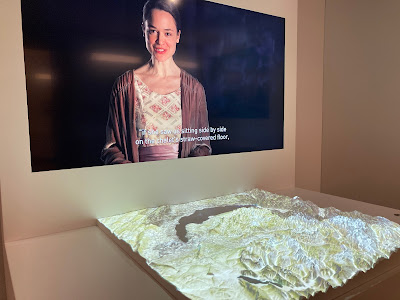
Visitors are received first by his frock coat and hobnailed shoes – there wasn’t much in the way of crampons in those days – and then by his devoted wife Albertine, ably re-enacted in a video display. While she reads out their correspondence, a light beam traces out her husband’s journeys of geognostic discovery on a relief map of the Alps in front of her.

This son et lumière notwithstanding, Horace-Bénédict isn’t allowed to hog the show. As promised in the exhibition’s title, savants are celebrated in the plural. Some were de Saussure’s predecessors: a display of antiquarian books includes those of alpine pioneers in German-speaking Switzerland such as Johann Jakob Scheuchzer (1672-1733), who famously documented the dragons of the Alps.

Strange encounter near Sargans by courtesy of Scheuchzer

For de Saussure, the most formative of these Swiss influencers were probably Gottlieb Sigmund Gruner (1717-1778), whose multivolume work on Die Eisgebirge des Schweizerlandes moved him to learn German, and Albrecht von Haller (1708-1777), celebrated throughout Europe for his lengthy poem on the Alps.

A glacier as seen by Gottlieb Sigmund Gruner

But it was more for Haller's botanical expertise that de Saussure looked to him. When the younger man visited Chamonix for the first time – this was in 1760 – his main aim was to collect plant specimens for Haller. But the magnificent views sparked de Saussure’s interest in finding a way to the top of Europe’s highest mountain. And the rest is history…


From the pages of De Saussure's pressed plant collection 

Next come exhibits on de Saussure’s contemporaries. These include André-César Bordier (1746-1802), whose Voyage pitoresque aux glaciers de Savoye set out one of the first theories to explain how glaciers flowed, Marc-Théodore Bourrit (1739-1819), the tireless promoter of Mont Blanc, and Louis Jurine (1751-1819), who assembled such a vast array of alpine minerals and fossils that his collection ended up at the Sorbonne.

Successors get a mention too. Here is a fine portrait of the astronomer Marc-Auguste Pictet (1752-1825), who took over from de Saussure as professor of natural philosophy at the Academy of Geneva when the older man’s health failed. There was Alphonse Favre (1815-1890), who published a three-volume geological study on the Mt Blanc range. In search of ground truth, he climbed extensively and later helped to found the Swiss Alpine Club, also serving as one of its first presidents. 

Alpine folding as modelled by Alphonse Favre

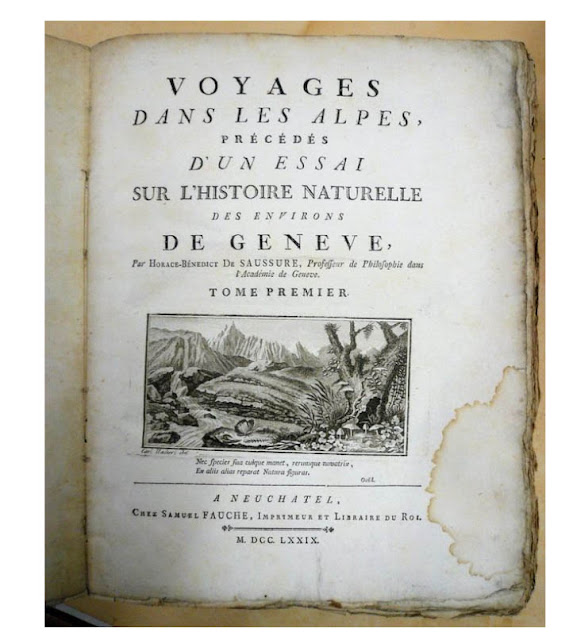
Lastly there was the great Alexander von Humboldt (1769-1859), who visited Chamonix with de Saussure’s magnum opus, the Voyages dans les Alpes, in hand (presumably only one volume at a time). Later, von Humboldt undertook his own scientific ascents, setting a world altitude record (at least for Europeans) during an attempt on Chimborazo in June 1802. De Saussure’s Voyages also furnished James Hutton (1726-1797) with some key geological evidence that he needed to nail down his Theory of the Earth (1785).


By now, your reporter was getting the picture. De Saussure didn’t work in a silo: instead he corresponded, hobnobbed and networked across the length and breadth of Europe. If he mounted higher than others – to borrow a bon mot from an eminent British natural philosopher – this was because he climbed on the shoulders of giants.

Richard Pococke in oriental dress
Image by courtesy of Jean-Etienne Liotard, via Wikipedia

Speaking of the Brits, they figure quite prominently in this exhibition. Up on the wall are portraits of William Windham (1717–1761) and Richard Pococke (1704–1765), who were among the first outsiders to tour and publicise the glaciers of Chamonix, making their visit nearly two decades before de Saussure.

De Saussure was well-known in English circles. Accompanied by Albertine, he had travelled round the country in 1768-69, visiting mines, universities and men of science and culture such as Sir Joseph Banks and Lord Palmerston, father of the prime minister. It may have been during this stay that he acquired from the workshop of John Dollond, a master optician, the fine achromatic telescope that is displayed on the museum’s ground floor.

An optic of distinction from the atelier of John Dollond

The English reciprocated these visits. In the summer of 1776, the polymathic Sir George Shuckburgh invited de Saussure on an excursion to a hill near Geneva in order to estimate the height of Mont Blanc. By triangulation, Shuckburgh arrived at a figure of 2,451 toises (equivalent to 4,779 metres), rather close to the altitude of 4,778 metres that de Saussure himself obtained just over a decade later, when he boiled up his thermometer on the summit. 

De Saussure's alcohol stove front-runs the MSR by 200 years

This prompted your correspondent to muse that, to get the measure of Mt Blanc more or less accurately, it took a joint Genevan-British collaboration. And to wonder how present-day Shuckburghs and de Saussures are going to fare in the face of take-back-control policies that stifle international cooperation. Outside the museum’s front door a drab December afternoon awaited. Across the lake, Mt Blanc was quite lost to view.

The exhibition La montagne, laboratoire des savants runs until 23 April 2023 at the Musée d'histoire des sciences, Geneva.

References

Musée d'histoire des sciences, La montagne, laboratoire des savants: Catalogue d’exposition

Horace-Bénédict de Saussure, Voyages dans les Alpes, edited and introduced by Julie Boch, Georg, Geneva, 2002

Sir Arnold Lunn, The Swiss and Their Mountains: A Study of the Influence of Mountains on Man, Rand McNally, 1963

Summoning up the very shades of H-B de Saussure

Monday, December 26, 2022

A meizanologist's diary (42)

9 November: after circling Narita airport, the Boeing takes up a northeasterly course out across the Pacific. Surely this can’t be the way back to Europe? Nobody announces anything – heck, we’re just px – and for a moment I wonder if I’ve boarded a flight to Seattle instead of Zurich. 


Then I get it. The next-best way back to Europe, if geopolitical factors obtrude, is over the North Pole. And so it turns out. We make a beeline, or more probably a great circle route, directly for the Bering Straits. Before we get there, the light fades through an abbreviated afternoon into an accelerated sunset. Then we turn due north, hugging the Alaskan coast.


In the event, we skirt the North Pole itself by some hundreds of kilometres. A little later, the polar night lightens enough for a long dark rift to appear in the undercast below – no, that’s not cloud but a lead of dark water in the drifting ice pack. The glimpse recalls Fridtjof Nansen’s Fram expedition, on a ship that was designed to drift across the arctic embedded in the pack-ice.

Of course, Nansen didn’t quite make it to the pole either, giving up his bold foray from the ship at 86 13.6′ North in April 1895. But what a vintage year for exploration that was. In August, Alfred Mummery vanished into thin air, in an attempt to ascend Nanga Parbat that was about a century before its time.

And in December, the meteorologist Nonaka Itaru and his wife Chiyoko were rescued from their pioneering midwinter sojourn on top of Mt Fuji. They too were far ahead of their era, for nobody else would attempt to emulate their feat until well into the following century.


The thought of that icy vigil prompts me to look at the flight display again – as we approach northeastern Greenland, the outside air temperature falls to minus 63⁰C. Not to worry, though, we should still have a few degrees in hand before the jet fuel starts to freeze. Now that really would be yabai....

Sunday, December 11, 2022

A meizanologist's diary (41)

9 November: Narita, 6am: as it’s too early to head to the airport, I head in the other direction, towards the eponymous temple. After all, folk refer to it as “Narita-san” (Mt Narita), hinting at something of meizanological interest. 


The old street winds away between souvenir shops, galleries and restaurants offering various renditions of eel – as favoured by old-time pilgrims from Edo, according to the helpful brochure I picked up in the hotel, to strengthen their knees.


Strengthening your knees might be a good idea. The countryside here may look flat from a passing airliner but, like Kent or Kentucky, the landscape actually ripples away into wolds and swales (not the local words for them, of course). 


Thus would-be visitors to Shinshō-ji, as the temple is formally called, must first scale a steep and sustained flight of stone steps. Fortunately, a fine rock garden provides an excuse for tarrying at half height.


At this hour, of course, actual visitors are few. But a chrysanthemum exhibition and a poster advertising the shichi-go-san ceremonies underline that this is a busily working temple with a full yearly calendar, not a tourist trap for passing travellers. But still I wonder what the deal is with this temple’s “mountain” suffix.


The answer comes from a straw-hatted pilgrim, or rather a bronze statue of one. No, not just a pilgrim, but the Daishi himself, the monk who – says H Byron Earhart in his  magisterial book on Mt Fuji – most radically altered the trajectory of Japan’s mountain religions.

Before Kōbō Daishi, mountains were themselves the objects of worship. But Kūkai, as he was also known, saw them more as places of spiritual retreat. “According to the sutra, meditation should be practised preferably on a flat area deep in the mountains … for the benefit of the nation and those who desire to discipline themselves,” he wrote.

And so, to this day, temples of the Shingon sect that Kūkai founded are known as "mountains", often including the character for 'yama' in their names. I should have guessed - we've visited such a "mountain temple" before.  


In fact, Shinshō-ji was founded by a disciple of Kūkai, not the Daishi himself. But the master's spirit seems to have faithfully imprinted itself on this far-flung outpost of the Shingon sect. I’m now wandering up another flight of stone steps towards the temple’s highest walks, which are surmounted by a “peace pagoda”.


Is it my imagination, or do the gardens take on a wilder character here, as if recalling the magnificent cryptomeria forests that surround the founder’s monastery on Kōya-san? It seems I’m not the only one to think so. This writer captures their atmosphere perfectly:

The natural Nature which is apt to be forgotten carelessly. Something recalling me to this is left in the Naritasan park. The park overflows in the trees and plants and Nature, and thought to respect all life of the thing which straight of the Buddhism arranges is incorporated …When the stairs near the light temple in the precincts are gone down, a waterfall of the donation that light comes in from a grove turns up from a huge rocky mountain…”

The light of a late autumn sunrise is starting to slant in over the groves. It is time to go down the mountain. In front of the Daihondō, a gardener is filling his watering cans for the daily round. “What splendid gardens,” I say as I pass, and he smiles. At Narita-san, natural Nature is in no danger of being forgotten carelessly.


Friday, December 2, 2022

A meizanologist's diary (40)

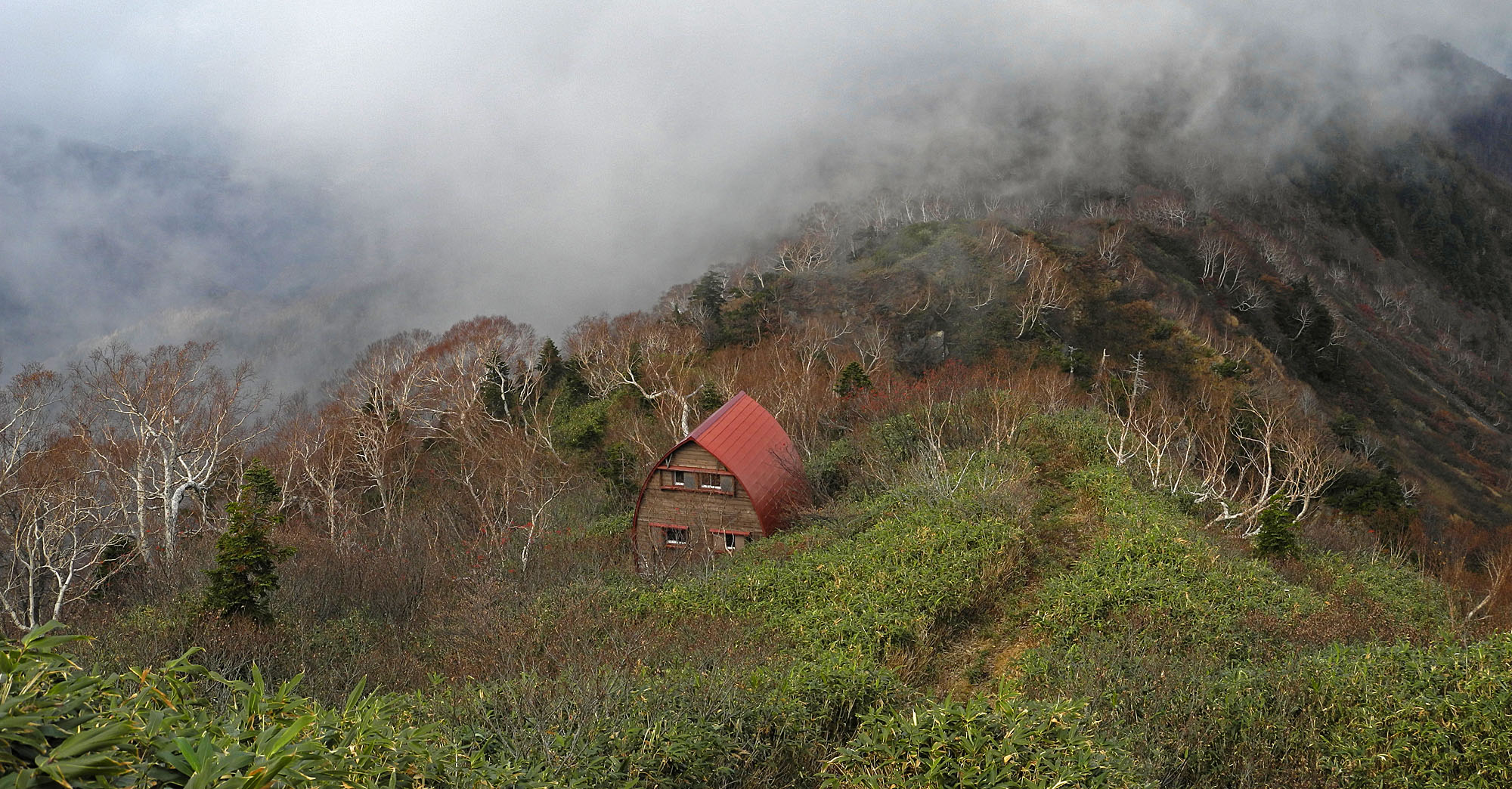
5 November, 6am: frost pillars, as wished for yesterday, heave obligingly out of the soil as we tackle the steep hill behind the hut. Fixed ropes help us to pull over greasy steps. At least there are no more slippery tree roots to stumble over, now that we’ve left the treeline. And the packs are lighter, as our bivvy gear has stayed at the hut.


We’re climbing the Pitch of the Beautiful Women (美女坂), observes the Sensei gleefully. Gaining height, we haul the Northern Alps into view over the intervening ridges – there’s Yari silhouetted against a chilly dawn glow, and Tateyama too. The latter, another dormant volcano, is the only mountain other than Hakusan that has paths known as Zenjōdō. And, intriguingly, it also has a place named for Beautiful Women (美女平). It's as if the two mountains have been conversing for centuries over this aery gulf between them.


Now we start across a frozen marsh. The scenery is like a miniature Oze, except that the boardwalks are frosted; we tread them warily. The Sensei points to a lily’s skeleton; in early summer, this would be a meadow of nodding yellow blooms. That would more than justify its name of Flower Garden (花園).


After the Trial of the Boardwalks (nobody fell into the marsh), we start on a grassy traverse. Across the valley is Hyakuyojō-no taki(百四丈滝), a waterfall purporting to be no fewer than four hundred chains high. Lurking in the early morning shadows, it is heard more than seen; we will inspect it properly on our return, when the light is better.


Ahead the Sensei points out Ōnanji. As this peak serves as the oku-miya (inner sanctuary) of the Hakusan shrine, it should make a fitting endpoint for our passage over this Zenjōdō. It doesn’t look that far above us.


This misapprehension is corrected when the traverse path drops away in front of us. As it would be too demoralising to lose a hundred metres of height all at once, we sit down on a boulder of pitted lava – a discreet reminder of Hakusan’s volcanic origins – and refresh ourselves with the Sensei’s home-grown sweet potatoes.


The sun is now high enough to warm us on our lava pedestals, and the wind has dropped too. But over there on Ōnanji, a filmy mist starts to veil the summit. We take the hint not to linger. While we scramble down to the col, what started as a mere wisp of vapour congeals into a fully fledged cap cloud.


Zig-zags take us down to a col. Its fluttering expanse of panda grass is a lost world halfway between earth and sky. A small pond, Abura-ike, would charmingly reflect the travelling clouds, except that it has long since frozen over. Then the path tilts upwards again. A glance at the map shows us to have embarked on Nagasaka – the Long Slope.


If only the slope were just long. The path is now entrenched in a steep grove of creeping pine trees, which rake us with their ice-glazed fronds as we push through them. When we emerge from this Austerity of the Hoarfrost, we find that a fox has made off with our visibility. But, no matter, my altimeter says we’re within a hundred metres of the summit.

Altimeters, as I should have learned yesterday, are but fickle guides on a Zenjōdō. The Sensei knows better; this is her local mountain, after all: “If we don’t turn back now, we’ll be walking back down in the dark,” she says. But, heck, I object, it’s only ten and we’re nearly there. What if I run on ahead and see if I can get to the top in the next half hour?


My proposal is not endorsed, but neither is it vetoed. Taking this as an assent, I push on upwards into the freezing fog, giving myself an extra half an hour to make the summit. Soon it starts to dawn on me that we're not yet on the slopes of Ōnanji, but only on what the Swiss would call a “Vorgipfel”. Or, depending on how you read the map, just a Vorgipfel of the Vorgipfel ...

Doubt is already creeping in when I come to what looks like a fork in the path – if one of us went astray, we would never find each other in this murk. And what is the point of summiting without the Sensei? For shame, even to think of it. I turn back and, a few minutes later, I’m relieved to see her still coming up. “You're right,” I admit, “this is no weather for splitting the party.” 

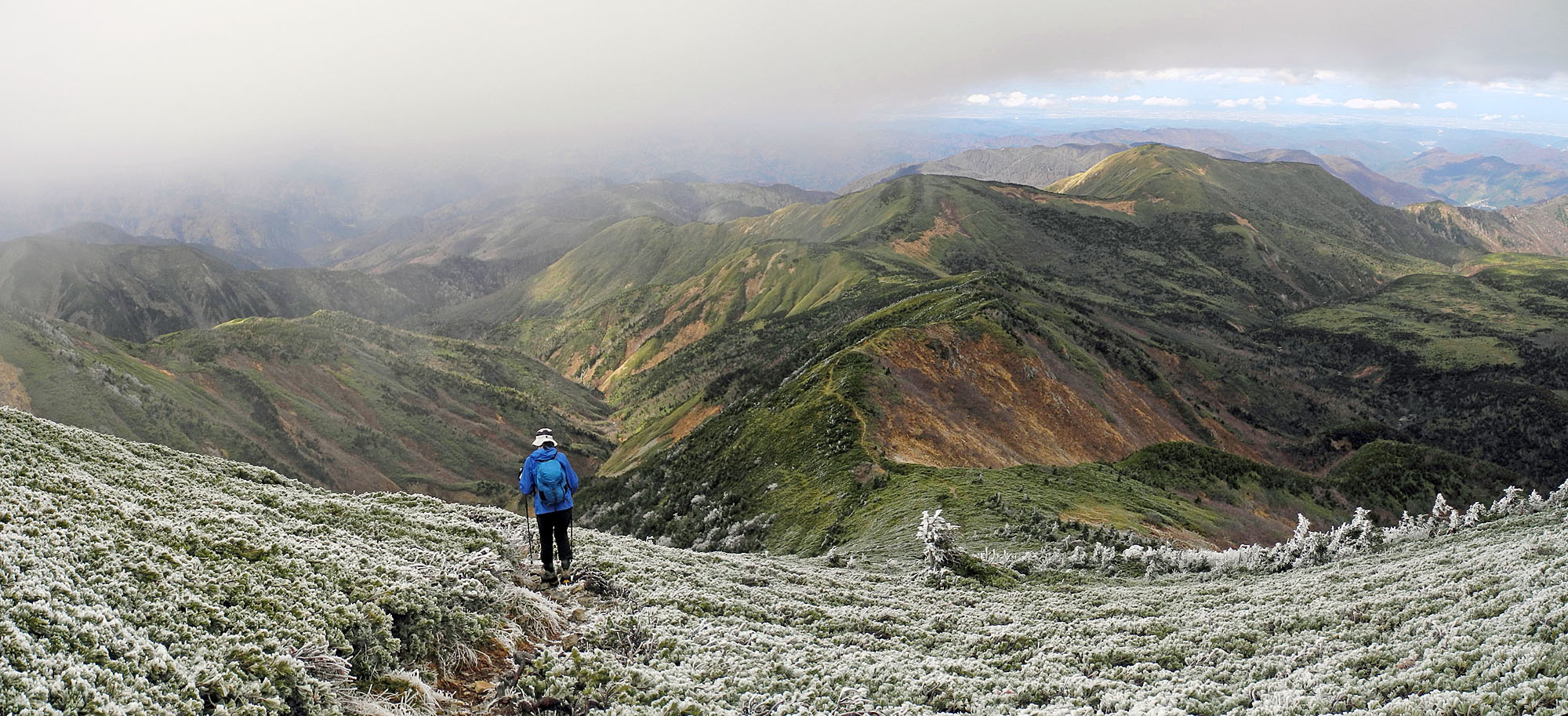
Zenjō (禅定), an expert on the Tateyama religion explains, refers to a state of mind during meditation. Moreover, it indicates austerities or 'meditations' on sacred mountains. Just as we start down, the Kaga Zenjōdō presents us with another of its revelations. When the clouds lift, we see the whole ridgeway uncoiling below, like the crenellated spine of a dragon. In this vast landscape - I realise we haven't seen another soul for two days - the two of us suddenly look very small.


A similar feeling seems once to have assailed Arne Naess, the alpinist/philosopher who famously turned back before reaching the summit of a sacred peak in the Himalaya. In his essay on Modesty and the conquest of mountains, he wrote that “The way is such that the smaller we come to feel ourselves compared to the mountain, the nearer we come to participating in its greatness,” before adding enigmatically, “I do not know why this is so.”


It takes a long time to retrace our steps. All too soon after we pick up our kit from the bivouac hut, the lingering clouds turn gold. In the fading light, those slippery tree roots send me sprawling more than once. The Sensei was right about turning back on time. The last zig-zags down to the valley must be illumined by the light of our headtorches. Walking back to the car, along a forest track, we wade through pools of moonlight so bright they seem almost to buoy us up. 


Friday, November 25, 2022

A meizanologist's diary (39)

4 November: from a nearby thicket reverberates a roar. Not your tentative, throat-clearing, osore-irimasu kind of growl, but the full-tilt boogie woogie, Metro-Goldwyn-Mayer r-r-roar of an apex predator. Less than an hour after starting, we seem to have disturbed a beast who resents our presence.


“Was that a bear?” I ask the Sensei, somewhat superfluously. “Probably,” she replies, sounding unimpressed, as if dealing with just another unruly pupil from her middle school teaching days. I am reassured: if that bear happens to be sporting a non-standard haircut, it will be ill-advised indeed to come out from that thicket.


Plodding on upwards under the dripping beeches, I start to see where the bear is coming from. For half a century, the animal – or its forebears – had this ridge to itself. The path for humans washed out in 1937 and wasn’t restored until the 1980s. Even today, it is far less frequented than the standard route up Hakusan, for reasons we will soon appreciate.

The bear has made its point. This is not a hiking trail. Rather, it is a Zenjōdō, a Way of Righteousness. And those who tread it will undergo various tests and tribulations until they reach some higher level of awareness. Or fall by the Wayside. The latter outcome can’t be ruled out, laden as we are by four or five litres of water, sleeping bags and cooking gear.


Hakusan, a sacred mountain, has three Zenjōdō, but the one we are attempting, from the Kaga side, is much longer and more rugged than the modern "normal route" from the west. We are heavily loaded because – unless we opt for trail-running – we’ll need to stay in the Oku-Nagakura bivouac hut, which is innocent even of a water source. The pack is starting to become a trial in itself.

At least the weather front has gone by, even if the clouds haven’t yet cleared. For November, it’s warm. “In the old days,” I observe to the Sensei, “you’d have seen frost pillars poking up out of the ground by now.” Always, people should be careful what they wish for.


We come up to a little shrine, shrouded in mist and watched over by a stand of evergreens – hinoki, says the Sensei, good for making storage chests. The girth and stature of these noble trees suggest what might have been if too many hadn’t been made into chests and temple pillars in centuries gone by.

The path levels out, stray sunbeams slant in below the drifting cloudwrack, and even our watch altimeters strike an optimistic note: they now read within a hundred metres of the hut’s altitude.


Alas, we are deluded: just as the digital readout says we are almost there, the path sinks away towards a deep col and, like pachinko players on a bad streak, we give up all of the last half-hour’s winnings. I recall reading somewhere that Hakusan is a “dissected edifice”. Naruhodo, like John Pierpoint Morgan’s stock market, this ridge will go up. And it will go down. But not necessarily in that order.


The hut is reached as the light starts to fade. The Sensei agrees that it’s been years since we’ve done anything like this. Nevertheless, she has the stove lit and the supper cooking before I have even managed to recombobulate myself. We slurp noodles by the light of our head-torches; I’d forgotten how quickly it gets dark in November around here.

Stepping outside after supper to address the bank of panda grass that fringes the hut, I find myself under a starry sky, Orion stretching up to the winter zenith, as he always did. The mountains have vanished into a void even darker than the sky, relieved only by the faraway strip of lights along the coastal plain. It’s going to be a cold night up here at 1,700 metres …


Thursday, November 17, 2022

A meizanologist's diary (38)

3 November: somewhere near Nagano, the morning Kagayaki goes to ground in a tunnel. And there the super-express skulks while the authorities work out where Kim Jong-un’s latest projectile is going to land. We arrive in Tokyo with half an hour’s delay.

From Shinjuku station, it is necessary to hurry through the badlands of Kabuki-chō to an office near Shin-Okubo. To be late for this meeting would be unthinkable, as the participants are risking a mostly “in person” meeting for the first time in months, if not years.


At 2pm, Dokiya-sensei calls us to order and the proceedings begin. The “Fuyō Nikki no kai” is dedicated to the memory of the meteorologist Nonaka Itaru and his wife Chiyoko, who sojourned on the summit of Mt Fuji in the winter of 1895 to make weather observations, holding out there for almost three months. Everybody at this meeting has some connection with this story, except perhaps for your blogger, who is merely representing the Sensei (otherwise occupied today).

Nonaka Itaru and Chiyoko in mountain garb
(Photo by courtesy of the Nonaka Itaru & Chiyoko Digital Archives)

As for the “Fuyō Nikki” (Mt Fuji diary) itself, this was the title of Chiyoko’s journal, which she published in a newspaper the year after the mountaintop adventure. A full English translation is forthcoming (watch this space), based on Ohmori Hisao’s definitive joint edition of Chiyoko’s journal and Itaru’s “Guide to Mt Fuji” (Fuji Annai).

Ohmori-san’s “kaisetsu” (introduction) to that edition is the starting point for anyone interested in the Nonakas’ story – he mentions today that it was based on painstaking trawls for contemporary newspaper articles preserved on microfilm in the Diet Library, conversations with legendary figures in the history of Mt Fuji such as Fujimura Ikuo, and more than one foray to the mountain in winter. Indeed, to fully appreciate the magnitude of the Nonakas’ achievement, it helps to have experienced Mt Fuji in full winter conditions.


All this happened a long time ago, yet new details of the Nonaka story are still coming to light – for example, that the Japan Meteorological Association almost certainly admitted Chiyoko to its ranks, showing that Meiji-era scientists might have held remarkably progressive attitudes, at least in this case.

Summit weather readings from November 1895
(Photo by courtesy of the Nonaka Itaru and Chiyoko Digital Archives)

Across the table, Yamamoto-sensei puts up a slide of the cloth-bound ledger in which Itaru and Chiyoko recorded their weather observations in a neat copperplate hand – amazingly, these records have survived in good condition. No less remarkably, the ledger shows that temperature and barometer readings were set down every two hours, night and day, throughout the twelve-week stay on the mountain – only the wind speed data are incomplete, as the anemometer broke down along the way.


Sadly, no trace of the Nonakas’ tiny summit hut remains. Nakayama-sensei, who also runs the association’s website, brings out a paper model of the present summit station, which was constructed in the early 1960s, and shows us that one of its outlying buildings must have obliterated whatever remained of the Nonakas’ refuge. Oh dear, I’d hoped to find some relics one day.

In Japan, Itaru and Chiyoko have been celebrated – mainly for their exemplary “gaman” – in a stage play and a full-length movie, as well as several novels and two TV dramas. The story has seeped out into the English language too, first via contemporaries such as Lafcadio Hearn and latterly through at least one scholarly article and a recent feature in Alpinist magazine.

After being rescued from the frozen mountaintop in December 1895, Nonaka Itaru never did manage to build a bigger and better weather station, as he’d intended. For that reason, some have dismissed him as a dreamer. But his epic eighty-two days atop Mt. Fuji did start people thinking.

One who took note was a prince of the realm, who as a naval officer considered weather forecasting to be a military imperative. Almost four decades after the couple’s winter sojourn, the government decided to fund an observatory on Mt. Fuji. It was staffed year-round from 1932 to 2004, when automated instruments finally replaced the weathermen.


Not all the meteorologists welcomed that decision. It seemed a pity to waste seven decades of high-altitude experience when good use could still be made of those summit buildings. And so, the very next year, some of their number set up a non-profit organisation for the “Valid Utilization of the Mount Fuji Weather Station”.


Since rebranded simply as the “Mt Fuji Research Station”, the summit buildings have been validly utilised every summer since 2007. And visiting researchers have published papers on topics ranging from altitude sickness to greenhouse gas concentrations and even the “sprites” that flash mysteriously upwards from thunderclouds.


With her eyes twinkling over the regulation face mask, our chairperson seems to be a bit of a sprite herself. It seems that the “Fuyō Nikki no kai” is meeting in the offices of the MFRS, and that the memberships of the two committees overlap quite extensively.

I would like to ask Dokiya-sensei about this interesting liminal zone between Art and Science, Adventure and Literature, but, alas, the meeting ends before there is a chance to put the question. And now there is a four-hour Shinkansen journey ahead. Kim Jong-un won’t be accepted as an excuse if I’m unreasonably late for supper …

Monday, November 14, 2022

A meizanologist's diary (37)

2 November: the Boeing coasts in from the Japan Sea above Komatsu. Daisen has already slid away astern, a mere appetizer for the parade of famous mountains that now unfolds. 

Daisen, the Uluru of West Japan

There, a crumpled sheet of green below, is Hakusan. And now the snow-dusted Northern Alps come up, hemming in the Kurobe valley, and beyond them extends the Fossa Magna, brimming with morning mist like a river of vapour. 

The Fossa Magna and friends

Last, Asama volcano goes drifting by beneath the starboard wing. And, always, in the distance, that familiar cone floats on the horizon. 

Mt Asama on a non-smoking day

All this early-morning meizanology works up a thirst. On the ground at Narita, I slake it (yes, I know the Sensei would disapprove) with a vending machine coffee. “Boss is boss of them all since 1992” the can proclaims. 


Later, the afternoon Shinkansen sweeps past that familiar cone, affording a closer view. Shouldn’t there be more snow at this time of year, I wonder. The only traces etch out the summit station’s bulldozer tracks in white zig-zags. 


Yet, even when the mountain lacks its usual winter crown, those breath-taking skylines, that rakish tilt of the crater rim all proclaim one thing. When it comes to Meizan, Mt Fuji is the boss of them all. Since 100,000 years ago.